
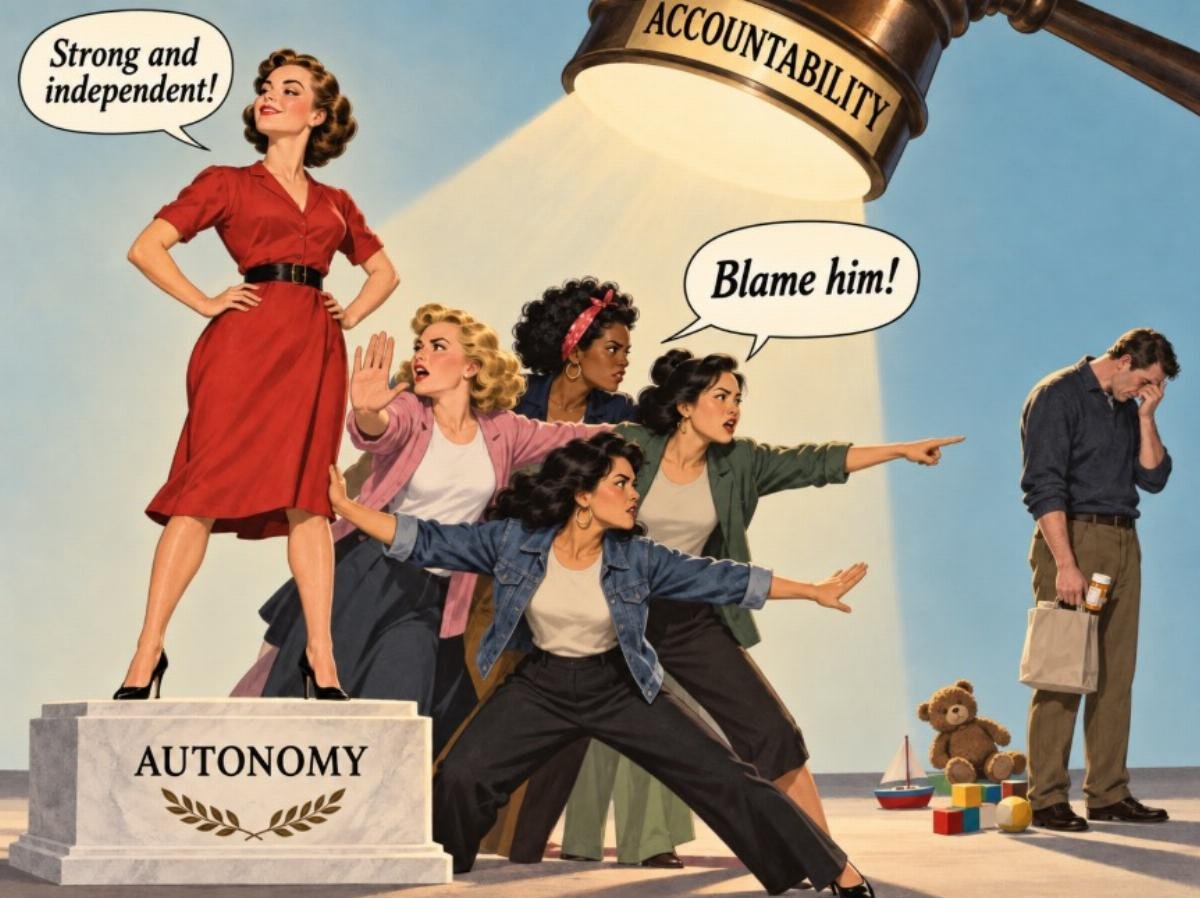
In a searing editorial published by American Thinker, columnist Jeannie DeAngelis argues that the modern feminist movement has developed a glaring blind spot: it demands women be treated as fully autonomous adults while refusing to hold them responsible for what those adults actually do.
DeAngelis traces the argument back to January 22, 1973, the day the Supreme Court handed down Roe v. Wade—just weeks after Helen Reddy’s “I Am Woman” hit No. 1. In her telling, that decision didn’t just legalize abortion; it handed women “unilateral power” over family size and, in the process, reduced men to “deferential docility” and subservience. Whatever credit a man deserved for his part in the reproductive process, she writes, was repaid with offspring treated as disposable.
From there, DeAngelis lays out what she sees as the movement’s core contradiction: the same cohort that spent five decades demanding to be seen as strong, invincible, and self-sufficient morphs into a chorus of accusers the moment one of their own is called to account. Accountability, she insists, ought to come with autonomy. Instead, when a woman is questioned or accused, anyone who presses the point is branded misogynist and anti-woman—and the blame gets redirected to the nearest man.
The Clancy case as Exhibit A
The column’s central case study is Lindsay Clancy. According to DeAngelis, Clancy admitted she was “down there on the floor” strangling her children while her husband Patrick was out running errands at her request. He came home with a Mediterranean Power Bowl and MiraLAX to find his daughter and two sons dead and his wife lying in the snow with hypothermia and a broken back after jumping from a window.
Three years later, at her trial for first-degree murder, Clancy again admitted to killing her children. Yet in DeAngelis’s account, a “cult of female defenders” decided Patrick was to blame—if not for the deaths directly, then for failing to coddle a woman they otherwise describe as capable of facing anything.

DeAngelis reports that the trial ended in a mistrial after a single male juror refused to join the nine female and two male jurors pushing to find Clancy not criminally responsible. Instead of accepting that outcome as the system working, she writes, supporters of the defendant turned their anger on that juror—and then on the judge, who declined a defense request to remove him. She calls the episode an object lesson in the irony at the heart of her argument: if women have demanded full self-governance since 1973, why is holding them to it suddenly anti-woman?
She also raises a darker concern. With Patrick Clancy now appearing publicly—including an upcoming 60 Minutes interview—and reportedly remarried, DeAngelis warns that feminists looking for a man to blame could radicalize to the point of vigilante violence, invoking the name of Luigi Mangione as shorthand for that kind of retaliation. She predicts his looks, demeanor, blink rate, and new wife will all be treated as evidence in what she calls “Girl Court.”
What the column gets right—and what it leaves out
There is a real tension worth naming here. If the last half-century of feminist advocacy was built on the claim that women are full moral agents, then selectively suspending that agency whenever it becomes inconvenient is a genuine inconsistency, not a gotcha. DeAngelis is on solid ground when she points out that you cannot simultaneously claim women are strong enough to run everything and fragile enough to be excused from everything.
Where the column runs into trouble is in how broadly it paints. DeAngelis treats “feminists,” “female defenders,” and “progressive women” as a single monolithic bloc whose members all think alike, all rallied behind Clancy, and all want Patrick destroyed. That claim rests entirely on her characterization. The column names no organization, no poll, no specific defender beyond unnamed “throngs” and “pink-T-shirted women.” Readers are asked to take the existence of this collective on faith.
She also collapses distinct moral questions into one. Opposing abortion, opposing a particular verdict, and opposing a mistrial are three different positions, and the column treats them as a single ideological package held by the same people for the same reasons. Similarly, her leap from online outrage over the Clancy mistrial to the possibility of a politically motivated attack on Patrick Clancy is a significant escalation—asserted as a danger rather than documented as a trend.
The piece’s most arguable move is its framing of the single holdout juror. DeAngelis presents his refusal to convict as the justice system functioning exactly as designed, and she has a point—hung juries are a feature, not a bug, of requiring unanimity. But the same logic that forbids blaming a jury for a mistrial also complicates her broader thesis. If one dissenting voice is enough to stop twelve people from reaching a verdict, then “women” as a class can hardly be held collectively responsible for the outcome either.
Why the column lands where it does
Strip away the rhetoric and DeAngelis is making a narrower, more defensible argument than her loudest lines suggest: a movement that spent decades insisting on female agency cannot credibly abandon that principle at the first uncomfortable verdict. That’s a claim worth taking seriously, and it doesn’t require accepting every flourish around it.
What it does require is evidence that the pattern she describes is dominant rather than anecdotal. On that score, the column leans on assertion. It tells readers that women are pointing fingers, that they were “up in arms,” that they wanted Patrick Clancy “tried, convicted, and drawn and quartered”—without quoting a single one of them or naming where these views were expressed.
DeAngelis closes by tying her argument to a broader plea: that speaking our minds is crucial to the republic. It’s a fitting note for a piece that is less about one murder trial than about who gets to be held responsible in American life—and who, by custom, gets a pass. Her answer is that men now absorb the blame by default, and that the women who demanded to carry the weight themselves have decided, in this one area, not to pick it up.
Whether that holds up as a description of feminism or of a single tragic prosecution is a question readers will have to answer for themselves. DeAngelis, for her part, has no doubt which one it is.
Source: www.americanthinker.com — https://www.americanthinker.com/articles/2026/09/i-am-woman-hear-me-roar-but-blame-it-on-the-boogeyman/