
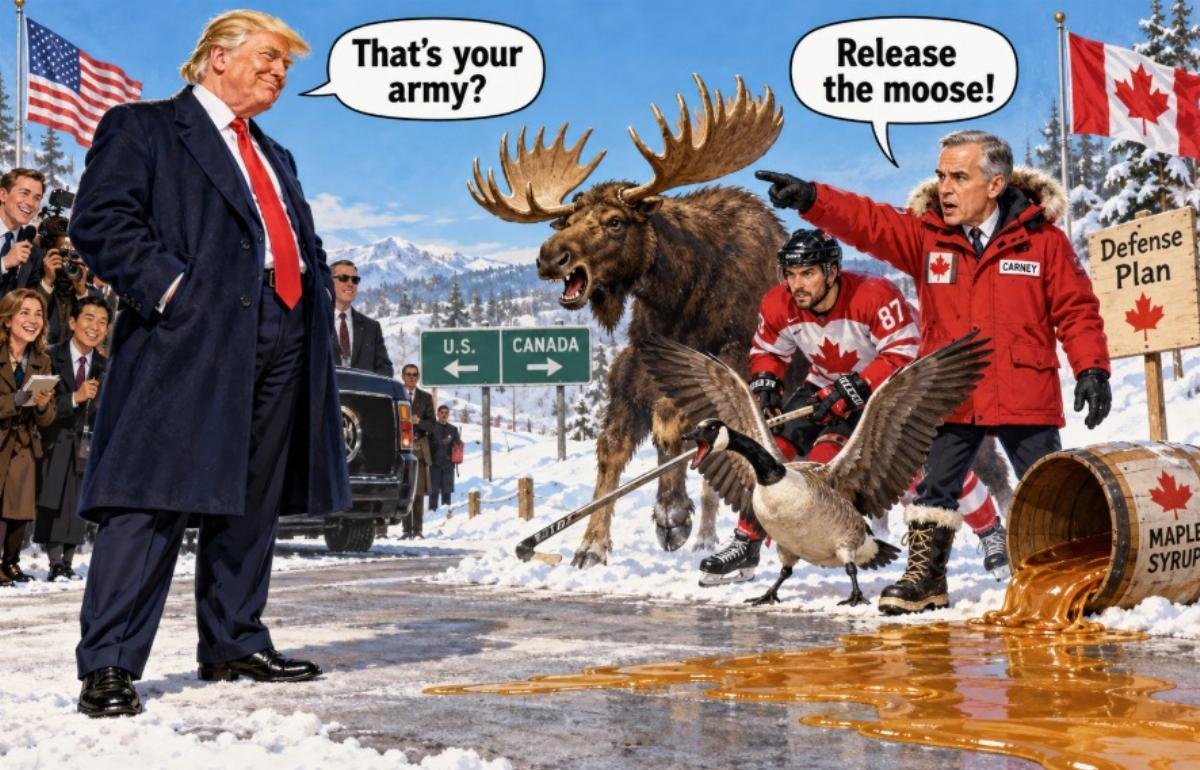
The American Thinker published a satirical commentary Friday mocking Canadian Prime Minister Mark Carney’s reported preparations for the possibility of a U.S. military incursion, dismissing the planning as the empty posturing of a leader the outlet describes as a humorless globalist banker. The piece, written by Pete McArdle, leans on national stereotypes, hockey references, and a distinctly Trump-era brand of brash mockery to make a single point: Canada’s leverage in any confrontation with the United States is close to nonexistent.
At the center of the piece is a phrase Carney reportedly used in an interview with The New York Times. According to the op-ed, Carney told the paper he has seriously prepared military scenarios to address the “extreme tail risk” that President Trump might order an invasion of Canada. McArdle seizes on the jargon with glee, spending a paragraph riffing on what an “extreme tail risk” might mean to a regular person before concluding that Carney, a former central banker, probably never closed out a bar in his life.
The Hockey and Moose Defense Strategy
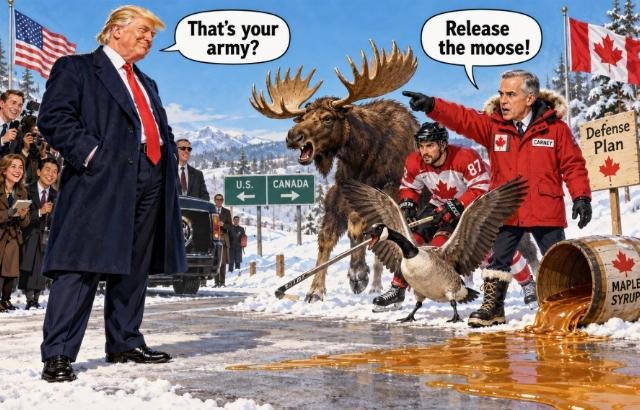
Much of the commentary consists of McArdle’s own tongue-in-cheek assessment of how Canada might actually defend itself, and the answer, in his telling, is that it can’t. He lists moose as a potential border deterrent, acknowledges they are large and aggressive during mating season, then notes they mostly just stand around. He points to Canadian hockey players as the country’s other great export, suggesting they can skate, handle the puck, and cause dental injuries but “can’t close the deal” — a reference to the U.S. defeating Canada in Olympic hockey, behind Jack Hughes, an event the op-ed invokes in its opening lines.
From there the mockery extends to Canadian roads, which McArdle imagines being coated in maple syrup to send U.S. military transports sliding off highways, and to Canada geese, which he proposes deploying as trained bombers against the Lincoln Memorial Reflecting Pool to irritate the president. The jokes are intentionally absurd, and the author flags them as such, writing that he jests — though he adds that hockey players are tougher, except in the offseason.
The piece pivots to a serious argument beneath the comedy. Canada’s main exports to the United States, McArdle notes, are energy — oil, gas, and electricity — along with cars and trucks. He argues the U.S. has more than enough oil and gas to serve itself and sell abroad, and that American manufacturing can meet vehicle demand, with Japan and automakers like Honda and Subaru available to fill showrooms. That framing is meant to underscore a single conclusion: Canada needs the United States far more than the reverse.
‘Sound and Fury, Signifying Nothing’
The op-ed’s sharpest language is reserved for Carney himself, whom McArdle describes as making threats, professing affection for China and the European Union, and promising that the U.S. would regret tangling with Canada. McArdle calls those threats “flatus in an Arctic blizzard,” borrowing a line from Macbeth to describe Carney’s rhetoric as “sound and fury, signifying nothing” — except to what he calls credulous Times readers. He predicts Carney will eventually bend to Trump’s demands, pointing to Greenland as a precedent, and imagines a future photo op in which the two leaders shake hands and the image itself tells a story of relative strength.
McArdle also spends early paragraphs on Trump’s recent recalibration of U.S.-Canada trade, saying the president threw out trade deficit and tariff figures that should infuriate Americans who are paying attention, and landed barbs that got under Carney’s skin. He characterizes Carney’s response as the reflexive outrage of a globalist, and frames the Canadian leader as small, humorless, and outmatched.
For American readers trying to separate the comedy from the critique, the substance of the piece is a familiar Trump-aligned argument: that Canada’s economic dependence on the U.S. leaves it with almost no credible leverage, that its leadership’s threats are performative, and that the eventual outcome will be Canadian concessions. The military scenario Carney reportedly described to the Times — planning for an “extreme tail risk” — is treated by the op-ed not as prudent contingency planning but as evidence of a leader who has lost perspective.
What the commentary does not do is engage with the substance of Carney’s reported remarks, the actual state of U.S.-Canada trade negotiations, or the specific tariff and deficit numbers McArdle references without citing. It is an opinion piece built for a sympathetic audience, and it closes with the outlet’s customary appeal for reader donations to support its staff and keep its voice in the conversation.
Whether Carney’s contingency planning amounts to serious strategy or political theater is a question the op-ed answers with a joke about maple syrup and a line about high school military academies overrunning Canada in a weekend. For American Thinker’s readers, that is likely the point: the piece is less an analysis of North American defense than a loud raspberry aimed northward, delivered with the confidence of a writer who believes the outcome is already settled.
Source: www.americanthinker.com — https://www.americanthinker.com/blog/2026/09/woe-canada/