

In a commentary published this week by American Thinker, writer Mike McDaniel takes aim at what he calls the endless recycling of climate catastrophe deadlines, arguing that decades of predictions have come and gone without the world ending. The piece, titled “You’re all doomed in 10 years and this time we mean it!” and dated October 14, 2026, runs under the site’s “Climate Change Hoax” category and reads as a memory-driven indictment of doomsday forecasting.
McDaniel, who describes himself as a USAF veteran, retired police officer, and longtime English teacher, frames his argument around a simple observation: as people age, distant memories become sharper even as short-term recall fades. He suggests that generational amnesia helps explain why each new ten-year ultimatum lands with fresh urgency, as if no one remembers the last three.
A personal history of the apocalypse
The author roots his case in his own school years, when the prevailing fear was global cooling and an imminent ice age rather than warming. That prediction, he notes, faded with little media fanfare and was replaced by global warming, which he says was likewise supposed to kill everyone within a decade. When temperatures later stabilized, the phrase morphed into “climate change” — which he characterizes as an unfalsifiable catch-all in which hot weather, cold weather, hurricanes, the absence of hurricanes, wildfires, and even a random Tuesday can all be chalked up to the same cause.
He also nods to other supposed apocalypses he says he may have overlooked, including threats involving “Lizard People, Polar Bear, and ‘white paint is racist’ holocausts” — a reference to other cultural flashpoints he lumps into the broader pattern of panic cycles. The article’s tone is openly derisive toward what it calls climate hysteria and toward the news media’s role in amplifying it.
Seventeen examples, seven highlights
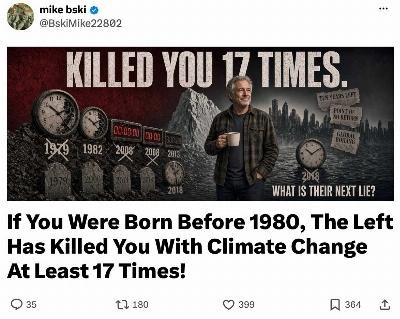
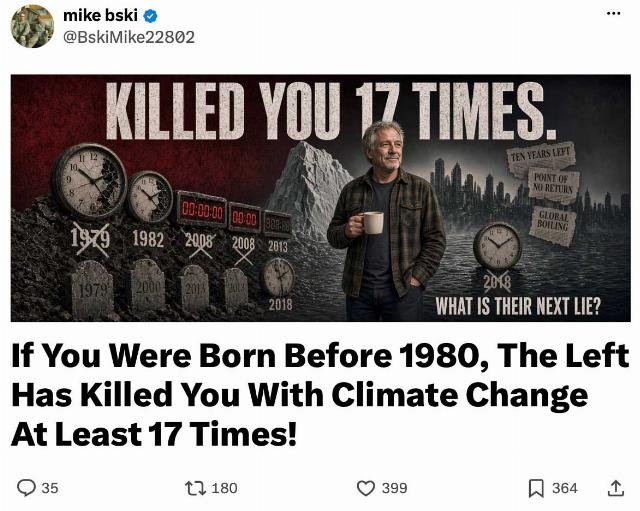
To substantiate the memory thesis, McDaniel cites a retrospective compiled by a writer named Mike Bski, who assembled 17 examples of predictions that the end was near. McDaniel reproduces a selection of seven, each with a source, a date, and a deadline that has since lapsed:
1982 — UNEP’s Mostafa Tolba warned that by the turn of the century the world would face an environmental catastrophe “as complete, as irreversible, as any nuclear holocaust.” As McDaniel puts it, the century turned, and the world threw a Y2K party instead.
1989 — Noel Brown, who ran UNEP’s New York office, told the Associated Press that entire nations could be wiped off the map by rising seas if the warming trend was not reversed by 2000, and that governments had a ten-year window before the situation slipped beyond human control.
2006 — Al Gore’s Vanity Fair essay warned that leading scientists said we were in grave danger of crossing a point of no return within a decade. Ten years from 2006 lands in 2016, which McDaniel notes passed like any other year.
2008 — NASA’s James Hansen, marking the 20th anniversary of his famous 1988 Senate testimony, said we were “toast” without a different path and told senators the Arctic would be completely ice-free by summer 2018. McDaniel’s rebuttal is blunt: satellite imagery still shows ice up there.
2009 — Prince Charles, speaking in Rio, recalculated the window to less than 100 months before catastrophic, unimaginable horrors arrived. That deadline, McDaniel calculates, expired around July 2017.
2009 — James Hansen told The Guardian that Barack Obama had exactly four years to save the world. That clock ran out in January 2013, yet Obama went on to complete a full second term.
2018 — A tweet, later quietly deleted, quoted a headline claiming a top climate scientist said humanity would be wiped out within five years absent immediate fossil fuel bans. The scientist actually quoted, McDaniel notes, called that framing a “complete fabrication” of anything he had said — meaning the claim failed twice over: it was fabricated to begin with, and its five-year window closed in 2023.
The political turn
From there, McDaniel pivots to the present political moment. He argues that with the second Trump administration, the federal government has withdrawn support for what he calls climate hysteria. Plenty of scientists, he concedes, are still predicting our demise within a decade, but without federal funding behind those predictions, he argues the Democratic-leaning media has lost interest in covering them.
His closing warning is twofold. First, that the pattern is not over: the same predictions will return. Second, that the stakes are political. “If and when Democrats—Communists—take over again, we’ll all be doomed—in ten years or less,” he writes, using the same ten-year frame he has just spent the entire essay mocking.
What the piece is really arguing
Underneath the sarcasm, McDaniel’s structural argument is about falsifiability. A prediction that cannot fail — because any outcome, including the absence of predicted outcomes, is taken as confirmation — is not science, he contends, but hysteria. It is a familiar critique from climate skeptics, and McDaniel delivers it with the rhythm of a man who has watched the same movie four or five times and can recite the ending.
What the piece does not do is engage with the substance of climate science itself, nor with the possibility that some forecasts were directionally correct even when their deadlines were imprecise, nor with the distinction between worst-case scenarios and predictions. Its evidence is anecdotal and curated, drawn from a sympathetic retrospective, and its conclusion is largely a rhetorical mirror: the doomers say ten years, so McDaniel says ten years right back at them.
Still, as an artifact of a particular political moment, the essay is revealing. It captures a conservative confidence that the climate debate has shifted — that the alarmist register no longer commands the funding or the airtime it once did — alongside an anxiety that the pendulum could swing back. The ten-year deadline, in McDaniel’s telling, is less a scientific claim than a political one, deployed whenever power changes hands.
Whether the next ten years prove him right is, by his own framing, the only test that matters. He has set the clock himself. The rest of us get to watch it run.
Source: www.americanthinker.com — https://www.americanthinker.com/blog/2026/10/you-re-all-doomed-in-10-years-and-this-time-we-mean-it/