
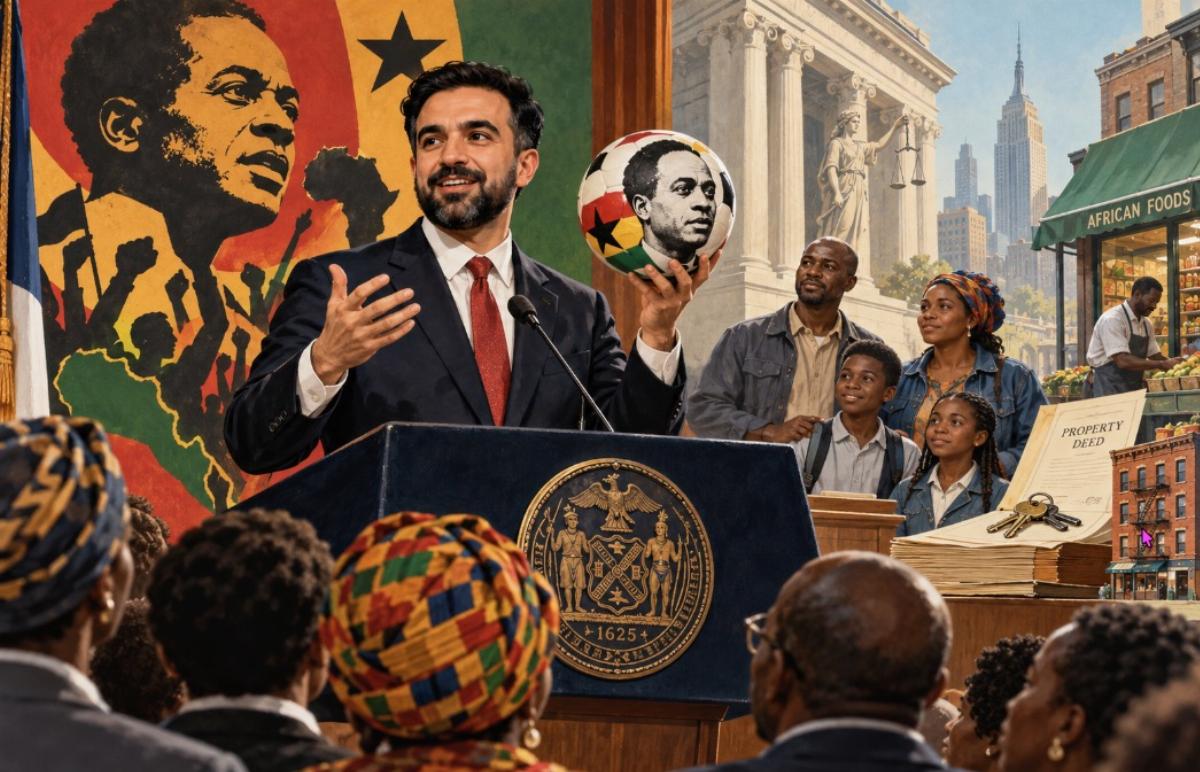
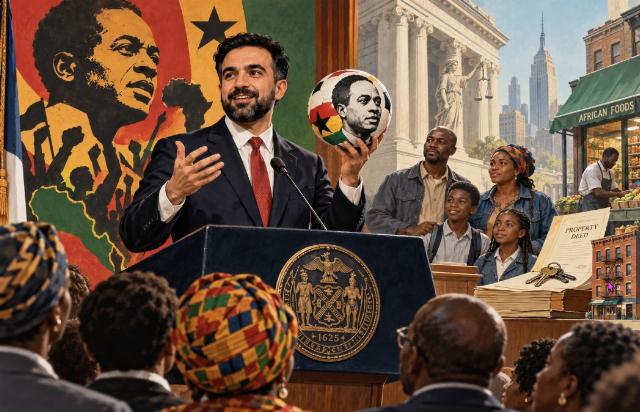
Mayor Zohran Kwame Mamdani keeps a soccer ball on the mantel across from his desk at City Hall. Its surface bears the face of Kwame Nkrumah, the Ghanaian independence leader and Pan-Africanist whose name the mayor also carries. At Gracie Mansion on September 9, Mamdani told a room of African New Yorkers that the ball was a keepsake, and that Nkrumah was one of the continent’s “clearest voices for Pan-Africanism.”
In an op-ed published by American Thinker, contributor Jonas Divine argues that the sentimental story Mamdani told that evening sits awkwardly alongside his own family history — and alongside the political record of the man on the ball.
A tribute that skipped the record
Mamdani presented himself as the inheritor not only of Nkrumah’s name but of his Pan-African voice. Born in Kampala and raised in Cape Town, he arrived in New York at seven, carrying Africa with him. Divine concedes that the narrative was moving. His objection is that it omitted what Nkrumah actually did in power.
Divine writes that Nkrumah declared Ghana a one-party state in 1964 and used the Preventive Detention Act to jail political opponents without trial. His party, according to the op-ed, made him president for life shortly before the army removed him. Nkrumah’s vision of a continent united under a single government, built on socialist principles and state-led industrialization, is presented by Divine as an economic failure for ordinary Ghanaians — even as its symbols survived untarnished.
What actually worked in post-colonial Africa, Divine argues, looked nothing like the imagery on the soccer ball. He points to Botswana, Mauritius, and, unevenly, Ghana and Kenya in more recent decades. Their gains, in his account, came from unglamorous machinery: independent courts, secure property rights, limits on executive power, peaceful transfers of power, and markets open enough for ordinary people to build something and keep it.
That list, Divine says, is the Enlightenment inheritance — Locke and Montesquieu filtered through decades of African constitutional struggle — rather than the inheritance of Nkrumah.
The expulsion in the mayor’s own family
The most pointed turn in the op-ed concerns Mamdani’s father, Mahmood Mamdani, who was among the roughly 70,000 people of South Asian descent expelled from Uganda in 1972 on the orders of Idi Amin. Their businesses, homes, and property were expropriated in the name of returning the economy to Ugandans.
Amin’s campaign was wrapped in the language of decolonization. Divine describes it plainly as ethnic cleansing and theft — one that impoverished the people it claimed to liberate, gutted Uganda’s merchant class, and helped push the economy down for a generation. The elder Mamdani, who was in the audience at Gracie Mansion, lived through that theft.
Divine argues that the mayor, standing in that room, lionized the intellectual tradition that gave men like Amin their cover story, without addressing what it cost his own family. He goes further, suggesting the son’s veneration of Pan-Africanism was likely inherited from the father, who spent decades writing about exile and ethnic identity and who, in Divine’s reading, later recast Amin’s expulsion as decolonization in practice while dismissing Amin’s reputation for atrocity as a Western exaggeration.
The op-ed’s language is sharp: the father, who lived through the expropriation, became an apologist for the movement that justified his community’s expulsion. The son, in this telling, inherited the soccer ball along with the cultural capital he once traded on as a rapper.
TWIs, jollof, and the limits of performance
Divine then pivots to what he considers the more immediate irony for the immigrants and first-generation Americans in the room. A mayor can learn a phrase of Twi or Yoruba, he writes, and can talk about Agege bread on Glenmore Avenue or jollof pots on Burnside Avenue. None of it costs him anything, and none of it constitutes an argument.
African immigrants, in Divine’s account, did not come to New York for a mayor who can pronounce their food correctly. They came to work, open shops, practice medicine, drive cabs, run home health aide businesses, and send their children to schools that take them further than their parents got. The inheritance they are chasing, he writes, is private effort, secure property, and the freedom to build something that belongs to your family rather than the state.
From there, Divine turns to policy. A mayor who wants government to hold a monopoly over what people are allowed to achieve — and who opposes the kind of school choice that lets a first-generation immigrant family route around a failing assigned school — is not aligned with that community’s interests, he contends. He characterizes Mamdani’s posture as treating private initiative as something to be managed rather than unleashed: at best indifferent to those constituents while performing solidarity with their culture, at worst offering the aesthetic of belonging as a substitute for opportunity.
That trade, he argues, is precisely what Pan-Africanism offered the continent two generations ago — and it failed.
The case for unglamorous institutions
The op-ed closes on a contrast between the man on the soccer ball and the machinery that, in Divine’s view, actually built post-colonial Africa’s successes. If we want to honor what worked, he writes, we should start with judges who refused to rule by decree, constitutions that survived a change of government, property registries, independent central banks, and parliaments that checked a president.
None of that fits on a soccer ball. But for Divine, it is the difference between a nation that builds and one that only tears down — and the reason, he says, that so many of the people in that Gracie Mansion room crossed an ocean in the first place. They came for the rule of law they did not have at home, he writes, and they deserve a mayor who will build it here rather than one cosplaying the symbols that, for too many of their home countries, signaled that something had gone badly wrong.
The piece is a commentary, not a news report, and its claims about Nkrumah’s governance, Amin’s expulsion, and the elder Mamdani’s scholarship are the author’s characterizations. What is not in dispute is the setting: a mayor, a mantel, a soccer ball, and a speech that asked an audience of African New Yorkers to see in both the man and the symbol a shared inheritance. Divine’s argument is that the inheritance cuts the other way.
Source: www.americanthinker.com — https://www.americanthinker.com/articles/2026/09/mayor-mamdani-kept-the-wrong-souvenir-from-africa/
Source: www.americanthinker.com