
When Smithsonian Institution Secretary Lonnie G. Bunch III announced on September 8 that he would retire at the end of the year, the tributes came quickly. Bunch, 73, has been widely praised as a historian willing to confront the country’s hardest chapters and as a canny institutional operator who held bipartisan support across 38 years at the Smithsonian — including shepherding the National Museum of African American History and Culture into existence.
But in a commentary published by American Thinker, writer Susan Quinn argues that the applause has papered over something more troubling. Her contention is blunt: the exhibits and programming at the Smithsonian’s National Museum of American History (NMAH) are worse than President Trump described, and the scholars behind them are more radical than most people realize.
The Report That Started the Fight
At the center of the dispute is a White House report issued in July, which the Organization of American Historians — described in the piece as the nation’s largest group of scholars of U.S. history — condemned in a scathing statement. The group called the report part of “an ongoing and multipronged assault by the Trump administration against accurate and evidence-based history in American public life.”
The historians rejected the report’s characterization of the Smithsonian, pointing to the institution’s foundational holdings: the Star-Spangled Banner, Abraham Lincoln’s top hat, and exhibits celebrating American industrial achievement. They argued the report was an attempt to restore a superficial vision of America that never existed.
Anthea Hartig, director of the National Museum of American History, took the lead in the defense. During a July congressional hearing, she testified before a House subcommittee that the museum does not take sides in political debates and operates under strict standards of scholarship and nonpartisanship.

What the Commentary Says the Record Shows
Quinn’s approach is to let the museum’s own words make her case, drawing on statements she says were documented in the White House report.
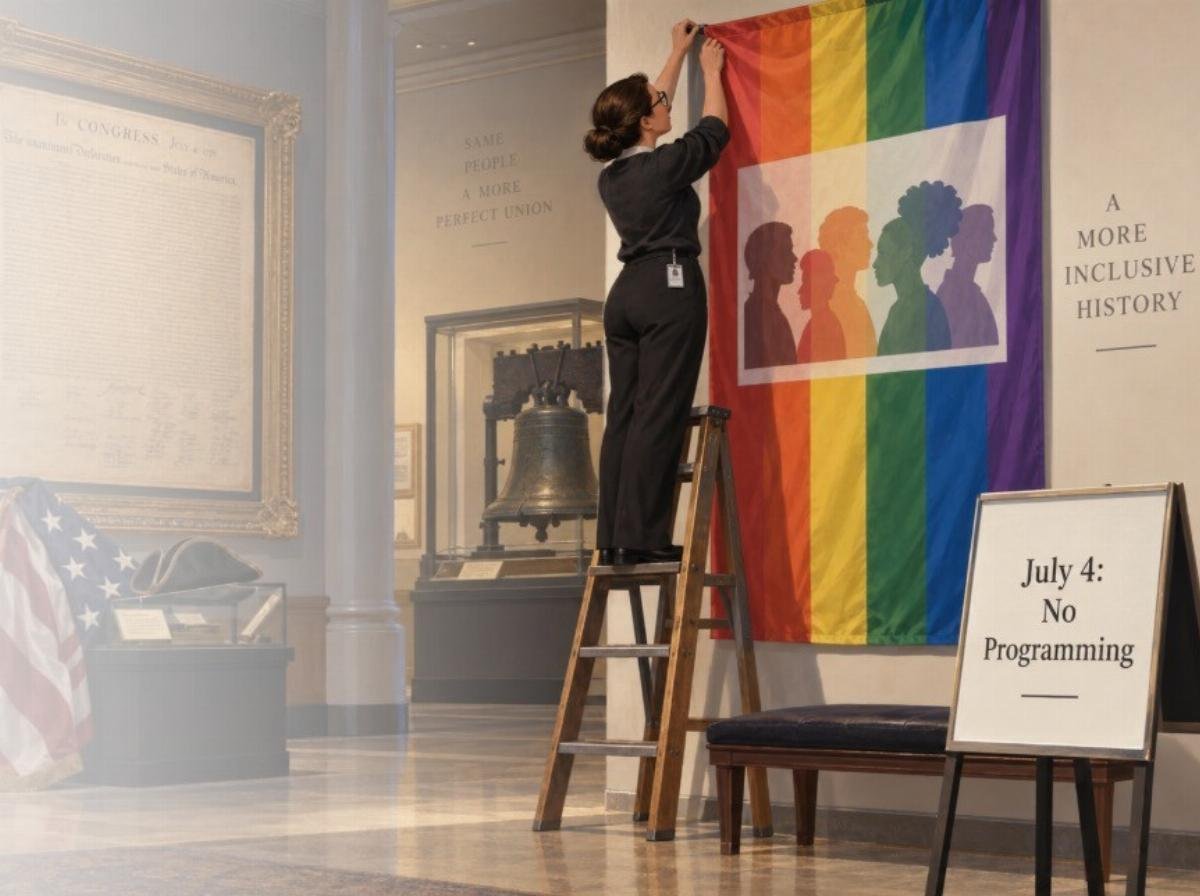
Among them: a June 2024 presentation in which Hartig described serving as liaison to the Smithsonian Pride Alliance. According to the commentary, Hartig recounted that for the first time in the institution’s history, the pride flag had been flown in 2023 and again in 2024, describing the act of flying what Hartig called the alliance’s “intersexual pride flag” that June as “a small thing in a way.”
Quinn also points to NMAH’s Calendar of Exhibitions and Events for summer 2025. Her claim is striking: the national history museum devoted no special programming to Independence Day on July 4, 2025, even though it was open that day. An NMAH article describing the museum’s July 2025 programming, she writes, never once mentioned “Independence Day” or “July 4” — leaving a reader with no indication the holiday existed, let alone that 2026 marks the 250th anniversary of the drafting and adoption of the Declaration of Independence.
From there, the commentary turns to statements by museum leadership about the country’s flaws. Hartig asserted in 2020, according to the piece, that the museum profession had “to figure out” how “we’re going to problematize” the “250th Anniversary of the signing of the Declaration of Independence in 2026.” In 2023, Hartig wrote that “given that we are lurching towards the semiquincentennial of the signing of the Declaration of Independence in 2026, let’s focus on the gaps surrounding that document.”
A Verdict, Not a Question
Quinn is explicit about where she lands. Anyone seeking balance in the museum’s exhibits, she writes, would conclude that promoting Pride was a leftist effort, that excluding Independence Day insulted the Founders who risked their lives against Great Britain, and that deliberately focusing on America’s flaws amounts to a political betrayal of the country.

She goes further, describing the work of Bunch and his colleagues as an attack on the country — an effort, in her telling, to rewrite history through a “hateful, Marxist lens” in which the Founders are strongly implied to be white supremacists with few redeeming qualities. She notes that the phrase itself appears in museum material used, in her reading, to denigrate America’s founding ideals.
As for what comes next, Quinn expects President Trump to ensure that the next leaders of the Smithsonian and its museums pursue objectivity while celebrating the country she calls the most successful democratic republic in the world.
Why It Matters Beyond the Museum
The piece lands at a genuinely unsettled moment for the Smithsonian. Bunch’s departure at year’s end opens the question of who will steer the institution next, and the fight over the July report shows how much is riding on that answer. The Organization of American Historians has framed the administration’s scrutiny as an assault on evidence-based history; Quinn frames the museum’s leadership as the ones who abandoned neutrality while claiming it.
Both sides, notably, invoke the same standard — nonpartisanship and fidelity to the historical record — and accuse the other of violating it. Hartig told lawmakers the museum simply does not take sides. Quinn counters that the calendar, the programming choices, and the director’s own recorded words tell a different story.
What is not in dispute is the symbolic weight of the building itself. The Star-Spangled Banner and Lincoln’s top hat sit inside it. So does the responsibility of explaining to visitors what the Fourth of July means — a task that, as the 250th anniversary approaches in 2026, will be scrutinized as closely as anything the Smithsonian does.
Source: www.americanthinker.com — https://www.americanthinker.com/blog/2026/09/the-controversy-over-the-smithsonian-national-museum-of-american-history/