
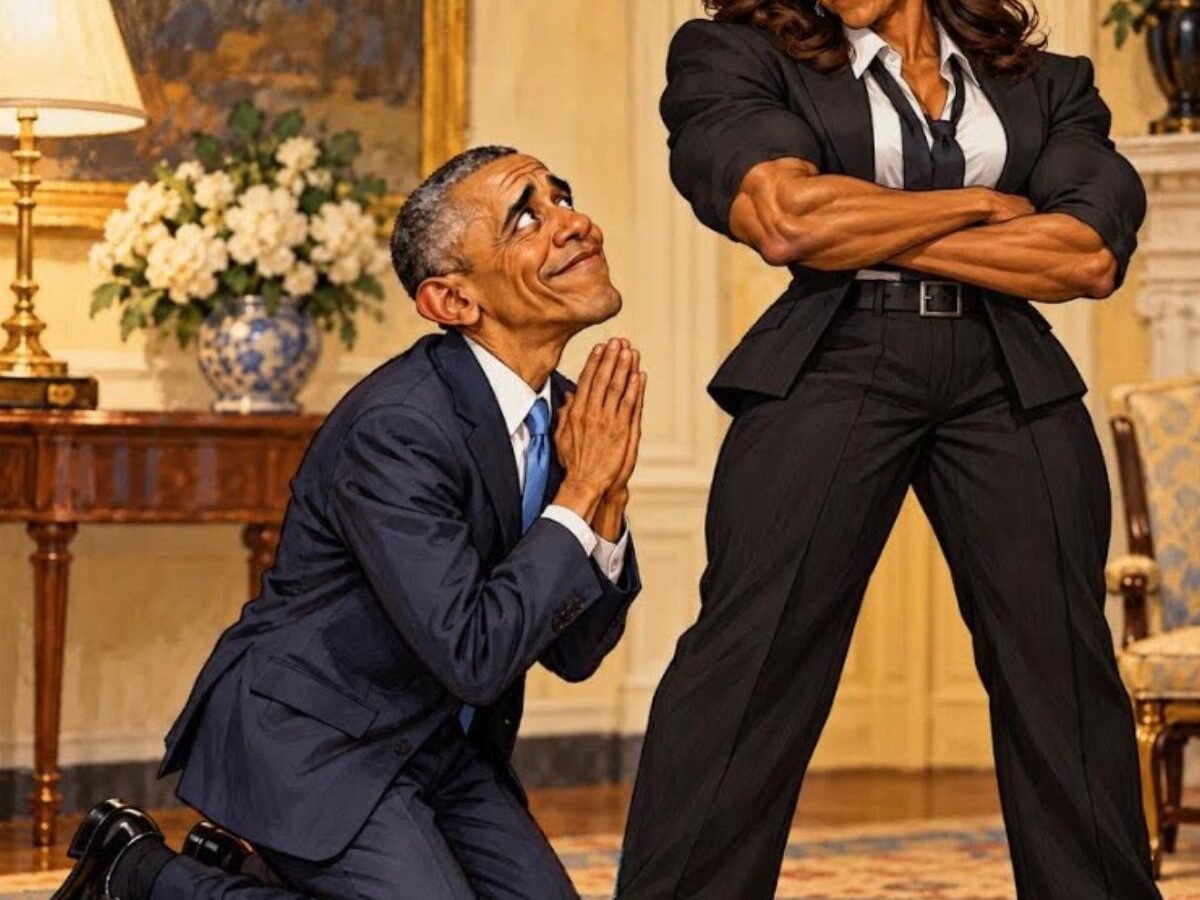
Barack Obama has never been shy about stirring the pot, but his latest musing—that the world would almost certainly be better off if women ran every government for a two-year experiment—has drawn a sharp rebuke from American Thinker, where writer Olivia Murray argues the former president is either cynically pandering or dangerously out of touch with reality.
Speaking from a stage, Obama floated the idea in characteristically casual terms: “Even when I was president, I’d sometimes fantasize about, if you put, uh, women in charge of every government for like two years, and then just kinda saw, ‘alright, how, how’re things goin’?’” He added, “I have a strong belief that things would, they wouldn’t be perfect, but they’d be better. I’m, I’m, I’m confident about that.”
Murray, writing in her essay for the outlet, doesn’t waste time on pleasantries. She calls Obama a “complete and utter jackass” and frames his comment as one more example of a man who has, in her telling, “abdicated his masculine birthright” and stands fundamentally “anti-male.”
Questioning the premise — and the definition
Before tackling the substance, Murray notes a semantic problem. When Obama says “women,” she asks, who does he mean? She points out that Obama’s own progressive politics have embraced the idea that biological men can identify as women, yet she suspects that in this moment he meant actual women—members of the female sex—suggesting an inconsistency she finds telling.

Murray then goes further, questioning whether Obama even believes what he’s saying. She suggests he may simply be “scoring cheap political points with an ignorant audience.” But if he actually does believe it, she writes, it’s a “delusional ‘belief.'”
Her evidence? A sweeping claim that since women entered the workforce, things have “only gone downhill. Objectively.” She acknowledges her own position as “a woman in the workforce” and calls herself “an anomaly,” then points to what she describes as an astronomical increase in sexual harassment lawsuits and the economic cost those carry—while making clear she isn’t excusing bad behavior by men. “Do I believe all women? Hell no,” she writes, adding that men who have served in the armed forces recently likely understand why.
From there, Murray transitions to personal anecdote: bad experiences at businesses, she says, almost always involve a woman running things or a female employee who is grumpy or doesn’t know what to do. She accuses women in the workplace of loving “get to no,” of being incapable of functioning like men, and of always having an excuse for failing to fulfill their duties. As an example, she cites recent public sympathy for a mother who strangled her three young children, with some justifying the act by saying “her hormones made her do it.” Murray notes that these same women are teachers, secretaries, HR administrators, cashiers, servers, and dental hygienists—the everyday face of the female workforce.
History as the closing argument
Murray then moves from the workplace to the halls of power, arguing that women in government have been “disastrous” throughout history. She names Angela Merkel and Ursula von der Leyen as recent examples, then cites a 2020 study published by the Journal of Political Economy finding that female leadership in European states historically increased the likelihood of war participation by 39 percentage points.

She anticipates a counterargument—that academics have tried to explain away that statistic by suggesting these women were simply trying to secure their place in patriarchal societies—and rejects it flatly. “Vindictiveness is a female (and gay male) trait,” she writes, “and then you mix that with the emotionality of women? I’d wager that’s the real reason.”
Her final historical example is Queen Mary I of England, whose reign was so bloody—bloodier, Murray notes, than countless male counterparts—that she earned the nickname Bloody Mary. Murray points out that Mary’s violence wasn’t defined by traditional war but by the slaughter of Christians who refused to denounce their faith, burned alive at the stake. “Vindictive, right?” she asks.
The essay ends where it began: with Obama. “Obama opens his mouth and proves once again he’s a complete and utter jackass,” Murray concludes. The piece closes with the outlet’s standard appeal for donations, framing the ability to speak one’s mind as crucial to the republic.
What the pushback reveals
Murray’s essay is less a measured rebuttal than a full-throated culture-war salvo, one that leans on anecdote, broad generalization, and a selective reading of history to argue that Obama’s hypothetical—women running every government for two years—would not yield the improvement he predicts. But the piece also captures a broader frustration among conservative commentators: the sense that Obama’s brand of progressivism casually elevates identity as a proxy for competence, and that questioning the premise is itself treated as taboo.
Whether Obama’s comment was a genuine thought experiment, a rhetorical flourish, or—as Murray suspects—a bid for applause lines, it has landed in a political moment where gender, leadership, and power remain among the most volatile fault lines in American life. Murray’s answer is unambiguous: the fantasy isn’t just wrong, it’s backwards. History, she argues, already ran the experiment. Her verdict: women in charge made things worse.
For readers on the left, that conclusion will read as reactionary caricature. For readers on the right, it will read as a rare moment of someone saying plainly what they think the data and the historical record already show. Either way, the exchange is less about a two-year hypothetical than about who gets to define what competent leadership looks like—and whether the answer can ever be separated from the identity of the person doing the leading.
Source: www.americanthinker.com — https://www.americanthinker.com/blog/2026/09/obama-has-a-strong-belief-that-if-women-were-in-charge-everything-would-be-better-but-reality-and-history-prove-otherwise/