
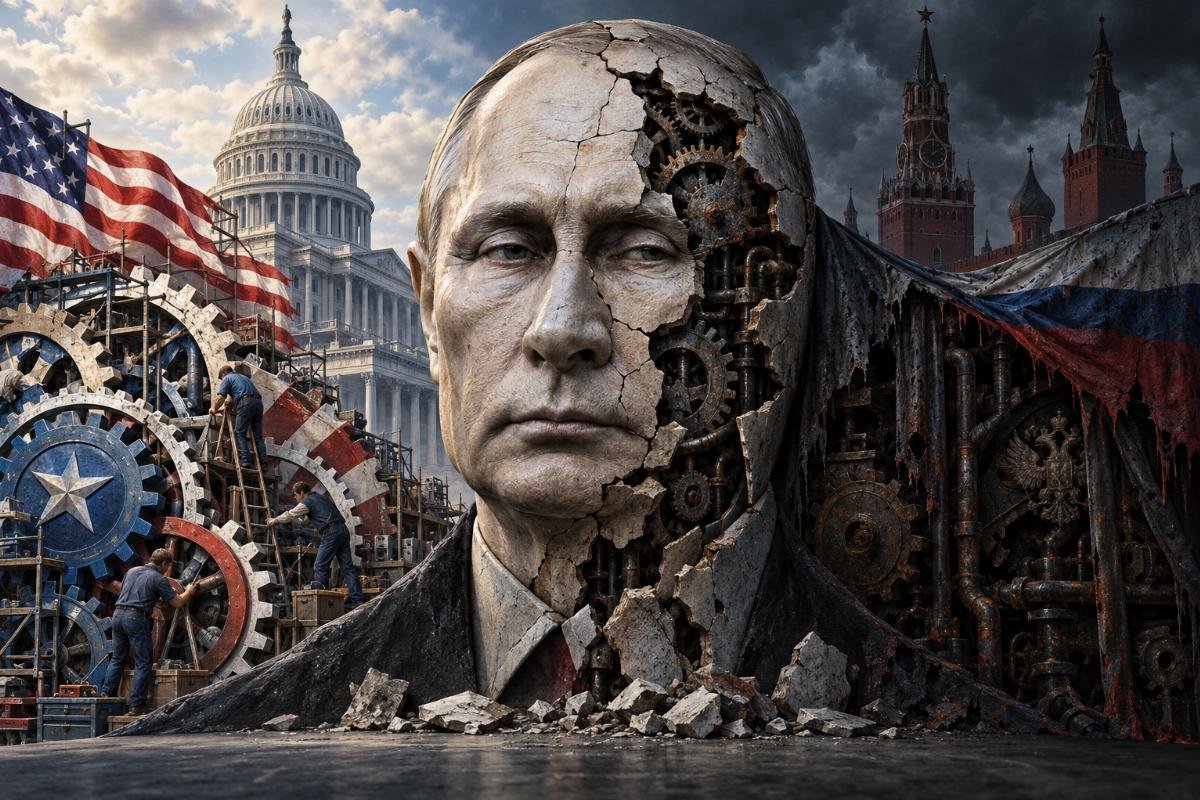
America’s internal disorder is on display for anyone who cares to look: open dissent, endless media scrutiny, institutions that air their own failures in public. Russia’s disorder is harder to see, hidden behind censorship, coercion, and a carefully maintained appearance of control. According to a new essay in American Thinker, that difference is not a sign of Russian strength. It may be the clearest evidence of Kremlin weakness.
In the September 13 piece, author Allan J. Feifer argues that both the United States and Russia are suffering from what he calls “cognitive fatigue” — a condition in which a nation’s collective capacity to process complexity, maintain coherence, and act with discipline steadily erodes. It isn’t about raw power, he writes. It’s about overload, showing up as shortened attention spans, hyper-reactivity, belief in falsehoods, distorted institutional memory, paralysis born of lost confidence, and distrust of the institutions that hold a country together.
The two countries, Feifer contends, arrived at that condition by opposite routes — and that difference matters enormously for which one can recover.
A strongman’s apparent advantage comes with a hidden bill
On paper, Russia looks like the more decisive actor. A single man sets the course. Putin doesn’t have to negotiate with a legislature, a skeptical public, a sprawling bureaucracy, an independent judiciary, political rivals, or allied governments. He can move fast.
Feifer’s argument is that this speed carries a cost that rarely shows up until it’s too late. When the information reaching the top is inaccurate — flattered, filtered, or simply invented by subordinates afraid to deliver bad news — errors and false assumptions accumulate rather than get corrected. A system built to move quickly in one direction can keep moving quickly in the wrong one.
The West, by contrast, processes information through open debate, legal restraint, institutional transparency, and constitutional checks. Those features, Feifer concedes, can make democracies painfully slow when speed matters most. Historically, he writes, the U.S. has often been reactive — allowing Putin room to run before eventually catching up and bringing superior industrial and military resources, backed by Western allies, to bear. That assumes, he notes, that the political will exists in the first place.
Russia’s military ceiling is lower than its rhetoric
The essay’s most specific claim concerns Russian military capacity. Feifer argues that Russia’s ability to meaningfully expand its war effort in Ukraine is far more constrained than its public posture suggests. Its manpower pool is already strained, its training pipeline saturated, and its industrial base running at full stretch. Each additional mobilization round, in his telling, delivers diminishing returns: lower-quality recruits, more domestic resistance, and inevitable economic strain. Equipment losses, meanwhile, continue to outrun production, logistics are stretched thin, and the loyalty of the ruling class is, in his words, highly suspect.
The result, he writes, is an erosion of capacity that is outpacing the political willingness to escalate. Putin can still announce new offensives, threaten fresh mobilizations, and rattle the saber. But the machine underneath is increasingly unable to generate the combat power those threats imply. The rhetoric, Feifer argues, has begun to exceed the reality.
That gap produces a strategic paradox he says Western governments are reluctant to acknowledge out loud. Ukrainian victory is desirable in principle. But a destabilized Russia — one that tips into internal disarray, political infighting, or uncertainty over nuclear command and control — is the outcome many Western policymakers privately fear more than a stalemate. So the West finds itself caught between two competing imperatives: supporting Ukraine strongly enough to prevail, without pushing so hard or so fast that Russia’s internal stability collapses.
Feifer puts the uncomfortable conclusion bluntly: an exhausted or cornered nuclear-armed Russia lurching toward instability frightens Western capitals more than a Ukrainian victory appeals to them.
Why concealed fatigue is the more dangerous kind
The core of the essay is a comparison between two ways a nation can come apart. America’s fatigue is loud. It is expressed through open argument, a combative press, and institutions that expose their own flaws. Russia’s fatigue is concealed — behind censorship, coercion, and a façade maintained by state disinformation.
What looks like resolve from outside, Feifer writes, is often the product of narrative control. The Kremlin’s restrictions mask a reality of fractured leadership, worsening corruption, internal infighting, and a population increasingly at odds with the war’s stated purpose.
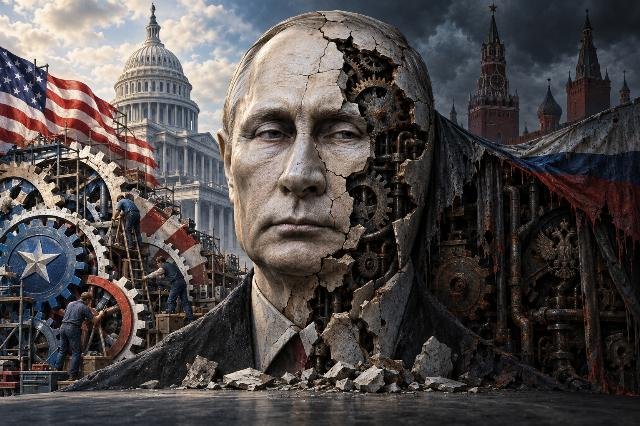
An autocracy, in his account, has a particular vulnerability when it is cognitively fatigued. It cannot easily handle complexity or correct its own mistakes, because admitting error risks tearing away the mask. For Putin, acknowledging failure is not merely a political problem but a personal one — it threatens his safety. So the mistakes compound instead of being fixed, and the system’s fatigue runs deeper and becomes structurally harder to reverse.
One-man rule, so often mistaken for strength, becomes a severe liability. A system that depends on a single person to interpret reality, absorb complexity, and make fateful decisions will eventually fail at that task. Putin’s dominance, Feifer argues, blocks corrective feedback, suppresses dissent, and lets strategic errors accumulate rather than self-correct.
Distributed leadership, for all its mess, has the opposite property: multiple points at which a false assumption can be challenged. Democracies stumble constantly, he writes, but they also repair themselves.
That is where the American version of fatigue may prove less fatal. The disorder is visible precisely because the system permits disagreement, criticism, and competing versions of reality. Russia can hide its condition because one man controls the story. America cannot.
The question that outlasts the analysis
Feifer frames his argument inside a broader historical claim: that the world periodically rebalances, most recently after the Second World War, and that new challengers — principally China, Islam, and Russia — now claim to represent the future. The U.S. need not lose its position, he writes, but it will be contested. No nation has a guaranteed shelf life. Longevity depends on internal consistency and a refusal to treat every idea as equally valid, a point he insists history has settled repeatedly.
His prescription is less about policy than about confidence. America, in his telling, can face any number of adversaries if it stays grounded in its values and traditions — above all the moral confidence that binds a people together. The problem is that a growing share of Americans no longer believe the country is unique, special, or, warts and all, the best example of what a nation should aspire to be.
The closing question is pointed: can the country retain enough faith in itself, its institutions, and the principles behind its success to recognize the danger and act before cognitive fatigue becomes irreversible? If not, Feifer warns, the next great rebalancing may not simply end American dominance. It may be remembered as America’s most avoidable catastrophe.
Whether one shares his framework or his politics, the essay raises a question that applies well beyond the United States and Russia: which is more dangerous — a country that argues with itself in public, or one that has learned to keep quiet?
Source: www.americanthinker.com — https://www.americanthinker.com/articles/2026/09/america-and-russia-are-suffering-from-cognitive-fatigue/