
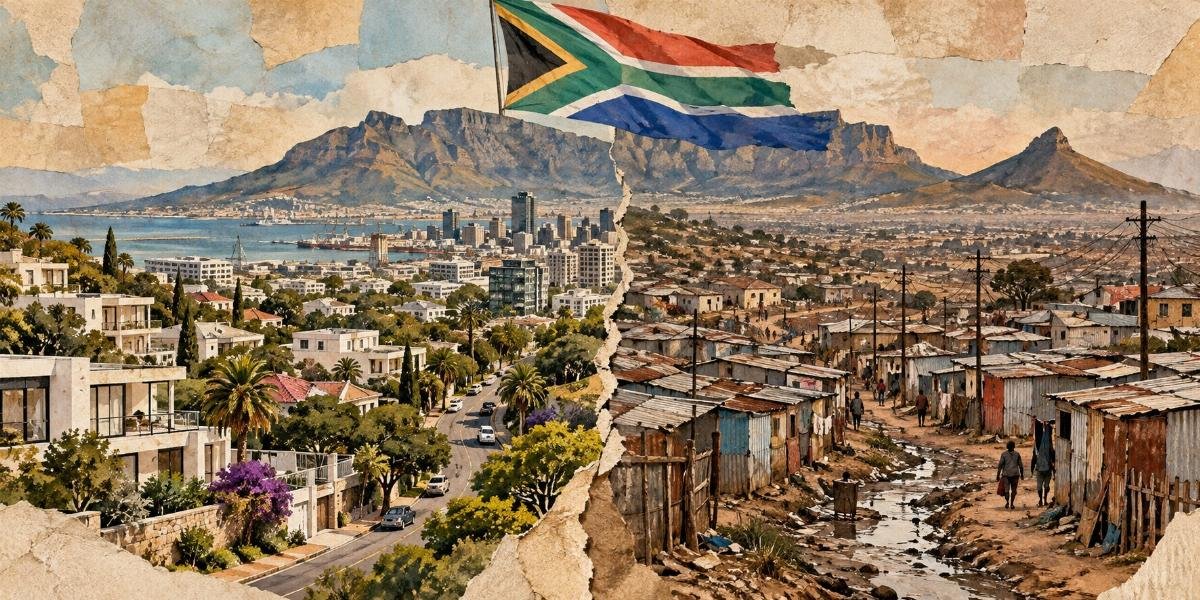
Two conversations, one island chain, and a country that looks nothing alike depending on who’s describing it. That’s the premise of a new American Thinker column by Olivia Murray, who says a week in the Bahamas left her with sharply conflicting portraits of white South African life under President Cyril Ramaphosa’s government.
Murray describes meeting a construction worker named Dewet at a small grocery in the Exumas, a man whose accent gave away his origins and whose account of home was bleak. According to Murray’s telling, Dewet said every person he knows in South Africa has either been a victim of anti-white violence or knows someone who has been hurt or killed. His own father, she writes, was shot during a robbery over what she describes as a very small sum of money.
Dewet reportedly welcomed President Trump’s confrontation with Ramaphosa, telling Murray he was glad the violence against white farmers was drawing global attention. Murray notes that Trump cited articles from her own outlet during that pressure campaign. Dewet added that his ex-wife and twin daughters were pursuing relocation to the United States under refugee category priorities established by the Trump administration, describing South Africa as unsafe for them.
For Murray, that account matched her expectations. Then came the second encounter, and the frame shifted.
Two Families, Two Realities
Stranded at a small air hangar in Nassau after a scheduled driver failed to appear, Murray and her party accepted a ride from a friendly couple also bound for Paradise Island. Also white South Africans, also chatty about politics. But this husband’s assessment, in Murray’s words, was that “things aren’t as bad as the news makes them out to be.”

Murray writes that she immediately placed the pair in the liberal, out-of-touch camp. The evidence, as she presents it, was his own phone.
The man showed her live camera feeds from his Johannesburg home: a walled compound with razor wire atop a heavy brick perimeter, uniformed guards patrolling outside the boundary, and an alarm system he demonstrated onscreen. His wife added that people often assume South Africa is a warzone, but insisted it is not. The husband offered his own framing—that it’s like the United States, with good areas and bad areas.
Murray pushes back on that comparison in the column, arguing the right to armed self-defense is well established in America and has been effectively taken from South Africans, and noting that the couple’s “good area” was Johannesburg. If that’s the good part, she writes, she has no interest in seeing the bad.
Class, Not Just Country
The column’s organizing idea isn’t race or nationality so much as class. Murray contrasts the two families’ circumstances to make her point. Dewet, she writes, is a blue-collar worker taking whatever jobs he can find, even when it means being separated from his children. The Nassau couple, by contrast, were in town shopping for a yacht, planning to spend most of the year sailing the Mediterranean, with a follow-up stop in San Francisco to look at boats there. The wife, an artist, is retired; the husband, per Murray, has done extremely well in government contracts as a middleman collecting utility payments, a function she characterizes as something the corrupt and inept state couldn’t manage itself. Both of his children and his daughter’s boyfriend, she adds, are on his payroll.
Murray also relays the couple’s claim that the government hasn’t updated the national grid since taking power more than twenty years ago—a detail she uses to underline her portrait of state dysfunction.

The argument she builds from these two encounters is that prosperity under a failing state can insulate people from what that state is doing to everyone else. The wealthy couple’s optimism, in her reading, isn’t ignorance so much as it is a refusal to let political ideology collide with visible evidence—razor wire, guards, cameras, and a compound that she says would read as a warlord’s residence or a government installation anywhere else. The cost of that dissonance, she writes, is borne by other people, sometimes in blood.
She closes by tying the story to a broader theme: the importance of speaking freely, which she frames as essential to the republic Americans cherish.
The Reporting, and What It Actually Says
It’s worth being clear about what this column is and isn’t. It is a first-person opinion piece built on two chance meetings during a vacation. Its factual claims about South Africa rest on the author’s characterization of what two families told her, plus her own conclusions about what security footage and a compound wall mean. It is not an investigation, a data analysis, or a survey of South African opinion. The reader gets two data points, chosen by the author, arranged to make an argument.
That doesn’t make the piece dishonest—it makes it a column. Murray is upfront that she expected Dewet’s account and not the couple’s, and she says plainly whose side she’s on. What she’s documenting, at minimum, is that white South Africans themselves don’t agree on how bad things are, and that disagreement tracks something other than geography. It tracks money.
The column also lands in a specific political moment, one in which the Trump administration has made South Africa’s treatment of white farmers a recurring theme in U.S. foreign policy messaging, drawing on outlets like American Thinker itself. Murray’s anecdote about Dewet’s family pursuing American resettlement slots directly into that policy story, illustrating at human scale the refugee categories the White House has prioritized.
What the piece does not do is resolve the question it raises. If a man living behind razor wire with armed patrols says his country isn’t a warzone, is he lying, in denial, or simply describing a life that a person with his resources can sustain? Murray has a clear answer. A reader might reasonably want more than two taxi rides’ worth of evidence before signing on.
Still, the column captures something real about how crises get narrated from the inside: the people most exposed to a country’s failures are often the ones with the least room to look away, while the people best insulated from those failures are the ones most invested in saying things are fine. Murray’s yachtsman and her laborer aren’t just two South Africans. They’re two ways of surviving the same place—and only one of them gets to leave by choice.
Source: www.americanthinker.com — https://www.americanthinker.com/blog/2026/10/a-tale-of-two-south-africas/