
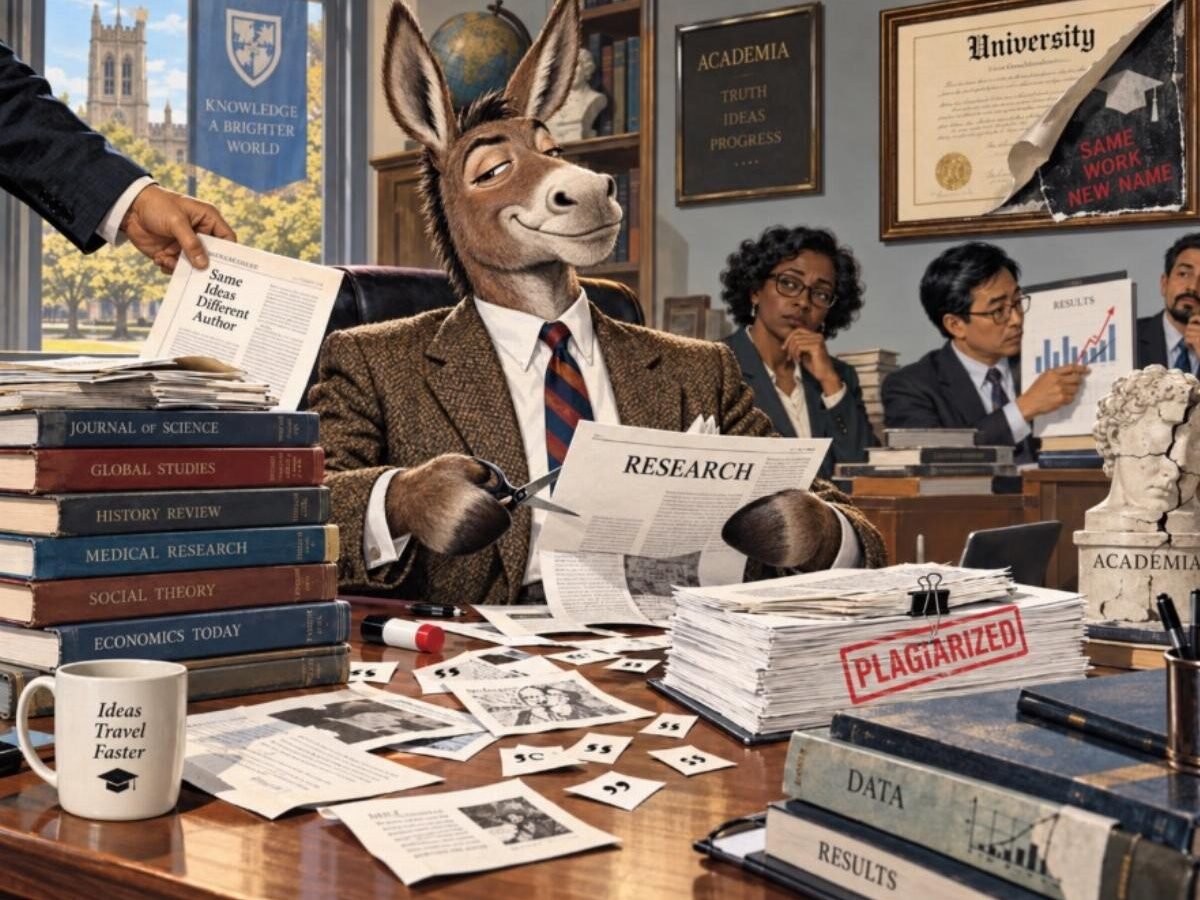
Accusations of scholarly fabrication almost never arrive with a drumroll. They tend to surface quietly, in book reviews and listserv threads, long after the awards have been handed out and the blurbs have gone stale. That is more or less what has happened with Kerri K. Greenidge, a Boston University–trained historian whose 2022 book The Grimkes: The Legacy of Slavery in an American Family was, by any measure, a critical success.
As American Thinker’s Andrea Widburg details in a recent column, The Grimkes received glowing coverage from The New York Times Book Review and Publishers Weekly, which placed it among the ten best books of 2022. The following year, the American Historical Association awarded Greenidge the Joan Kelly Memorial Prize, a prominent honor for work in women’s history and feminist theory.
The trouble, according to reporting in the Times that Widburg quotes at length, is that the book’s evidentiary foundation may not be as sturdy as its reception suggested.
The Fact-Checking Begins
Several scholars who were skeptical of some of Greenidge’s assertions began checking her work. Myra C. Glenn, a retired professor of American history at Elmira College and the author of multiple books on U.S. history, told the Times that the process started with a simple question: “Where is she getting this?” From there, Glenn said, “Boy, it became a major problem.”
In March 2024, Glenn reviewed The Grimkes for Reviews in American History, a scholarly journal published by Johns Hopkins University Press. Her verdict, as quoted by the Times, was blunt. “Although well-written, ‘The Grimkes’ is also a deeply flawed book,” Glenn wrote. “All too often Greenidge lacks the evidence to substantiate many of her major claims. Her work is also riddled with factual errors and repeatedly omits needed endnotes.”
The article also describes what may be the most concrete problem of all: Greenidge’s reliance on letters she says are held at the University of Michigan, but which no one has been able to locate. That is the kind of claim that, in a discipline built on archival verification, tends to be fatal.
Greenidge, for her part, has rejected the framing of the criticism. In an interview with the Times, she said her life’s work had been torn down by white scholars who disagreed with her conclusions about racism, slavery, and white supremacy. “I am heartbroken that a field I have given my life to can treat me this way,” she said. “The attack on Black women academics is real.”
A Question That Goes Beyond One Book
Widburg grants that Greenidge is right about one thing: several Black academics, both male and female, have faced fraud accusations. But she argues that race is the wrong lens. In her telling, the more revealing pattern is ideological. To test that hunch, she asked ChatGPT to compile all headline-topping examples of proven academic fraud in the U.S. and the U.K. since 2000.
The results, as Widburg describes them, split along disciplinary lines. Cases where fraud was used to advance an agenda, she writes, were “always leftist” — a conclusion she attributes to the chatbot’s own summary: “I don’t see a comparably strong, unambiguous right-leaning case among them.” Meanwhile, scientific fraudsters — and there have been many — appeared largely apolitical, while liberal-arts fraudsters leaned left.
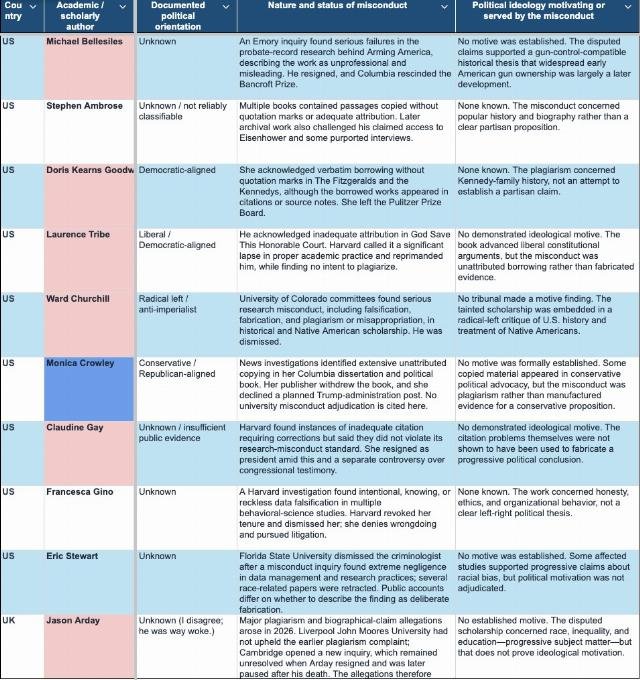
Widburg acknowledges that the sample is small and that she is relying on an AI tool to assemble it. She also notes that ChatGPT tends to be conservative in assigning political motives, declining to label Jason Arday’s bias as known even though, in her view, testimony from people involved makes his hard-woke orientation clear. On her chart, she marks left-leaning cases in red and the single conservative case — Monica Crowley — in blue. She readily admits the blue entry is lonely.
She also flags the limits of the exercise. Greenidge’s scandal, for instance, isn’t famous enough to register in the chatbot’s analysis. Neither is Robin DiAngelo, who faced accusations that her university ultimately dismissed. Widburg’s suspicion is that a deeper dive into less prominent but still newsworthy cases would make the red even more dominant.
The Larger Argument
What Widburg is really describing isn’t a bookkeeping exercise about who cheated and who didn’t. It’s an argument about institutional culture — about what happens when, as she puts it, morality is removed from a profession. Academia, in her account, has become a “hard-left redoubt,” and the result is an “end justifies the means” ethos in which anything goes. Plagiarism, she suggests, is only the beginning; there is no stopping point.
The people training the West’s best and brightest, she concludes, sit at “Ground Zero for a society that has a moral vacuum at its heart.”
That is a sweeping claim, and readers will bring their own priors to it. But the specific case at hand is not sweeping at all. It is a book that won prizes, earned rapturous reviews, and now faces detailed scholarly objections about missing endnotes, missing evidence, and missing letters. How the historical profession handles those objections — and whether the racial-motivation defense holds up against the archival record — will say as much about the discipline as it does about one author.
However the Greenidge case resolves, it lands in a broader conversation that shows no sign of cooling: who gets to claim authority over the past, and what happens when the receipts turn out to be missing.
Source: www.americanthinker.com — https://www.americanthinker.com/blog/2026/09/would-you-be-surprised-that-another-leftist-academic-allegedly-made-up-facts/