
The U.S. Army’s long-running effort to replace the M4 carbine with a more powerful rifle has produced a second generation of hardware that critics say repeats many of the same flaws that plagued its predecessor — at a far higher cost per round, and with a combat loadout that leaves soldiers carrying less ammunition.
Writing in American Thinker, veteran and firearms instructor Mike McDaniel takes aim at the XM8, the Army’s newest rifle from Sig Sauer, which the service is now championing after a rocky debut for the earlier M7A1. McDaniel, a U.S. Air Force veteran and retired police officer, describes the XM8 as the latest iteration of a “rifle by committee” — a weapon whose design priorities, he argues, were driven more by procurement goals and marketing than by the needs of troops in the field.
A heavy rifle with a heavy price tag
The XM8 is lighter than the M7A1 it replaces, but McDaniel says that’s not saying much. He reports that the rifle weighs 7.33 pounds empty without its suppressor — which adds another 1.31 pounds — bringing it to 8.64 pounds before any optic is attached. The design has no iron sights, meaning an optic isn’t optional; the standard Vortex XM157 sight weighs two pounds on its own. Add a loaded 25-round magazine, and McDaniel calculates the XM8 easily tops 12 pounds, making it heavier than the M14 — a battle rifle the military abandoned in part because of its 9.4-pound weight and the burden it placed on soldiers carrying ammunition.
“No soldier has ever wanted less ammo on the battlefield,” McDaniel writes, noting that the new 6.8x51mm cartridge is so large and heavy that it substantially reduces the number of rounds troops can carry into combat. The M7A1 came with a 20-round magazine, a capacity that Army Capt. Braden Trent flagged as a liability in a May 2025 assessment. The XM8 now ships with a 25-round magazine, which McDaniel acknowledges addresses at least that specific complaint — while pointing out that both the Army and Sig Sauer publicly disputed Trent’s findings at the time.
The cartridge problem
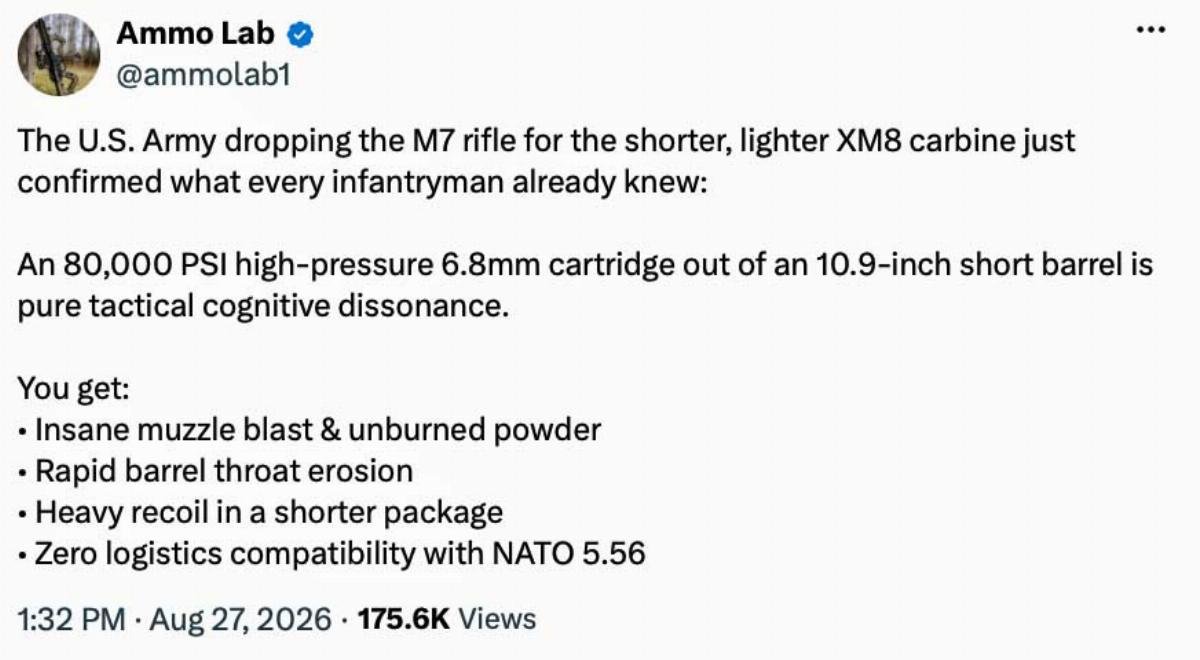
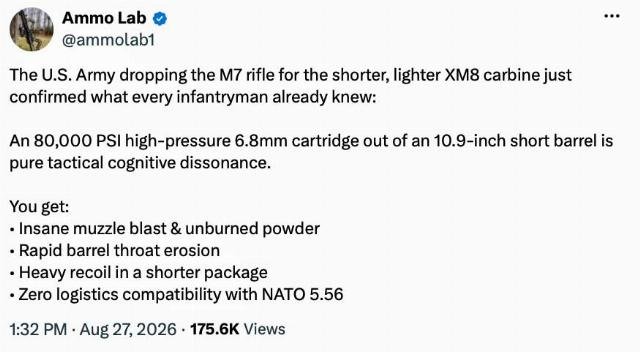
At the heart of the controversy is the ammunition. The Pentagon’s decision to pursue a new rifle with significantly greater range and stopping power required a hybrid cartridge — a 6.8x51mm round with a brass case mated to a steel base — operating at chamber pressures exceeding 80,000 psi. According to McDaniel, that extreme pressure dramatically shortens barrel life and has produced inconsistent accuracy. The all-brass .277 Fury version costs roughly four times more than a standard 5.56mm round; the hybrid version costs nearly ten times more. Both are reportedly difficult to find.
McDaniel questions the underlying rationale for the program altogether, noting that the last war in which long-range marksmanship was regularly necessary was World War II. The M14 was eventually abandoned in part because of its weight and the limited ammunition loadout it forced on soldiers — a lesson, he suggests, that the current program appears to have forgotten.
Cheerleading versus criticism
Sig Sauer has been unreserved in its praise of the new weapon. Tory Mazzola, the company’s vice president of global communications, said in a statement that “the XM8 carbine’s improved balance, felt recoil, and ergonomics expand soldier maneuverability while delivering the same level of incredible lethality as the M7 rifle.” The company notes that the XM8 shares the same 6.8x51mm caliber and general action as the M7, so ballistic performance is comparable, with ergonomic and weight improvements driving the Army’s preference shift.
McDaniel is not persuaded. He notes that the XM8’s barrel is only slightly over 10 inches — compared to 13 inches on the M7 and 16 inches on the M4 — a necessity driven by suppressor mounting. Shorter barrels reduce bullet velocity, undercutting the long-range accuracy that was a primary justification for the new rifle. Meanwhile, cheerleaders claim the XM8 is more accurate than the M7, despite giving up around 200 feet per minute in velocity.
Two charging handles and a heavy optic
McDaniel also flags what he calls persistent design oddities. The M7A1 included two separate charging handles — an unusual feature that the XM8 appears to have retained. The original rifle’s suppressor rapidly overheated, and the optic, which McDaniel describes as attempting “to do everything but write home to mother,” added significant weight without, in his view, working as advertised.
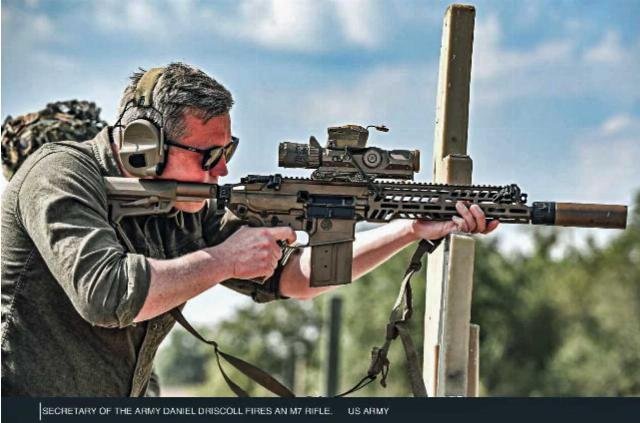
The XM8 also features a folding stock and a so-called softer recoil pad intended to help soldiers manage the recoil of the same powerful cartridge in a slightly lighter weapon. McDaniel’s assessment is blunt: the rifle is “far too heavy for all but our very strongest troops” — and remains, in his phrasing, “an example of a rifle made by a committee.”
The Marines do more with less
Perhaps the sharpest contrast McDaniel draws is with the Marine Corps, which, he notes, is keeping its 5.56mm rifles. “The Marines, as usual, do more with less,” he writes. While the Army has pursued a heavier cartridge in pursuit of greater range and power, the Marines have reportedly opted to stick with a lighter round that allows troops to carry more ammunition and has been tested extensively over decades of service.
McDaniel’s larger point echoes a recurring tension in U.S. military procurement: the gap between what weapons designers and program managers believe soldiers need and what soldiers themselves report after field testing. The M7A1’s debut was followed by a flood of complaints, he says, and while the brass “don’t often listen to the complaints of troops when military procurement is involved,” the outcry over the M7’s obvious flaws was apparently too visible to ignore — leading to the XM8.
Whether the XM8 will fare better in the field than its predecessor — or whether it represents yet another case of the Pentagon solving a problem soldiers didn’t ask about, with hardware they’ll have to carry anyway — is a question that will ultimately be answered by the troops assigned to use it. For now, the rifle’s cheerleaders and its critics remain sharply divided.
Source: www.americanthinker.com — https://www.americanthinker.com/blog/2026/09/the-military-cheerleads-a-rifle-designed-by-committee/