
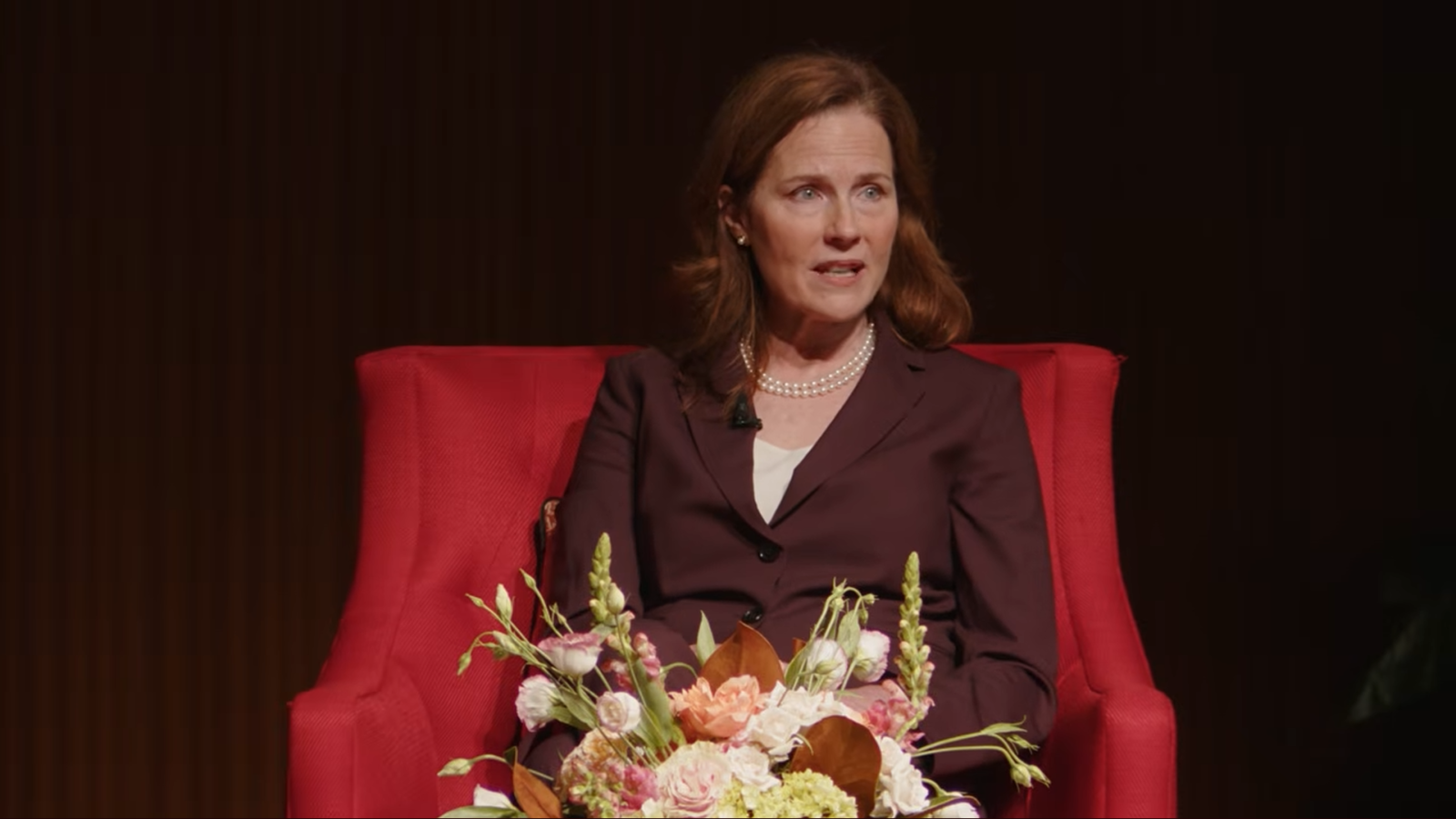
Justice Amy Coney Barrett made her first public comments Thursday since joining the Supreme Court’s majority in Trump v. Barbara, the decision that solidified birthright citizenship into constitutional law — a ruling that drew sharp dissents from two of her conservative colleagues.
The junior justice sat down with University of Virginia Law School Professor John Jeffries Jr. in Charlottesville to discuss her newly released book, Listening to the Law, which offers a window into how the high court operates, from opinion drafting to statutory interpretation.
“I wanted to teach both lawyers and law students and non-lawyers about the court,” Barrett said, explaining that friends and fellow academics outside the legal field had long pressed her with basic questions about how the institution functions — questions she and Jeffries “would take for granted” given their legal backgrounds.
Emergency Docket and the Modern Court
Jeffries steered the conversation toward the court’s emergency or interim docket, which handles cases still winding through lower courts. The Trump administration has relied on it repeatedly to seek relief from judges whose rulings blocked administration initiatives, according to The Federalist.
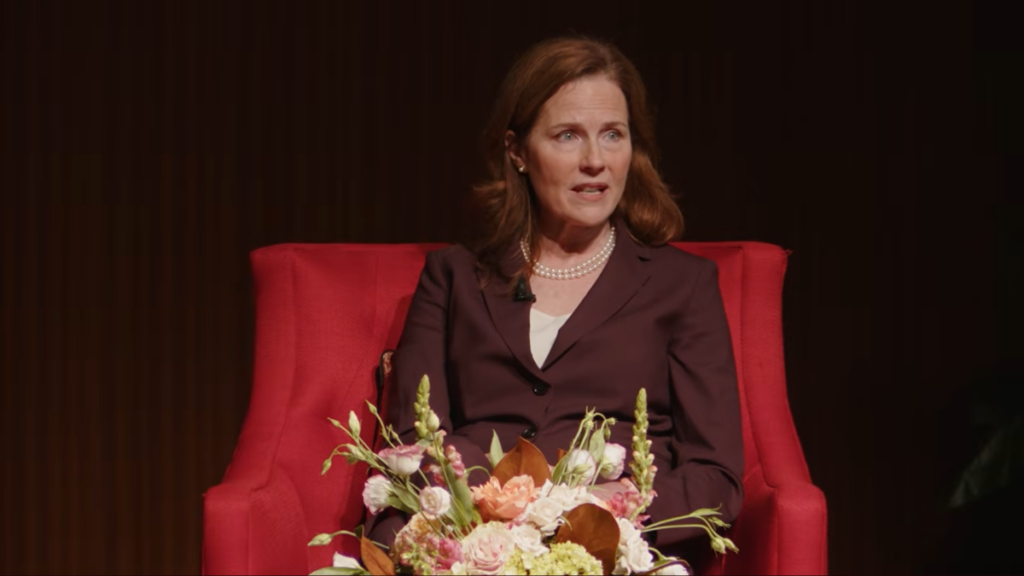
Barrett acknowledged the docket’s increased activity but declined to attribute it to a single cause, noting that “people have different theories for why it’s becoming more active.” She floated one possibility: “we have a lot more executive orders than we used to 20 years ago.”
The discussion turned to what Jeffries described as “the anxiety that pervades the judiciary.” He asked whether President Trump’s criticism of certain federal judges and his pointed remarks about Barrett and other Trump-appointed justices who ruled against his agenda might be contributing to security concerns.
Barrett sidestepped the invitation to address Trump’s attacks directly. Instead, she identified social media as a factor transforming the environment in which public officials operate. Platforms, she said, allow people to amplify thoughts that would previously never have circulated to a wide audience.
“We certainly live in a time and in a climate where people are equipped to say things that I certainly wish you know that they wouldn’t,” Barrett said. Broader recognizability, she added, means that “public officials, including judges and justices, are more easily recognizable, which also heightens the security risk.”

Barrett’s own experience with such threats is well documented. After the 2022 leak of the Dobbs draft opinion overturning Roe v. Wade, she wore a bulletproof vest to protect herself and her children, as The Federalist’s Mollie Hemingway recounted in her book Alito. More recently, Barrett testified before Congress alongside Justice Elena Kagan about Supreme Court security funding, testimony that followed an attempted swatting at her home.
Declining on Term Limits
After a segment on judicial methodology, Jeffries turned to what he framed as a threat to the court’s independence: Democratic proposals to expand the court. Since the justices gutted race-based redistricting earlier this year, Democrats have renewed calls to add seats to the bench and shift its ideological balance, according to The Federalist. Some prominent Democrats have also rallied behind 18-year term limits that would apply retroactively.
Asked about those term-limit proposals, Barrett said she has “thoughts” — but would not share them publicly.
“It might come before me,” she said, laughing. “When it’s a matter of active public debate [in Congress], then … I can’t weigh in on that.”
Barrett explained that opining now could prove imprudent given the possibility of future litigation.
The Ruling That Went Unmentioned
One subject Thursday’s event did not touch: Trump v. Barbara itself.
Barrett was among six justices who concluded that the president’s executive order restricting citizenship for children of illegal aliens and foreign “birth tourists” was unlawful. She went further, joining Chief Justice John Roberts and the court’s liberal wing in holding that birthright citizenship is guaranteed by the 14th Amendment.
The decision provoked fierce dissents. Justice Clarence Thomas, joined by Justice Neil Gorsuch, wrote that the majority “devalues [American] citizenship.” Justice Samuel Alito called the ruling a “serious mistake.”
Barrett and her colleagues will return to the bench for the court’s 2026 term in the coming weeks, with oral arguments scheduled to begin Oct. 5.
Source: thefederalist.com — https://thefederalist.com/2026/09/18/justice-barrett-gives-first-interview-since-mistaken-birthplace-citizenship-ruling/