
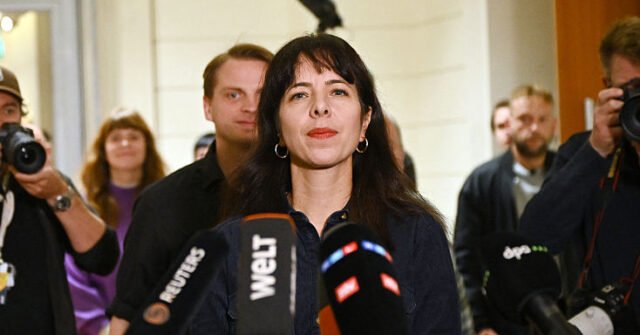
A German left-wing politician on track to become Berlin’s next mayor has found herself at the center of controversy after accidentally revealing deep personal fears about her own party’s pro-Palestine activist base in an email meant to remain private.
Elif Eralp, the Berlin mayoral candidate for Die Linke (The Left), apparently forwarded an internal version of an interview transcript back to Der Spiegel, Germany’s best-selling news magazine, with her private notes and internal party discussions still attached. The accidental disclosure has exposed tensions within Germany’s hard-left political movements and raised questions about the sustainability of alliances between socialist parties and pro-Palestine activists.
In the leaked communications, Eralp wrote that both she and her husband are afraid of certain pro-Palestine supporters within their political coalition. “There is a PROBLEM… [my husband] is afraid of these people, and so am I… What do I do now? I should never have agreed to this interview,” Eralp reportedly wrote in notes she believed would remain private.
Victory Party Triggers Controversy
The concerns emerged following Die Linke’s victory in Berlin’s September state elections. The party’s celebration that night drew immediate scrutiny when it was revealed that attendees included Ibrahim Ibrahim, described in German media as a prominent pro-Palestine activist and “long-time supporter of the Popular Front for the Liberation of Palestine.” Ibrahim has reportedly praised Yahya Sinwar, the architect of the October 7, 2023 attack on Israel, as a “martyr hero.”
Also present at the victory celebration was Issa Remmo, an alleged clan crime boss. The presence of these controversial figures at what should have been a triumphant moment for the party immediately raised eyebrows across Germany’s political establishment.
According to Der Spiegel, Eralp appeared annoyed that her interview with the magazine focused on Die Linke’s relationship with Ibrahim and other Islamist figures. The politician had hoped to discuss her plans to seize property from landlords to nationalize housing in Berlin, a signature policy proposal that reflects the party’s hard-left economic agenda.
Security Concerns and Police Advice
The leaked notes reveal that Eralp has received security guidance from Germany’s State Criminal Police advising her not to mention potential threats by name. “They recommended never mentioning specific names. At the time, it was about organized crime. Now it’s about people with ties to Hamas. I can’t endanger myself and my family for SPIEGEL. What do we do now? Cancel the whole interview?” she reportedly wrote.
After Der Spiegel published the private comments, arguing there was a public interest case given Eralp’s candidacy for mayor of a major European capital, Die Linke criticized the magazine for going “too far” and endangering Eralp’s family security. The comments “do not belong in the newspaper,” party officials stated. A spokesman told German newspaper Die Welt that Eralp has been subjected to daily threats for months.

Coalition Complications
Die Linke won the September Berlin election but, following standard European political practice, fell short of an outright majority. The party has since been attempting to negotiate a left-wing coalition with the Social Democratic Party (SPD) and the Greens.
Even before this leak, coalition talks faced significant obstacles. The SPD has expressed repeated concerns about antisemitism within Die Linke, particularly regarding its pro-Palestine activist base’s views on Israel. Eralp had previously downplayed these worries, stating in September that such incidents are isolated problems with individuals and that “as leftists, our empathy extends to all people.”
Revealing Electoral Demographics
The September election revealed striking demographic patterns in Berlin voting behavior. According to reports, a majority of Muslims in Berlin voted for Die Linke, as did a majority of women under 25. These voting blocs significantly outperformed the party’s support among groups such as Catholic voters or young men, who tend to lean toward conservative parties.
This demographic reality helps explain the delicate balancing act facing Eralp and her party. While Die Linke’s electoral success depends partly on strong support from Muslim voters, many of whom are sympathetic to the Palestinian cause, this same coalition appears to be creating personal security concerns for the party’s leadership.
The Broader European Question
The situation highlights a tension that has emerged across Europe as hard-line socialist parties, environmental activists, and Islamist-aligned groups have increasingly found themselves in alliance. Critics have long questioned whether progressive parties fully understand the extent to which their values may clash with those of their Muslim coalition partners, particularly on issues related to LGBTQ rights, women’s equality, and views on Israel.
Die Linke itself carries historical weight as the inheritor of East Germany’s Marxist-Leninist Socialist Unity Party, which ruled the communist German Democratic Republic until reunification. The party’s evolution from authoritarian communism to democratic socialism, and now its navigation of multiculturalism and religious conservatism, represents a complex political journey.
Political Career Continues Despite Controversy
Despite the security concerns expressed in her private communications, Eralp’s political activities continue. She recently appeared at Berlin’s city hall, known as the ‘Red Hall’ for its distinctive 19th-century brick and external terracotta panels, to celebrate the 65th anniversary of post-war West Germany opening its borders to migrant workers.
Germany invited Turkish ‘guest workers’ during that era to address labor shortages, believing the arrangement would be temporary. However, many Turkish workers chose to settle permanently and bring their families, fundamentally transforming German society. This history is particularly relevant to Eralp, who is of Turkish heritage herself and represents a constituency with a significant Turkish and Muslim population.
As coalition negotiations continue and Eralp navigates the fallout from the leaked communications, the incident serves as a rare glimpse into the private calculations and concerns of European left-wing politicians managing increasingly complex ethnic and religious coalitions. Whether these revealed fears will impact coalition talks or Eralp’s path to becoming Berlin’s next mayor remains to be seen.
Source: www.breitbart.com — https://www.breitbart.com/europe/2026/10/31/in-private-germanys-left-admit-theyre-afraid-of-their-pro-palestine-allies/