
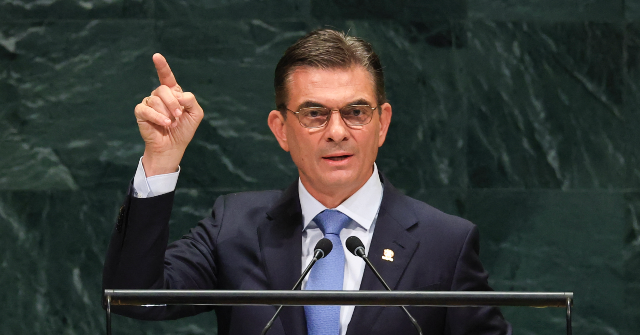
Bolivia’s President Rodrigo Paz used his first address before the United Nations General Assembly on Thursday to deliver a blunt indictment of the socialist movement that governed his country for two decades, arguing that ideology cannot feed a nation, according to reporting by Breitbart.
“Socialism and ideology don’t put food on the table,” Paz told the assembly. “What puts food on the table is employment, the development of our economies, and our production.”
The speech marked a striking debut on the world stage for Paz, a former moderate senator from Bolivia’s Christian Democratic Party who took office in November 2025. His victory ended twenty years of rule by the Movement Towards Socialism, or MAS, a period that began under Evo Morales and continued under his former ally-turned-rival, Luis Arce.
A Rapid Economic Turnaround
Central to Paz’s message was his claim that Bolivia’s finances have already begun to recover under his administration. He told the assembly that when he assumed office, the Bolivian Central Bank’s reserves had been “entirely liquidated,” leaving just $53 million in the nation’s coffers.
Ten months later, he said, reserves stand at close to $1.2 billion, with expectations of reaching nearly $4 billion by the end of the year. Paz projected that figure could climb to nearly $10 billion over the next 18 months.
“For many nations, that might not be much,” he said, “but, for Bolivia, it is a record, a milestone, a challenge, and a process of construction to build, strengthen our democracy, and to strengthen our productive model within the country.”
The Bolivian leader described a nation working to rebuild its economy and institutions after years of crisis, acknowledging that the country’s difficulties are “a reality that cannot be hidden.” He attributed those difficulties to what he characterized as two decades of ideological construction across the region, and said his government is now focused on restoring fuel supplies, putting “our house in order,” and rebuilding the trust of Bolivians.
Invoking Chavez and Morales
Paz drew a direct line between Bolivia’s troubles and a broader leftist movement on the continent, invoking two symbolic moments from 2006 at the same U.N. podium.
He recalled the late Venezuelan leader Hugo Chavez’s infamous declaration that the rostrum “smells like sulfur” after then-President George W. Bush had spoken, describing it as part of “an ideological political line that was being built upon by another leader from my nation” — a reference to Morales, who famously displayed a coca leaf during his own 2006 U.N. address.
Without naming Morales, Paz displayed a coca leaf of his own and said his predecessor had turned the plant — an ancestral element of Bolivian indigenous culture and also the raw ingredient for cocaine — into “a betrayal of a nation’s construction, development, and vision for progress.”
“They said that they were socialists,” Paz said of Chavez and Morales.
Bolivia, he noted, was once a significant power in gas, hydrocarbons, and mining, but now finds itself negotiating with multilateral institutions and foreign nations out of economic necessity. By contrast, Paz said he campaigned on a platform of “capitalism for all” and has begun the work of drawing investment and financial capacity back into the country.
His remarks came as he touted his administration’s immediate restoration of diplomatic relations with the United States — ties that Morales had unilaterally severed early in his rule. Under Morales and Arce, Bolivia had moved toward closer alignment with Venezuela, Cuba, Nicaragua, and Iran; Paz has instead pledged friendly relations with Washington and the free nations of the region.
Open for Investment, on Bolivia’s Terms
The Bolivian president said his country is fighting to overcome its crises and become a producer and exporter once more, and that it seeks investment, employment, technology, and resources. He stressed a desire to integrate Bolivia into the global economy while preserving “something that no economic growth can replace, and that is its people, its territory, and its extraordinary biological diversity.”
Paz also signaled openness to partnerships on critical minerals such as copper and lithium, but with a caveat: Bolivia should not be treated merely as a source of raw materials. He described the approach as a “responsible” one, suggesting his government wants extraction to come with broader economic development rather than simply exporting unprocessed resources.
Bolivia’s lithium reserves are among the world’s largest, making the country a potential focal point for global supply chains as demand for battery minerals grows — a dynamic Paz appeared eager to leverage, on different terms than his predecessors.
A Message to the World’s Youth
Paz also used the address to speak directly to a broader theme, telling the assembly that all U.N. member states have an obligation to give their young people purpose and meaning, “the very reason for being.” He said his government is working to ensure that young Bolivians, despite the country’s hard times, have a future worth building.
Paz opened his address by describing Bolivia as a nation that has known poverty but also the meaning of work, and one that has weathered economic and political crises without losing sight of “the hope of building a better life.”
He closed with a defiant declaration: “We never give in. Long live the homeland, damn it, long live Bolivia.”
The speech positions Paz as one of the most vocal critics of the socialist governments that dominated South America earlier this century, and as a leader betting that market-oriented reforms and closer Western ties can turn Bolivia’s fortunes around. Whether the reserve figures and investment pledges translate into durable recovery will be the central test of his presidency.
Source: www.breitbart.com — https://www.breitbart.com/latin-america/2026/09/24/bolivias-rodrigo-paz-at-u-n-socialism-doesnt-put-food-on-the-table/