
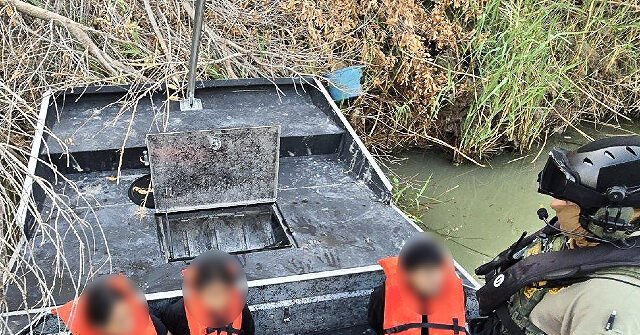
On August 29, just after sunrise, Border Patrol agents patrolling the Rio Grande near Laredo, Texas, spotted a group of six people attempting to cross the river into the United States. Within minutes, one of them was struggling to keep his head above the swift, murky water — and agents rushed to pull him out just before he disappeared under the surface for good.
The rescue unfolded around 7:30 a.m. when agents aboard a U.S. Border Patrol marine vessel observed the group fording the river near Laredo. According to the agency, one member of the group was repeatedly submerging and appeared unable to stay afloat in the strong current.
Agents noted in their report that the unidentified man went underwater for several seconds on multiple occasions as he fought to reach the U.S. bank. The marine unit closed in, reached him, and hauled him from the water — seconds, by all accounts, before he could drown.
Once on board, Border Patrol emergency medical technicians evaluated the man and administered first aid. He was then transferred to Laredo Sector agents for processing and removal, officials said. The other five people in the group were also taken into custody and processed for removal under standard procedure.
“This rescue is a reminder of how dangerous the Rio Grande can be and how quickly an attempted crossing can become a life-threatening emergency,” said Laredo Sector Chief Patrol Agent Desi De Leon in a statement. “Our agents have a duty to enforce the law and secure the border, but they also have a responsibility to protect human life. When someone is in distress, our agents act quickly.”
The incident comes despite what Border Patrol and outside analysts describe as the most fortified and difficult border environment in U.S. history. Crossings have plummeted by more than 90 percent in monthly numbers since President Trump returned to office in 2025, compared with averages during the previous administration.
But as the near-drowning illustrates, the danger hasn’t vanished — even if the sheer volume of attempts has collapsed.
Rescues Down More Than 96% From Peak Years
The sharp decline in crossings has been matched by a corresponding drop in water rescues. U.S. Customs and Border Protection data show that in fiscal year 2023 — the height of the border crisis — agents conducted more than 37,000 rescues along the Southwest border. In fiscal year 2026, from October through July, that number was just 1,128 — a decrease of more than 96 percent.
The Laredo rescue fits a broader pattern: fewer people are attempting to cross, but those who do are often taking greater risks in remote or treacherous areas. The Rio Grande, which remains one of the deadliest stretches of the U.S.-Mexico border, is known for quick-changing currents and depths that can overwhelm even strong swimmers.
In 2023, at the peak of record crossings, the United Nations declared the entire U.S.-Mexico boundary the deadliest land border in the world. The statement highlighted not just drownings but also deaths from heat exposure, falls, and other hazards.
Agents Face Dual Mission: Enforce, Protect
For the Border Patrol’s Laredo Sector Marine Unit, the August 29 rescue was a routine part of a dangerous job. The agents’ primary mission is to prevent illegal entry, but they are also trained to become first responders when a crossing turns deadly.
De Leon highlighted that duality in his statement. “Our agents act quickly,” he said, underscoring that the Border Patrol’s first priority in an emergency is to save a life — even if that life belongs to someone who was breaking U.S. immigration law.
The agency does not release the identities of people rescued or arrested during such incidents, citing privacy and operational concerns. The man’s nationality, age, and specific condition after treatment were not disclosed.
The other five individuals were processed for removal, according to the agency, which said they were handled “in accordance with applicable law and policy.”
Border Patrol officials continue to warn that the Rio Grande is unforgiving. Currents can shift in seconds, the riverbed is uneven, and fatigue sets in fast when a person tries to swim or wade across while carrying belongings. Even in areas that appear calm from the surface, conditions below can be lethal.
The rescue near Laredo is a reminder that the human cost of illegal crossings remains high — even as the political debate over border policy shifts to how to handle the lower numbers.
Randy Clark is a retired Border Patrol agent who writes for Breitbart Texas.
Source: www.breitbart.com — https://www.breitbart.com/border/2026/09/09/exclusive-border-patrol-rescues-drowning-illegal-alien-determined-to-enter-united-states/