
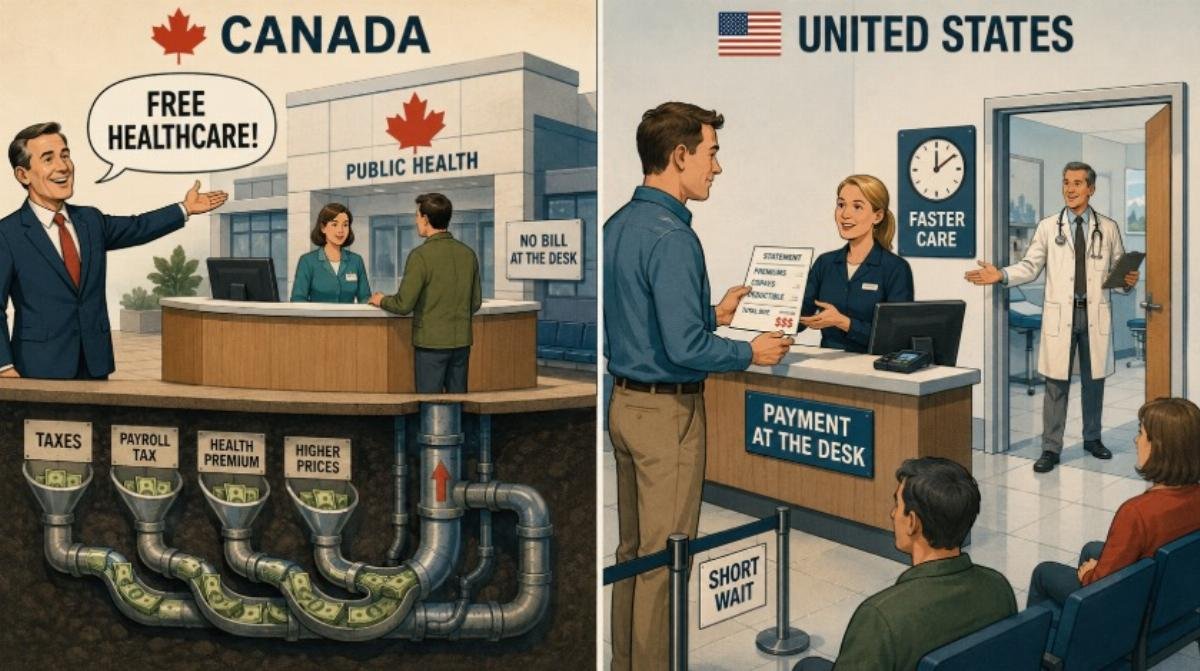
The notion that Canada offers “free” healthcare has become a centerpiece of progressive political rhetoric in the United States, particularly among Democratic Socialist advocates who point to the Canadian system as a model worth emulating. But according to a new analysis published in American Thinker, that characterization fundamentally misrepresents how the system actually works—and what it actually costs.
The analysis, written by Christian Vezilj, argues that Canadian healthcare is far from free. Instead, it operates as what he describes as a “government-controlled prepaid system” where costs are embedded in layers of taxation rather than presented as direct medical bills. According to the piece, most middle-income Canadians contribute between $400 and $800 annually through various healthcare-related taxes and premiums, in addition to bearing indirect costs through higher consumer prices.
The Mechanics Behind the Curtain
The illusion of free care, Vezilj contends, stems from a simple fact: Canadians don’t receive a bill when they visit the doctor. This absence of point-of-service payment creates a powerful perception that healthcare costs nothing. But the reality, he argues, is that the funding simply arrives through different channels—federal transfers, provincial taxes, employer payroll levies, and individual health premiums.
One significant component is the Employer Health Tax, a payroll tax that businesses must pay based on total employee compensation. In provinces like Manitoba and Quebec, according to the analysis, this tax can exceed four percent of payroll. While levied on employers, these costs don’t simply disappear into corporate balance sheets. Instead, businesses pass them along through higher prices for goods and services, reduced wages, or slower hiring.
“Canadians may not see a healthcare bill,” Vezilj writes, “but they pay for healthcare every time they buy groceries, fill their gas tank, or purchase consumer goods whose prices have quietly risen to absorb payroll taxes.”
Beyond these indirect mechanisms, Canadians also contribute directly through provincial health premiums. Ontario, for instance, includes a “Health Premium” on tax returns that can reach up to $900 annually depending on income level. Other provinces embed healthcare funding within general income tax brackets, meaning portions of every paycheck flow into the healthcare system without being explicitly labeled as healthcare expenses.
What “Universal” Actually Covers
Even the term “universal” requires qualification, the analysis argues. Canada’s public healthcare system covers medically necessary physician and hospital services, but it doesn’t extend to prescription drugs outside hospitals, dental care, vision care, physiotherapy, mental health counseling, or numerous other ancillary medical services. For these, Canadians must pay out of pocket or purchase private insurance—just as Americans do.
“A Canadian needing glasses, dental work, or regular medications faces the same financial reality as an American: these services cost money, and the consumer pays out of pocket,” Vezilj notes. This gap in coverage, he argues, further undermines the narrative of comprehensively “free” healthcare.
Comparing Systems: Control and Transparency
The fundamental difference between the Canadian and American systems, according to this analysis, isn’t whether they require payment—both do—but rather who controls the money and how visible those payments are to consumers.
In the United States, most Americans pay monthly insurance premiums, deductibles, and copays that are itemized and visible. They see healthcare deductions on their paychecks and watch money leave their bank accounts for medical expenses. This transparency creates what Vezilj describes as a “perception of cost” that Canadians don’t experience, even though both systems are fundamentally prepaid.
The U.S. operates through a mixed-market model dominated by private insurance companies, while government programs like Medicare and Medicaid serve specific populations through payroll taxes and federal spending. Americans generally see these payments, whether through FICA deductions or visible budget allocations.
In Canada, by contrast, the government collects, allocates, and distributes all healthcare funding. The analysis frames this as a question of trust and control: “Who do you trust more to run your medical system, the government or private companies?”
The Trade-off: Speed Versus Universality
Advocates of government-run healthcare argue that public control ensures fairness and universal access, while critics contend it leads to inefficiency, extended wait times, and reduced innovation. Supporters of private insurance argue that competition drives quality and speed; critics counter that profit motives can produce inequity and inflated costs.
According to Vezilj’s analysis, one distinction remains clear in outcomes: Americans generally receive faster, more immediate care. The U.S. system, he argues, offers quicker access to specialists, shorter wait times for surgeries, and more rapid diagnostic testing. Canada’s government-constrained system, by comparison, often requires patients to wait weeks or months for non-urgent procedures.
“This is the tradeoff inherent in government-controlled healthcare: universality comes at the cost of speed,” the analysis states.
Political Implications
As Democratic Socialist policies gain traction in American political discourse, the Canadian healthcare model has become a frequent reference point. Proponents frame healthcare as a human right and point to Canada’s universal coverage as proof that an alternative to America’s market-based system is both feasible and desirable.
But Vezilj’s analysis challenges this narrative by questioning the premise itself. He argues that the comparison between systems is often based on a false dichotomy: free versus costly. In reality, he contends, both systems are costly—the difference lies in how those costs are collected, distributed, and perceived.
“There is no such thing as free,” he writes. “Someone must pay.”
The piece concludes by asserting that despite its acknowledged flaws, the American system delivers “better, faster care with access to the world’s most advanced technologies”—a claim that positions speed and innovation as the decisive factors in evaluating healthcare systems.
As healthcare policy continues to be a defining issue in American politics, analyses like this one contribute to an ongoing debate about trade-offs: between government control and market competition, between universal access and rapid service, between visible costs and hidden taxes. The question of which system serves its population better may ultimately depend on which values—equity or efficiency, universality or speed—a society prioritizes most.
Source: www.americanthinker.com — https://www.americanthinker.com/articles/2026/07/canada-the-illusion-of-free-healthcare/