
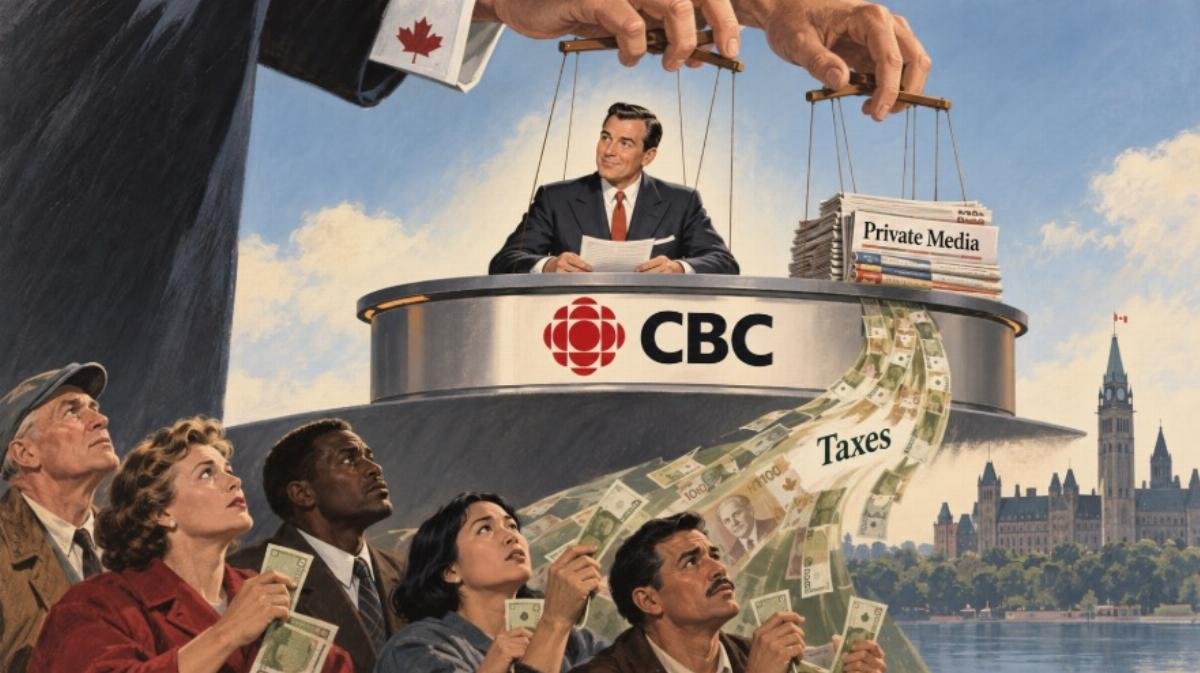
Canada has long presented itself as a country with a robust, independent press—one willing to scrutinize its government and hold power to account. But according to Kris Larsen, writing in American Thinker, that self-image collapses under the weight of a simple fact: the government is paying the bills for a substantial chunk of the country’s news media.
The result, Larsen argues, is an unavoidable conflict of interest. When the people journalists are supposed to scrutinize also fund their salaries—directly or indirectly—the editorial independence they claim becomes hard to take seriously.
The Scale of the Funding
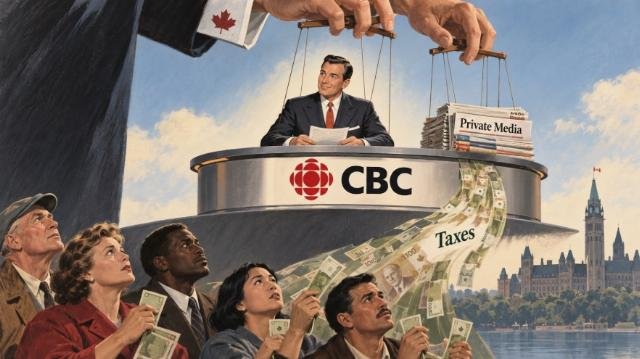
At the center of the arrangement is the Canadian Broadcasting Corporation, a Crown corporation owned by the Canadian government. Officially, it operates with some of the trappings of a private company, but that was only ever the intent. In practice, Larsen notes, the CBC runs on somewhere between $1.3 billion and $1.6 billion in Canadian taxpayer money annually—depending on which figures one consults. That money flows to the broadcaster whether or not it has ever been watched, listened to, or liked by the citizens funding it.
The CBC is hardly the only beneficiary. Larsen writes that the federal government also subsidizes several ostensibly private-sector television operations—CTV and Global among them—along with radio, online, and print outlets. That list includes the Globe and Mail and the Toronto Star, two papers widely regarded as Canada’s papers of record. The combined annual total for those subsidies comes to at least $230 million, and Larsen suggests the true figure may be substantially higher.
A Structural Conflict, Not a Conspiracy
The objection Larsen raises isn’t principally about any individual journalist’s integrity. It’s about incentives. News organizations are supposed to follow the truth wherever it leads, including into uncomfortable territory for the government that funds them. When that same government is paying salaries, the relationship starts to resemble something closer to a bribe than a healthy arms-length transaction, Larsen argues.
Editors and reporters may be reluctant to criticize the state under those conditions—not because they’ve been ordered to hold back, but because they fear for their jobs. That fear, whether conscious or not, increases the odds of incubating what amounts to a state media that instinctively supports, runs interference for, and propagandizes on behalf of the government. Larsen concedes that many in Canadian journalism may genuinely believe what they’re putting out; the dynamic doesn’t require anyone to be a cynic.
The Outlets That Take No Money
There are exceptions, and Larsen names them. The Epoch Times’ Canadian weekly edition takes no government funding, he writes, nor do conservative online outlets such as Blacklock’s Reporter, The Rebel, and Juno, or podcasters like Jasmine Laine and David Krayden. Because they aren’t on the government’s payroll, Larsen argues, they are less prone to aiding and abetting state propaganda.
To be fair, Larsen anticipates the obvious counterargument: fully private outlets are still dependent on someone—subscribers, donors, advertisers. Aren’t they just at the mercy of their advertisers or owners, in the same way state-funded outlets are at the mercy of the government?
He acknowledges the parallel might hold to a point. But he contends there’s a crucial distinction between the two arrangements. A purely private outlet has no captive membership. It can’t force all taxpayers to support it whether they like it or not. Readers who value what a private outlet produces subscribe or donate; those who don’t care for it simply walk away. The market, in the broadest sense, decides whether the outlet survives or fails.
The Fiscal Argument
Larsen’s argument rests on principle but also on arithmetic. Canada’s federal government, he notes, is running a debt north of $1.3 trillion. Something has to give. Selling the CBC to private interests and ending subsidies to other outlets would be a reasonable starting point for cuts.
He also pushes back on the reflexive defense that defunding would doom Canadian journalism. There will always be demand for news and entertainment, he writes, with or without government money. Media outlets are businesses. Some won’t survive without a government crutch, and they’ll close the way any business that can’t make a go of it closes. Others will thrive. Many will simply muddle through. The point, in his telling, is to let a consumer-driven market sort out the winners and losers instead of having the government pick them.
The Broader Stakes
Writing for the American conservative outlet, Larsen frames the issue as bigger than media economics. Now more than ever, he writes, the ability to speak one’s mind is crucial. The piece closes with an appeal to readers to support American Thinker financially, framing its own subscription and donation model as the alternative to the arrangement he’s criticizing.
Whether one agrees with Larsen’s prescriptions or not, the underlying tension he identifies is real and not unique to Canada. Public broadcasting and press subsidies exist across many democracies, justified as protections against market failure and as guarantees of quality public-interest journalism. The counterargument—that a press funded by the state cannot credibly serve as a check on the state—is at least as old as public broadcasting itself.
What Larsen adds to that long-running debate is a set of numbers: a broadcaster costing Canadian taxpayers up to $1.6 billion a year, and at least $230 million more flowing to nominally private newsrooms, including the country’s most influential newspapers. For advocates of an unsubsidized, consumer-funded press, that’s the figure they’ll point to. For defenders of the current system, it’s the figure they’ll have to explain away.
Source: www.americanthinker.com — https://www.americanthinker.com/blog/2026/09/there-s-nothing-independent-about-most-canadian-media-outlets/