
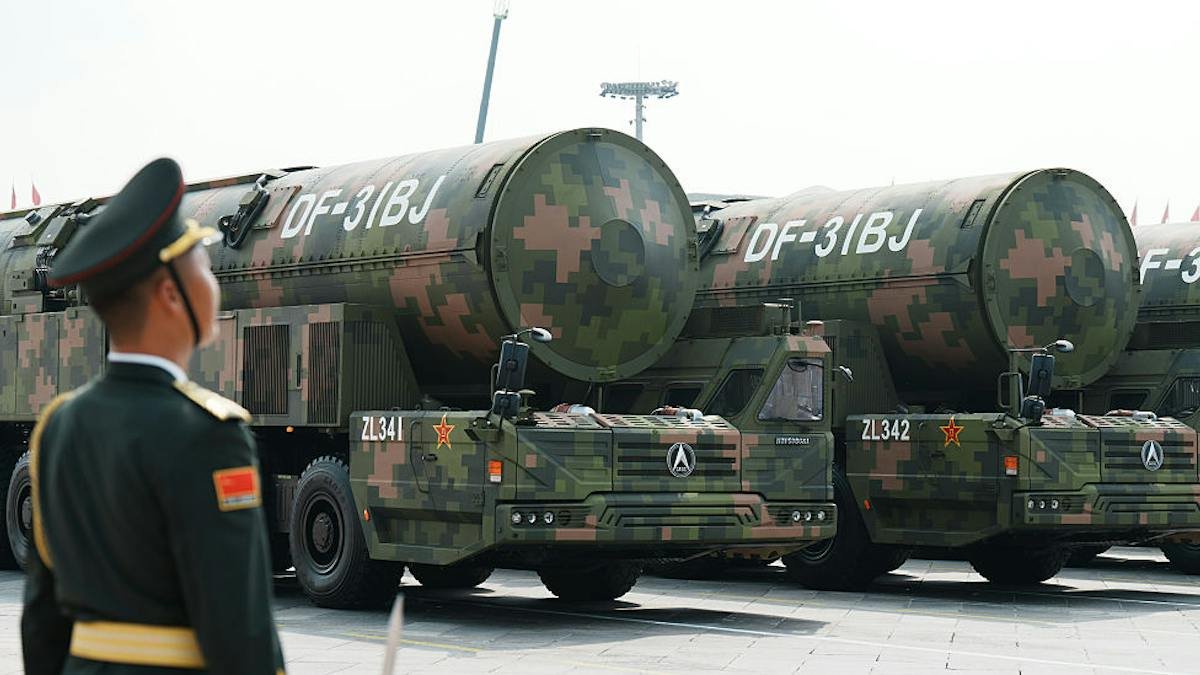
Satellite imagery has uncovered active construction at seven nuclear sites and testing areas across China, suggesting the country is quietly accelerating its nuclear production. According to an investigation published by The Telegraph on Wednesday, the sites — Pingtong, Zitong, Lop Nur, Jiuquan, Mianyang, Jinta, and Guangyuan — are undergoing rapid expansion. In at least one location, Chinese villages and farms have reportedly been demolished to make way for a facility where scientists use high-powered lasers to test how materials react under nuclear bomb conditions.
The discovery comes amid heightened tensions between Washington and Beijing over nuclear transparency. Earlier this year, the United States confronted China about a reported “secret nuclear test” conducted in 2020. In response, Chinese ambassador Shen Jian accused the United States of fueling an arms race. “China notes that the U.S. continues in its statement to hype up the so-called China nuclear threat. China firmly opposes such false narratives,” Shen said, adding that the United States “is the culprit for the aggravation of the arms race.”
U.S. Under Secretary of State for Arms Control and International Security Thomas DiNanno countered that China deliberately sought to hide its testing activities. “China sought to conceal testing by obfuscating the nuclear explosions because it recognized these tests violate test ban commitments,” DiNanno said. He also pointed to China’s use of “decoupling,” a technique designed to weaken seismic monitoring, to prevent the world from detecting its activities.
Despite its expanding arsenal, China maintains a strict “no-first-use” nuclear weapons policy, pledging never to be the first to deploy a nuclear weapon under any circumstances. As of 2026, China holds approximately 600 nuclear warheads, according to official estimates — far behind Russia’s roughly 5,500 and the United States’ approximately 5,300. However, China’s stockpile has more than doubled under President Xi Jinping, and the current construction boom suggests that trajectory is set to continue.

China’s nuclear program dates back to the 1950s, when it received assistance from the Soviet Union. The country tested its first nuclear weapon on October 16, 1964, and has since developed a comprehensive nuclear triad. The recent satellite evidence indicates that Beijing is now investing heavily in modernizing and expanding that infrastructure.
The timing is significant. President Xi is scheduled to meet with President Donald Trump in Washington, D.C., on Thursday. While the two leaders are expected to discuss artificial intelligence — which Trump has recently termed “super intelligence” — it remains unclear whether nuclear weapons will be on the agenda. AI has become increasingly intertwined with national security and military competition, making it a likely topic of conversation.

The United States has repeatedly urged China to join a major nuclear arms agreement. Trump has floated the idea of bringing China into the bilateral deal between the United States and Russia. Originally, only the U.S. and Russia were parties to the START I treaty, signed in 1991, which committed both countries to cutting and limiting their nuclear arsenals. Former President Barack Obama signed the “New START Treaty” with Russia after the previous agreement expired in 2009. That treaty expired in February, leaving no formal arms control framework between the world’s two largest nuclear powers.
At a conference in Geneva earlier this year, DiNanno argued that a bilateral treaty is no longer sufficient. “Today, the United States faces threats from multiple nuclear powers. In short, a bilateral treaty with only one nuclear power is simply inappropriate in 2026 and going forward,” he said.
China, however, has signaled reluctance to participate in trilateral negotiations. Ambassador Shen indicated that China’s smaller nuclear stockpile makes it unlikely to join talks with the U.S. and Russia on equal footing. “In this new era, we hope the U.S. will abandon Cold War thinking … and embrace common and cooperative security,” he said.
The satellite findings, combined with the allegations of secret testing, are likely to intensify pressure on the Trump administration to address China’s nuclear buildup. As the Xi-Trump meeting approaches, the question of whether nuclear arms control will be discussed — or remain on the back burner — looms large. For now, the imagery suggests that China is not waiting for diplomacy to catch up.
Source: www.dailywire.com — https://www.dailywire.com/news/china-is-secretly-throwing-its-nuke-production-into-overdrive