
China’s Commerce Ministry responded sharply this week to a joint U.S. government advisory accusing Chinese artificial intelligence companies of running “aggressive” and “malicious” campaigns to steal American technology, dismissing the allegations as “groundless” and warning that Beijing will take “resolute countermeasures” if Washington uses the distillation issue as a pretext to suppress Chinese firms.
The advisory, issued Tuesday by the FBI, the National Security Agency, and the Cybersecurity and Infrastructure Security Agency, according to Breitbart News, alleges that Chinese companies are “targeting U.S. AI companies to systematically extract proprietary models through knowledge distillation campaigns” — efforts the advisory says operate with the full blessing of the Chinese government.
What Distillation Actually Means
Distillation is a technique in which a more capable AI system is used to train a weaker one. The “teacher” is a frontier model — a cutting-edge system built through enormous investment of time, money, and computing power. The “student” is a smaller, more limited model that does not attempt to replicate the full capabilities of its teacher but instead learns to reproduce specific aspects of its knowledge and behavior.
Regular interaction with a frontier model can give a student model the opportunity to deduce and duplicate the teacher’s painstakingly designed and tested algorithms. The technique is a legitimate and widely used development method for new AI designs, but it can also be abused as a form of industrial espionage — comparable, in one common analogy, to spying on a master chef to copy private recipes he developed over years of effort.
A Familiar Dispute, Now Escalated by Washington
The U.S. advisory names the same Chinese companies that Anthropic flagged in a February security report. Anthropic accused DeepSeek, Moonshot, and MiniMax of waging “industrial-scale campaigns” to “illicitly extract” capabilities from Claude, its flagship product, alleging that the labs generated more than 16 million exchanges with Claude through roughly 24,000 fraudulent accounts in violation of Anthropic’s terms of service and regional access restrictions.
Anthropic’s report also warned that illicitly copied models may reproduce some capabilities of frontier systems while lacking the “necessary safeguards” to prevent dangerous abuse, including the creation of weapons or the conduct of cyber-espionage.
The FBI, NSA, and CISA advisory echoes those concerns and names the same firms plus several others. According to the advisory, the Chinese companies have “extracted billions of tokens across millions of exchanges/requests from U.S. frontier AI models, including variants of Claude, GPT, Gemini, and Grok, since at least late 2024.”
“The distillation tactics used by China-based AI companies violate the U.S. companies’ terms of service and shorten AI research development for the China-based companies, undermining fair competition,” the advisory states.
Beijing’s Pushback
The Chinese Commerce Ministry rejected the American concerns outright, calling them “groundless” and accusing the United States in turn of attempting to establish a “monopoly of the AI industry.” The ministry argued that distillation is a “common practice” and characterized the U.S. position as driven by unreasonable “anxiety” and “double standards.”
“If the U.S. suppresses Chinese AI companies under the pretext of targeting distillation, China will take resolute countermeasures,” the ministry warned.
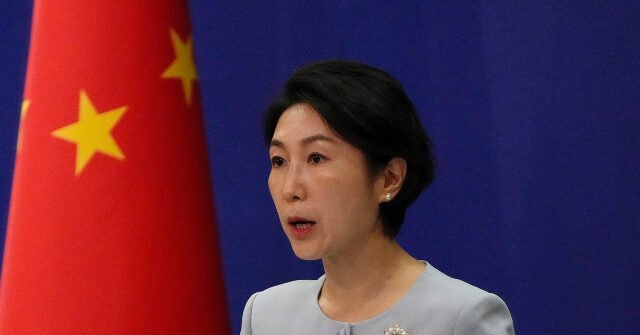
Speaking on Wednesday, Chinese Foreign Ministry spokeswoman Mao Ning attributed China’s advances in AI to what she described as “greater self-reliance and strength in science and technology,” saying the progress is “fueled by China’s vision of extensive consultation and joint contribution for shared benefit and commitment to open cooperation.”
“We hope the U.S. side will earnestly act on the important common understandings reached between the two presidents and stop leveling false allegations to smear China,” Mao said.
Stakes Beyond a Single Industry
The exchange marks a further escalation in the technology rivalry between Washington and Beijing, placing the mechanics of AI model development — not just export controls or chip restrictions — at the center of the dispute. American officials have now formally aligned three of the government’s top security agencies behind the claim that Chinese firms are harvesting capabilities from U.S. frontier models at scale, while Chinese officials have framed the same accusations as a protectionist maneuver designed to preserve American dominance in the sector.
Neither side has signaled a willingness to back down. The Commerce Ministry’s threat of “resolute countermeasures” leaves open what form any Chinese response might take, and the advisory from the U.S. agencies does not specify penalties for the named companies. For now, the disagreement remains as much about definitions — whether distillation campaigns constitute ordinary practice or industrial espionage — as it does about the technology itself.
Source: www.breitbart.com — https://www.breitbart.com/national-security/2026/09/10/china-pushes-back-against-american-allegations-malicious-ai-theft/