
The judge’s mistrial declaration in the Lindsay Clancy case was barely a week old when members of the hung jury began talking to the press. What they said has now become a political argument in its own right, with The Federalist framing the panel’s own words as evidence that the jury room was shaped by activism rather than evidence.
Clancy stood accused of strangling her three young children. The trial ended without a verdict, and jurors have since described a divided panel and a single holdout who would not vote to acquit by reason of insanity.

Jurors describe a divided room
According to The Federalist, several of the female jurors who spoke to media outlets said the holdout was one of the three men on the panel. Juror Paula Devlin, in a televised interview, told host Gayle King that the man who refused to vote not guilty by reason of insanity is black. King’s reaction — a pause and a comment that she would have to sit with that — drew attention online.
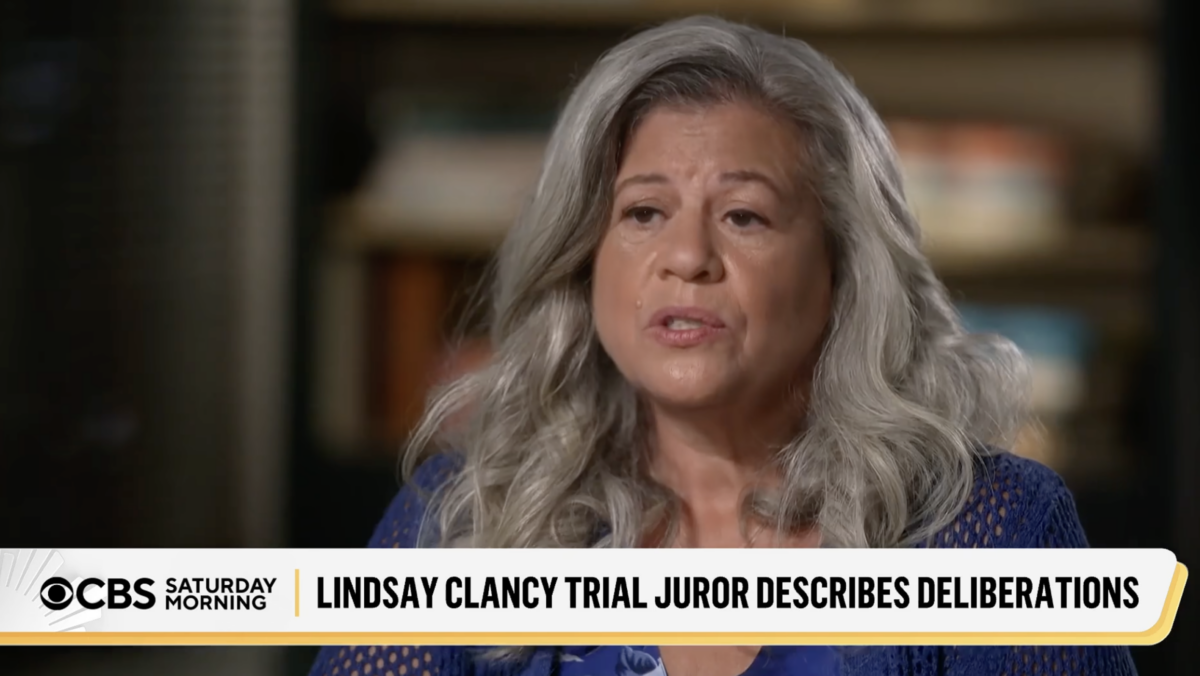
In a subsequent appearance on CBS Saturday Morning, Devlin described the jury’s mindset in broader terms. She said the panel saw its work as a chance to “change something to make it better for other women in the future, for other families,” per The Federalist’s account. Devlin also said the jury “didn’t know what was going on outside of our little bubble,” while acknowledging the jurors understood their verdict could amount to “a turning point.”

The Federalist notes that social change is not part of a jury’s charge. Jurors take an oath to remain impartial and are instructed to decide cases solely on the evidence presented in court. For the outlet, Devlin’s comments suggest at least some jurors arrived with an agenda.
The outside-expertise question
The Federalist’s account goes further, pointing to other jurors’ admissions that they leaned on outside expertise to pressure the holdout into agreement. That dynamic, the outlet argues, allowed a majority to move past the undisputed fact that Clancy killed her children. Those claims come from the outlet’s characterization of juror statements; the piece does not detail precisely which outside material was used or how it was introduced.

The article places those juror comments inside a much longer political frame. It argues that for decades Democrats have marketed soft-on-crime policies under euphemisms like “justice system reform,” and it ties that messaging to what it describes as a culture in which courts — and now juries — are treated as venues for activism rather than rule-of-law decision-making.
In that telling, repeated political and media claims that police are abusive, that judges and juries routinely get it wrong, and that bail and jail are racist have eroded public faith in the system itself. The Federalist singles out women as especially susceptible to what it calls progressive pro-crime messaging, invoking Black Lives Matter and arguing that online outrage among affluent white female liberals can escalate into real-world consequences.
A victim narrative, and a hero complex
The outlet traces Devlin’s apparent view of the case to a broader victim mentality it says has been reinforced through corporate and social media. It cites details that surfaced at trial — an “it’s a wonderful life” sign in Clancy’s home and the suggestion that she may have acted out of a distorted sense of love — as the kind of context that can pull jurors away from the facts of the killings. The piece closes by arguing that deliberations driven by solidarity and sympathy, rather than evidence, represent a hero complex that will keep eroding the integrity of the legal system.
The Federalist’s argument is opinion writing built on juror interviews, and its framing is contested terrain. Defense attorneys and mental-health advocates argue that insanity defenses require exactly the kind of context the outlet dismisses, and that jurors weighing intent and mental state are doing the work the law asks of them. What is not disputed is that the trial ended without a verdict, and that the jurors’ public comments have turned a criminal case into a flashpoint in the national argument over crime, punishment, and who the justice system is for.
Clancy’s case now returns to a system that has already shown it could not reach consensus once, with the public record of what jurors said about their own deliberations likely to follow any retrial. The Federalist’s conclusion is blunt: facts, not feelings, were supposed to decide the case, and in its view they did not.
Source: thefederalist.com — https://thefederalist.com/2026/09/14/lindsay-clancys-activist-jury-is-a-consequence-of-democrats-soft-on-crime-creep/