
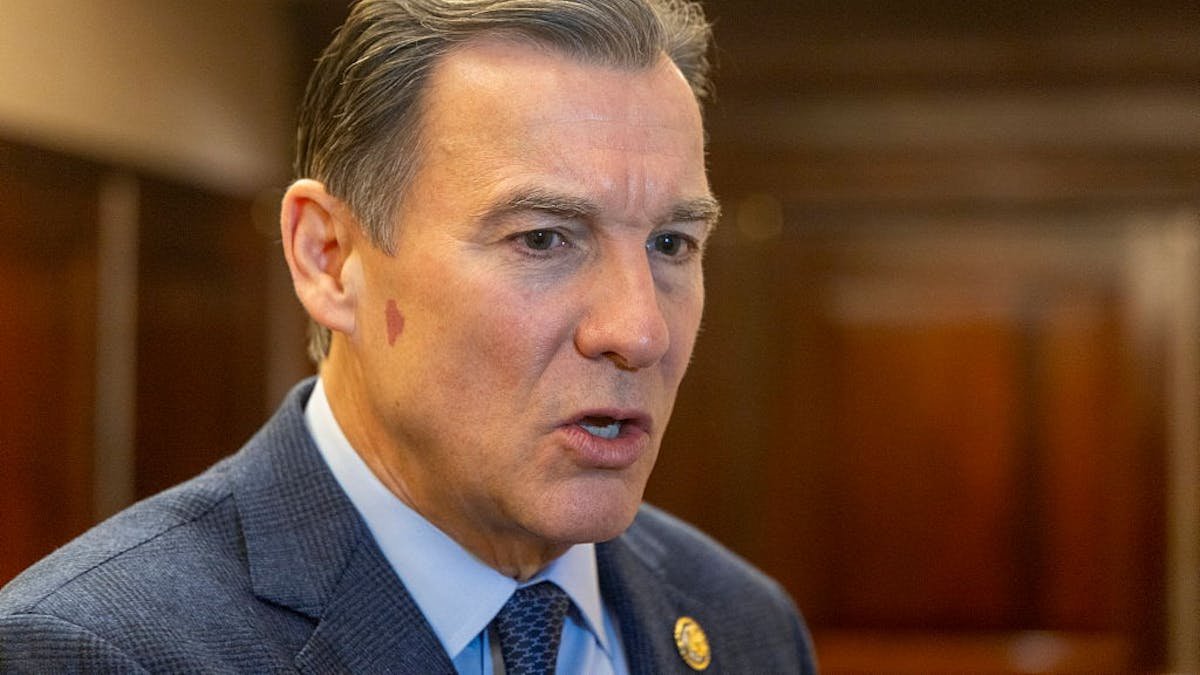
Rep. Tom Suozzi (D-NY) has emerged as a vocal advocate for China’s persecuted Uyghur population, co-chairing a congressional caucus dedicated to the issue and sponsoring multiple pieces of legislation targeting human rights abuses. Yet financial disclosure reports reveal the congressman simultaneously invested in Chinese companies that have faced allegations of connections to Uyghur surveillance and forced labor.
The investments, documented in congressional financial disclosures, include stakes in NIO, a Chinese electric vehicle manufacturer, and Baidu, a search engine company that drew criticism over facial recognition technology patents. The timing of these trades overlapped with Suozzi’s public advocacy on behalf of the Uyghur minority.
Uyghur Advocacy and Legislation
Suozzi’s engagement with Uyghur issues dates to March 2020, when he co-sponsored the Uyghur Forced Labor Prevention Act. President Joe Biden later signed the legislation into law. More recently, Suozzi co-sponsored the Uyghur Genocide Accountability and Sanctions Act of 2025.
In 2024, Suozzi assumed the role of co-chair for the bipartisan Congressional Uyghur Caucus. At the caucus relaunch, he delivered remarks condemning the Chinese Communist Party’s treatment of the predominantly Muslim, Turkic-speaking ethnic minority in northwest China’s Xinjiang region.
“What’s happening to Uyghur Muslims in Xinjiang should shock everyone’s conscience,” Suozzi stated at the time. “The CCP is brutally and systemically trying to destroy the Uyghur people with mass internment camps, forced labor, sexual abuse, and forced sterilization. We cannot shy away from this. We must shine a light on these atrocities.”
Investment Timeline
According to The Daily Wire, which reviewed congressional financial disclosure reports, Suozzi purchased NIO stock on two occasions in 2020. The first transaction, valued between $1,001 and $15,000, occurred on September 2, 2020. A larger purchase followed on October 5, 2020, with a disclosed value between $15,001 and $50,000. Suozzi sold between $15,001 and $50,000 worth of NIO stock on May 20, 2021.
NIO has faced scrutiny regarding potential links between its supply chains and Uyghur forced labor, though the company has not been subject to formal U.S. sanctions or import restrictions under the Uyghur Forced Labor Prevention Act.
Suozzi’s investments also included Baidu, the Chinese technology company that became controversial after a patent application described facial recognition technology capable of identifying individuals by ethnicity, including Uyghurs. When confronted with the patent, Baidu issued a statement claiming it “never developed or permitted its technology to profile any ethnic group” and asserting the patent did not represent the “expected implementation of the invention.” Suozzi sold his Baidu holdings, valued between $15,001 and $50,000, in 2017.
Broader Trading Activity
The Chinese company investments represent a fraction of Suozzi’s overall stock trading activity. Since joining Congress, the New York Democrat has reported 671 individual stock transactions with a combined disclosed trading volume of approximately $20.9 million.
Suozzi is among roughly half of current members of Congress who report trading individual stocks. The practice has drawn increasing criticism from ethics watchdogs and reform advocates who argue that lawmakers’ access to sensitive information creates potential conflicts of interest and opportunities for insider trading.
Push for Stock Trading Restrictions
The debate over congressional stock trading has gained momentum in recent years. Rep. Bryan Steil (R-WI) introduced the Stop Insider Trading Act earlier this year, proposing significant restrictions on lawmakers’ ability to trade individual securities.
Under Steil’s proposed legislation, members of Congress would be prohibited from purchasing individual stocks during their tenure in office. Any sales of existing holdings would require at least seven days’ advance notice before execution. The bill represents one of several recent attempts to curtail or eliminate stock trading by sitting lawmakers.
Previous efforts to restrict congressional stock trading have garnered bipartisan support in principle but have repeatedly stalled amid disagreements over implementation details and the scope of restrictions. Some proposals would require lawmakers to place assets in blind trusts, while others would mandate divestment from individual stocks entirely.
The Uyghurs have been subject to what human rights organizations and several governments, including the United States, have characterized as systematic persecution by Chinese authorities. Reports from international observers describe extensive detention facilities, forced labor programs, surveillance networks, and reproductive controls targeting the ethnic minority. Beijing has consistently denied accusations of human rights abuses, characterizing its policies in Xinjiang as counterterrorism and vocational training initiatives.
Suozzi’s office has not publicly addressed questions regarding the apparent tension between his advocacy work and his investment portfolio.
Source: www.dailywire.com — https://www.dailywire.com/news/this-democrat-spoke-out-against-chinas-abuses-then-came-these-investments