
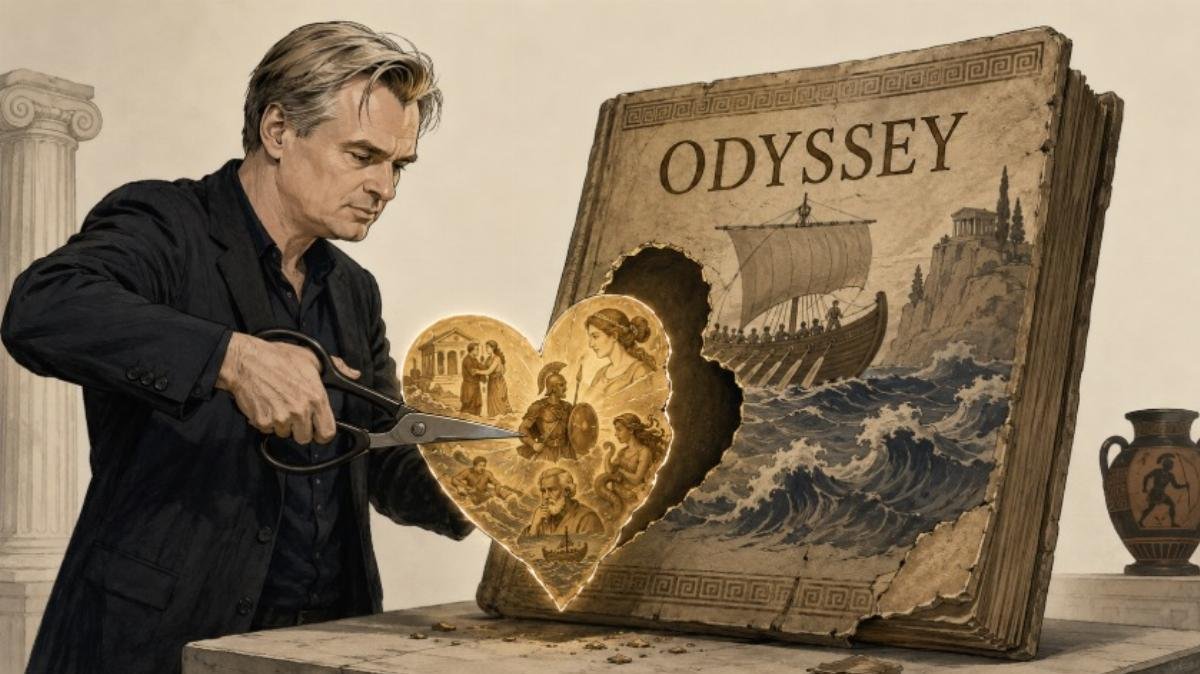
Christopher Nolan’s recently released film adaptation of Homer’s The Odyssey has sparked fierce debate, with conservative commentator Huck Davenport delivering what may be the harshest assessment yet. Writing in American Thinker, Davenport argues that the acclaimed director hasn’t merely adapted the ancient Greek epic—he has fundamentally corrupted it, replacing timeless moral lessons with what the critic characterizes as contemporary weakness and guilt.
According to Davenport, the film’s commercial success stems not from artistic merit but from cultural ignorance. “The only reason Nolan’s Odyssey is winning praise at the box office is that we stopped teaching the Classics a hundred years ago, and with it, education itself,” he writes, suggesting that audiences lack the classical education needed to recognize how drastically the source material has been altered.
Rewriting the Sack of Ismarus
The critique begins with one of the earliest episodes in Odysseus’s journey. In Nolan’s version, according to Davenport, Odysseus arrives at Ismarus seeking only provisions and questions why the inhabitants have fled. This portrayal, the reviewer argues, bears little resemblance to Homer’s original account, in which Odysseus deliberately attacks the city—an ally of Troy—for revenge, killing its men and taking women and wealth as plunder.
In Homer’s telling, disaster strikes not from the initial violence but from indiscipline: Odysseus’s men refuse his order to leave immediately, instead feasting drunkenly on their spoils until reinforcements arrive and inflict heavy casualties. Davenport sees this as a crucial lesson about how “greedy indulgence destroys discipline,” transforming victory into defeat. Nolan’s reframing, he suggests, offers instead a lesson to “never fear the stranger on your shore”—a pointed political commentary on immigration debates embedded in his criticism.
The Missing Lotus-Eaters
The review notes that Nolan entirely omits the episode of the Lotus-Eaters, in which some of Odysseus’s crew consume a narcotic flower that makes them forget their desire to return home. In Homer’s version, Odysseus forcibly drags them back to the ship and binds them, an uncompromising rejection of false contentment through oblivion. Davenport argues this omission is significant—though he notes Nolan later repurposes the lotus to serve a different narrative purpose that undermines “one of the most dramatic choices in literary history.”
Cyclops Without Consequences
While praising Nolan’s handling of the Cyclops episode as “quite well” done, Davenport identifies two crucial omissions. The first is Odysseus’s famous trick of calling himself “Nobody,” which causes the blinded Cyclops’s neighbors to dismiss his cries for help as divine madness—a celebrated demonstration of cunning intelligence.
More significant, according to the review, is the removal of what follows: Odysseus’s hubristic decision to reveal his true identity despite his men’s pleas for silence, taunting the Cyclops with his name and lineage. This act of pride prompts the Cyclops—revealed to be Poseidon’s son—to pray for divine vengeance, setting in motion the suffering that defines the rest of the epic. Davenport describes this as “the turning point in the epic,” teaching that “cunning without self-control is incomplete” and that “hubris can destroy everything that discipline and intelligence have achieved.”
A Different Underworld
The critique takes particular issue with Nolan’s reimagining of Odysseus’s visit to the underworld. In Homer, Odysseus encounters Achilles, who delivers one of the epic’s most powerful statements: he would rather be the lowliest living servant than rule over all the dead. This revelation comes from a hero who had chosen a short, glorious life over a long, obscure one—yet death has taught him that even the humblest mortal existence surpasses any form of death.
Nolan replaces this encounter with a meeting between Odysseus and Sinon, portrayed by Elliot Page. Davenport notes this constitutes a fundamental error: Sinon appears not in Homer’s Odyssey but in Virgil’s Aeneid, where he willingly deceives the Trojans about the wooden horse. In Nolan’s version, according to the review, Sinon rebukes Odysseus for this deception—essentially putting the hero’s defining act of strategic cunning on trial.
For Davenport, this substitution eliminates Homer’s affirmation that “life is a value greater than glory, power, and everlasting fame,” replacing it with an indictment of “Odysseus’s strategic cunning, the very essence of his heroism.”
Calypso Transformed
Perhaps the most extensive criticism concerns Nolan’s handling of Calypso’s island, which Davenport describes as erasing “one of the supreme affirmations of mortal human life in Western literature.”
In Homer’s original, Calypso holds Odysseus captive despite his longing for home. She offers him marriage to a goddess, eternal youth, immortality, safety, and paradise—acknowledging that she surpasses his wife Penelope in beauty. Odysseus concedes this point yet still chooses Penelope, consciously selecting mortality over immortality, danger over safety, an aging wife over an ageless goddess, and the imperfect reality of home over paradise.
According to Davenport, Nolan fundamentally reimagines this scenario. Odysseus becomes a traumatized veteran consuming lotus flowers to forget the war, while Calypso is transformed from captor to compassionate caregiver, helping rehabilitate a psychologically wounded man. The offer of immortality disappears entirely, along with Odysseus’s conscious choice. “Womanly compassion can heal the psychological scars of committing egregious war crimes,” Davenport summarizes as Nolan’s substitute lesson, his tone dripping with contempt.
The Missing Marriage Bed
The review’s final major complaint concerns the reunion between Odysseus and Penelope. In Homer, their relationship represents an intellectual union between equals—two individuals of extraordinary cunning, patience, and self-command. After twenty years apart, both proceed cautiously, with Penelope testing the stranger’s identity by ordering a servant to move their marriage bed.
Odysseus’s reaction confirms his identity: the bed cannot be moved because he built their bedroom around the living trunk of an ancient olive tree, a secret known only to the couple. For Homer, according to Davenport, this scene affirms that Odysseus’s choice of mortality is meaningful precisely because of this partnership—”a marriage rooted in shared memory, intelligence, loyalty, and identity.”
Nolan omits this test entirely. Instead, according to the review, his Odysseus laments the war and expresses doubt about his ability to rule. Rather than reclaiming his kingdom, Odysseus and Penelope depart, leaving their son Telemachus to govern—turning Homer’s restoration into what Davenport calls “renunciation.” The lesson he extracts: “The warrior must confess his guilt, surrender his authority, and depart in shame.”
Adaptation or Assault?
Davenport’s central argument is that Nolan has retained the superficial elements of Homer’s epic—the names, the voyage, the monsters, the spectacle—while systematically removing or inverting its moral core. Where Homer taught that intelligence must be governed by restraint, that pleasure without purpose leads to oblivion, that life exceeds glory in value, and that mortality shared with loved ones surpasses solitary immortality, Nolan allegedly offers different lessons entirely.
The reviewer characterizes these substitutions as replacing “discipline with trauma, cunning with guilt, captivity with caregiving, restoration with renunciation, and heroic self-command with therapeutic self-reproach.” In Davenport’s view, this represents not mere creative interpretation but a fundamental assault on the values embedded in one of Western civilization’s foundational texts.
“Nolan has not adapted Homer so much as replaced him,” Davenport concludes, recommending that audiences would do “far better to reread Homer than submit to Nolan’s toxic assault on Western civilization.”
The review reflects broader cultural debates about how—and whether—classical texts should be adapted for contemporary audiences. While some viewers and critics have praised Nolan’s film for making the ancient story feel relevant to modern sensibilities, Davenport’s assessment suggests that relevance achieved through fundamental transformation may constitute a betrayal rather than an adaptation. Whether one views Nolan’s creative choices as necessary modernization or cultural vandalism likely depends on one’s broader views about the relationship between contemporary values and classical tradition.
Source: www.americanthinker.com — https://www.americanthinker.com/articles/2026/07/the-odyssey-nolan-s-toxic-assault-on-western-civilization/