
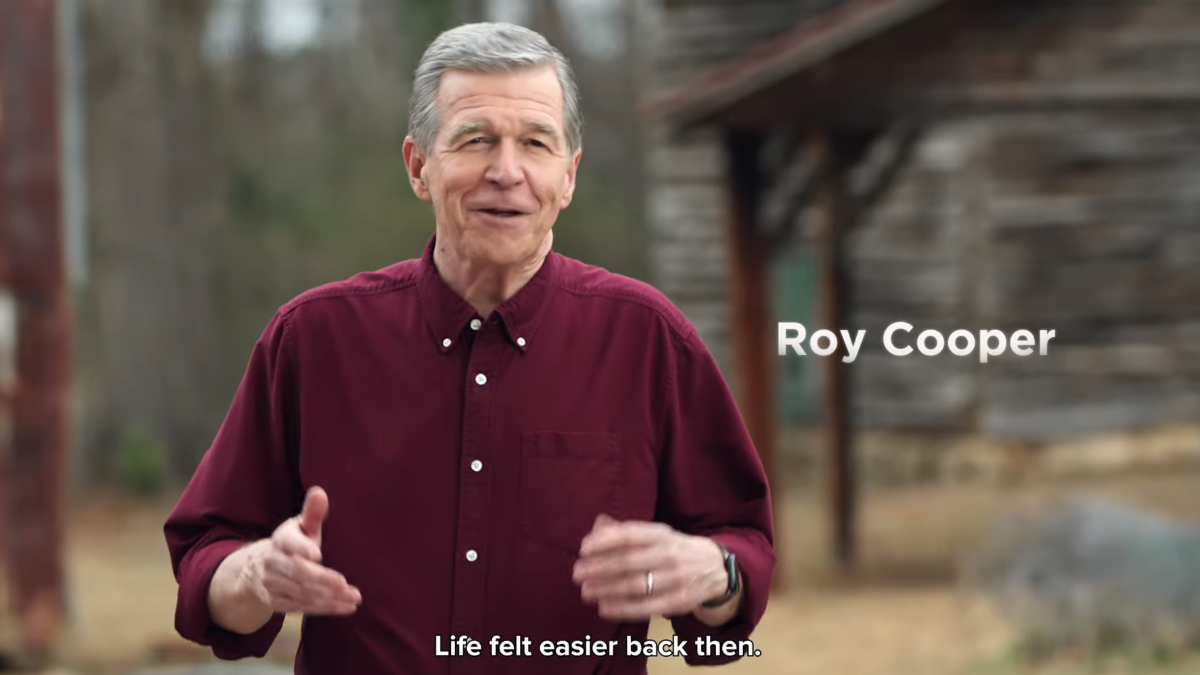
Roy Cooper’s U.S. Senate campaign in North Carolina is pulling out all the stops to cast the former governor as a moderate, small-town everyman. His opening ad features his parents—a teacher and a small-town lawyer-farmer—against a backdrop of church pews and high school football. The message is deliberate, echoing the ‘faith, family, and community’ theme he leaned on as governor.
At his launch event, held at a Raleigh brewery, the podium read ‘Make Stuff Cost Less,’ and a Wilson County tobacco farmer vouched for him. ‘I’m running to do something, not to be something,’ Cooper says. Political observers have taken note. Roll Call called him a ‘mainstream Southern Democrat,’ and The Bulwark highlighted his ‘folksy’ style. One Democratic strategist summed it up: Cooper built ‘a North Carolina Democratic brand, and that brand is not a national Democratic brand.’
But as Cooper tries to convince voters he’ll govern from the center in Washington, his record in Raleigh tells a different story—one that has some conservatives and even some centrists raising eyebrows. The Federalist’s analysis, which draws on public records and investigative reporting, suggests the gap between his campaign persona and his past actions may be wider than his ads suggest.

A Progressive Record in the Governor’s Mansion
Cooper’s governorship, which spanned from 2017 to 2025, was marked by several policy decisions that align more with the progressive wing of his party than with the moderate image he now projects. In 2023, he vetoed legislation that would have restricted gender-affirming care for minors. The move was celebrated by LGBTQ+ advocates but drew sharp criticism from social conservatives who saw it as a failure to protect children.
More controversially, his administration’s response to a COVID-era lawsuit by the ACLU led to the release of thousands of inmates from North Carolina prisons. The lawsuit challenged conditions during the pandemic. But a New York Post investigation later found that at least 18 of those released inmates were subsequently charged with murder, raising questions about public safety trade-offs.
These decisions, the Federalist argues, suggest Cooper governs to the left—even if he campaigns toward the center. ‘If he governed to the left in Raleigh, why would anyone believe he’ll govern to the center in Washington?’ the outlet asks.

The Biden Playbook
The article draws a comparison to President Joe Biden, who ran in 2020 as a folksy moderate from Scranton, only to govern, in the Federalist’s view, from the left. Under Biden, the administration ended the Remain in Mexico policy, paused border wall construction, and created a parole pipeline that admitted more than 530,000 migrants from just four countries. Border apprehensions hit a record of nearly 370,000 in a single month, and the refugee admissions cap was raised to 125,000 per year—the highest in nearly three decades.
The Biden Education Department also attempted to rewrite Title IX to include ‘gender identity’ as a protected category under federal sex-discrimination law, a move that was blocked in court. The Equal Employment Opportunity Commission issued guidance requiring men to have access to women’s bathrooms and mandating the use of ‘preferred’ pronouns in the workplace.
‘This is the work of San Francisco, not Scranton,’ the Federalist writes. The implication for Cooper is clear: campaign personas can be misleading, and once in office, party loyalty often trumps campaign rhetoric.

What a Senate Seat Would Mean
The stakes are high. If Cooper wins and helps Democrats secure a Senate majority, his voting record could tilt the balance on a range of issues—from immigration and education to workplace rights. The Federalist warns that voters should expect his record to reflect ‘Seattle more than Rocky Mount,’ regardless of his ads’ small-town imagery.
The article also points to other Democratic Senate candidates running in 2026 as evidence of a broader pattern. In Texas, James Talarico runs as a pastor but has said God is ‘nonbinary’ and ‘both masculine and feminine, and everything in between,’ and has credited Jesus with helping him ‘reckon with [his] own whiteness.’ He once touted a vegan campaign. In Michigan, Abdul El-Sayed projects a technocratic health-policy persona but has backed Medicare for All, called ICE ‘corrupted at its soul,’ and described Israel’s actions in Gaza as ‘genocide.’ In Maine, left-wing activists initially rallied around Graham Platner, who had a tattoo replicating Nazi iconography, until a sexual assault allegation forced him out; they’ve since regrouped around Troy Jackson, who twice led Bernie Sanders’ Maine presidential campaigns.
These examples, the Federalist suggests, highlight a disconnect between how some Democratic candidates present themselves and what they’ve actually stood for.
A Nice Guy—But What About Policy?
To be fair, the Federalist acknowledges that Cooper comes across as ‘a genuinely nice man.’ But the outlet’s central argument is that personal likability isn’t the issue—policy is. ‘There are a lot of people from San Francisco who hope that’s all the voters of North Carolina care about,’ the piece concludes, ‘because they have plans—and they need Roy Cooper to make their plans reality.’
Cooper’s campaign did not respond to requests for comment on the Federalist’s characterizations. The former governor’s record will likely be a central test in a race that could determine control of the Senate. For now, the question remains: Can a politician who vetoed parental-notification bills and released thousands of inmates convincingly sell himself as a moderate? North Carolina voters will have the final say.
Source: thefederalist.com — https://thefederalist.com/2026/09/04/roy-cooper-is-the-latest-dem-to-campaign-like-a-moderate-and-govern-like-a-socialist/