
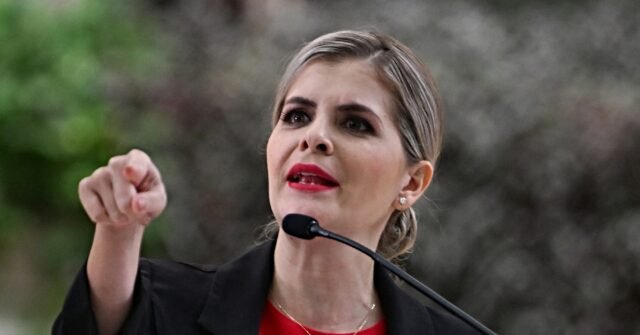
Costa Rican President Laura Fernández said Wednesday that potential U.S. ground operations on Costa Rican soil against international criminal organizations would be “very good” for the Central American nation’s security, while stressing that no such plans are currently being negotiated.
Speaking to Reuters at the presidential palace in San José, the conservative leader clarified that discussions about possible U.S. military cooperation were broached by her government earlier this year, when she was still president-elect. But she emphasized that any deployment would require approval from Costa Rica’s Congress.
“It would obviously be very good for national security if it were about pursuing a common objective against transnational crime, transnational drug trafficking, transnational terrorism,” Fernández told Reuters.
The Qatari news network Al Jazeera also published a video snippet of the interview with her remarks.
No Army, But a History of Cooperation
Costa Rica is one of the few countries in the world without a standing army, having abolished its military in 1949. Despite that, the country has historically cooperated closely with the United States in fighting organized crime across the region.
Fernández, a hard-line conservative who took office in May after a landslide electoral victory, has vowed to crack down on the country’s chronic violence, crime, and drug trafficking — aiming to replicate the success of El Salvador under President Nayib Bukele. In 2023, El Salvador recorded a homicide rate of 17.2 per 100,000 inhabitants, which was more than double the rate seen during the 2010s, though still a significant drop from previous highs.
Earlier this year, Fernández and her conservative predecessor and mentor, Rodrigo Chaves Robles, led Costa Rica into the U.S.-led Americas Counter Cartel Coalition (A3C), also known as the “Shield of the Americas.”
Since joining, other A3C members have deepened military ties with Washington. Colombia, for instance, has signed agreements allowing for possible joint strikes with the U.S. against narco-terrorist groups operating in its territory. Ecuador, another member, has participated in several joint operations — most recently helping dismantle a floating refueling station used by the deadly Los Choneros narco-terrorist organization.
Fernández’s comments suggest she is open to similar arrangements, but she stopped short of announcing any concrete proposal.
Shift on Emergency Powers
During the interview, Fernández reportedly said she is not considering asking Costa Rica’s Congress to declare a state of emergency or suspend civil liberties to tackle the country’s violent crime crisis — a reversal from positions floated during her campaign.
The president attributed her change in policy to new official data showing a steady decline in crime this year. According to Reuters, Costa Rican court data shows a 14 percent reduction in homicides in the first half of 2026 compared to the same period in 2025.
That trend, she suggested, has made extraordinary measures less necessary.
Standoff With the Judiciary
Fernández nonetheless finds herself in a tense standoff with the nation’s courts. She has accused the judiciary of being infiltrated by organized crime and of blocking some of her tougher security policies.
At the heart of the dispute is a series of sweeping budget cuts backed by Fernández that significantly reduce the judiciary’s funding.
“I’ve been very critical of how slow the courts are, very critical in specific cases where judges release convicted criminals long before their sentences are complete, and I’ve also been very critical of administrative failures and potential corruption in the judiciary,” she told Reuters.
Speaking during a Sunday address, Fernández defended the cuts, arguing that the current budget acts as a “straitjacket” on the government, locking in 93 percent of spending and leaving only 7 percent of flexibility. She reiterated that her administration has no plans to raise taxes or take on additional debt.
The combination of her tough-on-crime rhetoric, openness to U.S. military cooperation, and clash with the judiciary has positioned Fernández as one of the region’s most aggressive conservative leaders — even as she stops short of the emergency measures some of her counterparts have adopted.
Source: www.breitbart.com — https://www.breitbart.com/latin-america/2026/09/07/costa-rica-president-fernandez-says-u-s-ground-forces-would-help-national-security/