
The head of the nation’s largest credit union trade association is warning that a bipartisan bill aimed at reshaping the credit card market could leave consumers more exposed to fraud and data breaches, arguing that merchants would have little reason to adopt secure payment networks if the legislation becomes law.
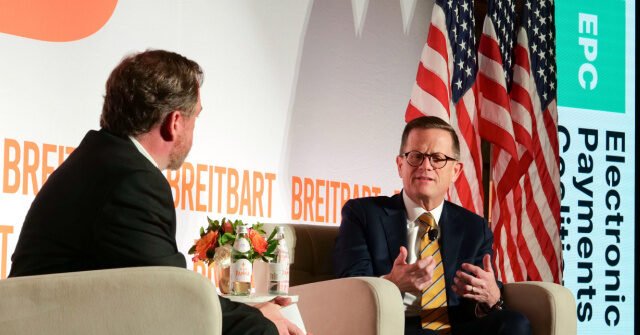
Scott Simpson, president and CEO of America’s Credit Unions, made the case during a Tuesday policy event in Washington, D.C., according to an exclusive interview with Breitbart News economy columnist John Carney. The event took place alongside Treasury Secretary Scott Bessent.
What the bill would do
The Credit Card Competition Act was first introduced by Sens. Dick Durbin (D-IL) and Roger Marshall (R-KS) in 2022 and reintroduced in January. The senators have argued the measure would “increase competition in the credit card market and put an end to the Visa-Mastercard duopoly.”
Under the current system, merchants who accept credit cards are locked into whatever payment network a given card runs on and pay whatever fee that network charges. Visa and Mastercard together control more than 80 percent of the market.
If enacted, the CCCA would require banks holding more than $100 billion in assets to offer merchants a choice of at least two networks for processing a credit transaction — one of which could not be Visa or Mastercard.
The bill’s original cosponsors included then-Sen. JD Vance (R-OH), along with Sens. Peter Welch (D-VT), Josh Hawley (R-MO), and Jack Reed (D-RI).
A dispute over who benefits
Supporters say the added competition would lower the operational costs merchants pay to accept Visa and Mastercard, savings they contend would be passed along to consumers. Opponents counter that retailers would simply pocket those savings, and that card companies could scale back rewards programs to offset lost revenue.
Critics have also pointed to security concerns, warning that merchants might route transactions through cheaper networks with weaker protections. That was the focus of Simpson’s remarks.
Carney raised the issue directly, telling Simpson that “a lot of people are worried about fraud and cybersecurity, and this could impact the ability of issuers to be able to, especially I think credit unions, but all issuers to be able to deal with fraud and cybersecurity.”
Simpson agreed, explaining that the interchange system exists to underwrite that protection. “Yeah, that’s what the interchange system is built for — is to establish contracts with the American consumers and reliable protection,” he said. “Well, that protection comes at the expense of the issuer.”
He then turned to the track record of major breaches, arguing that they tend to originate on the retail side rather than with card issuers. “We look at the biggest data breaches in the history of our country and they tend to come from retailers because they don’t have incentives,” Simpson said. “They’re not incentivized by the system to protect that data, and so it gives us zero confidence as issuers.”
The stakes for credit unions
Simpson’s comments reflect a broader anxiety within the credit union industry, whose members often operate on thinner margins than large national banks. Issuers absorb much of the cost of fraud detection, chargebacks, and cybersecurity, costs that are effectively funded through the interchange fees merchants pay on each transaction.
If that revenue stream were reduced — as the bill’s opponents expect — smaller issuers could find it harder to maintain the same level of fraud monitoring, the argument goes. Simpson framed the issue as one of incentives rather than capability, suggesting retailers have not faced the same pressure to safeguard customer data because the current system places much of that responsibility on issuers.
The legislation remains a live fight in Congress, with Durbin and Marshall continuing to press their case for injecting competition into a market long dominated by the two largest networks. The bill’s reintroduction in January revived a debate that has drawn in banks, credit unions, retailers, and card networks, each with a distinct stake in the outcome.
For now, Simpson’s message is that any overhaul should be weighed against the security infrastructure the current interchange model funds — and that merchants, not issuers, are the parties most likely to cut corners if given the option.
Source: www.breitbart.com — https://www.breitbart.com/economy/2026/09/09/exclusive-americas-credit-unions-president-scott-simpson-warns-of-less-secure-payment-systems-if-credit-card-competition-act-passes/