
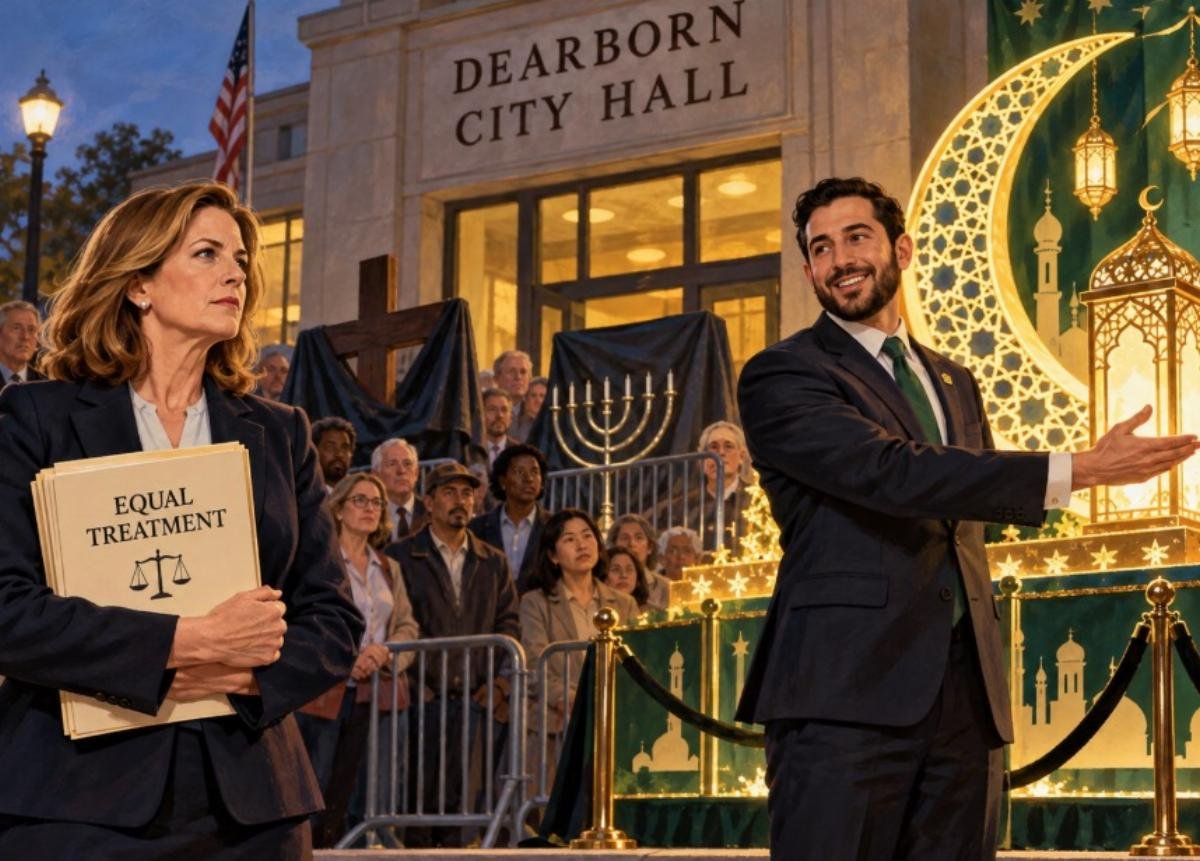
A new lawsuit against the City of Dearborn is putting a spotlight on a years-old conflict over how the municipality treats religious expression — and on whether its embrace of Ramadan has come at the cost of equal treatment for other faiths.
The American Freedom Law Center, a nonprofit legal organization, is pursuing the suit on behalf of Margot Cleveland, a Dearborn resident and Senior Legal Correspondent for The Federalist, according to an American Thinker editorial describing the case. The publication frames the litigation as the product of a simmering dispute that has divided the city for years.
The complaint alleges that Dearborn officials used public funds and city property to promote and celebrate Ramadan — the Islamic holy month of fasting — while declining Cleveland’s repeated requests that the city extend the same formal recognition to Christian and Jewish holidays. It further claims that Mayor Abdullah Hammoud and other city officials retaliated against Cleveland after she publicly questioned the disparity.
What Cleveland Says She’s Asking For
In comments to the American Thinker, Cleveland drew a line between the private exercise of religious belief and what she characterizes as state endorsement. She said she has no objection to people of faith observing their own traditions, and she emphasized that she is not seeking to strip Islamic religious expression from city life. What she wants, she said, is for Dearborn to comply with its constitutional obligation to treat all religious expression equally.
“I have a problem with people supporting or excusing terrorism and antisemitism and establishing a religion and discriminating against people of other faiths,” she said, describing the issue as one of government neutrality rather than opposition to Islam as a faith.
The editorial that first surfaced the lawsuit goes further in its framing, opening with a blunt assertion that Islam is not a pluralist faith. That claim reflects the publication’s own editorial stance, not the legal theory of the complaint itself, which rests on constitutional grounds rather than theological ones.
The Allegations in the Filing
According to the American Freedom Law Center, the lawsuit argues that Dearborn violated the First and Fourteenth Amendments, including the Establishment Clause, free-speech protections, and the equal-protection guarantee. The requested relief includes a declaration that the defendants violated Cleveland’s rights, an injunction, nominal damages, and related legal costs.
The editorial notes that Cleveland’s request for other religions to be permitted to put up displays for their own religious holidays went unanswered — a silence her lawyers cite as evidence of the city’s uneven approach.
The suit also points to the scale of city spending. In February 2026, according to the editorial, Dearborn expanded its Ramadan displays and the associated expenses, bringing the total to roughly $6,500. That figure is central to the argument that the city moved beyond mere acknowledgment of a holiday into active promotion at taxpayers’ expense.
A Longer History of Disputes
The litigation does not arrive in a vacuum. The editorial recounts a series of earlier legal clashes that it says established a pattern in Dearborn.
In 2011, the Sixth Circuit ruled that the city violated free-speech and religious-exercise protections by banning a pastor from distributing Christian pamphlets at Dearborn’s Arab festival. Two years later, the city paid $300,000 to settle similar claims after police arrested Christians for discussing Jesus at that same festival. In 2015, the Sixth Circuit again found that local government had unlawfully removed Christians from preaching to what the court characterized as a hostile crowd at the Arab festival — a ruling the en banc court treated as an impermissible heckler’s veto. In that matter, the surrounding county paid $200,000 in attorneys’ fees to the American Freedom Law Center.
Those outcomes, relayed in the editorial, form part of the backdrop the new complaint leans on as evidence that the current dispute is not an isolated incident.
The editorial also revisits a public exchange between Hammoud and a pastor, Ted Barham, who had questioned the city’s decision to rename a street after Osama Siblani, the publisher of the Arab American News. According to video of the meeting cited by the publication, Hammoud responded by calling Barham a “bigot,” a “racist,” and an “Islamophobe,” telling him that although he lives in the city, he is “not welcome here,” and adding that the day Barham moved out would be the day the mayor launched a parade celebrating his departure.
Siblani, per the editorial, was a known supporter of Hamas and Hezbollah — a characterization the publication presents as part of its broader case that city leadership has aligned itself with figures hostile to other faith communities.
Where the Case Goes From Here
Whether the suit gains traction remains an open question, and the editorial concludes on a note of skepticism rather than prediction, observing that it remains to be seen whether the complaint “falls on deaf ears once again.”
For Dearborn, the stakes extend beyond a single filing. The city has one of the largest Arab American populations in the country, and its approach to religious observance has been litigated repeatedly over more than a decade. Each round has ended with the courts reaffirming limits on how far a municipality can go in regulating — or endorsing — religious expression in public spaces.
Cleveland’s case, if it proceeds, will test whether the city’s Ramadan programming crosses the same constitutional line the Sixth Circuit drew in the Arab festival disputes, or whether it falls within the discretion courts typically afford local governments in marking cultural and religious occasions. The answer will likely turn on how a judge weighs the roughly $6,500 in public expenditures and the city’s silence on parallel requests from Christian and Jewish residents against the Establishment Clause’s demand for neutrality among faiths.
For now, the lawsuit stands as the latest chapter in a long-running argument over what equal treatment means in a city whose religious demographics have changed dramatically — and over who gets to decide.
Source: www.americanthinker.com — https://www.americanthinker.com/blog/2026/09/city-of-dearborn-sued-for-favoring-islam/