

Median wages for full-time middle-class workers have grown faster, after inflation, under Donald Trump than under other recent presidents, according to an analysis published by American Thinker and drawn from Federal Reserve data.
The piece, co-authored by Howard Richman and Jesse Richman, uses the Fed’s series on “Median usual weekly earnings: Wage and salary workers: 16 years and over” to compare inflation-adjusted annual gains across administrations. The authors argue median figures are the right lens for this question, since half of workers earn less and half earn more, meaning the measure isn’t pulled upward by a handful of very large salaries at the top.
The methodology is straightforward: for each presidency, the authors take the quarterly wage reading for the three months ending in April of the year the president took office, and compare it with the reading for the three months ending in April of the year they left. For the current Trump term, only one year of data is available — the authors note the reading for the three months ending in July 2026 had not yet been published at the time of writing.
What the comparison shows — and its limits
The headline claim is that real median wage and salary growth has been stronger during Trump’s time in office than under the other recent presidents in the comparison window. That is the central finding the authors present, illustrated by a chart built from the Fed series.

The one-year window for the second Trump term is the obvious caveat, and the authors acknowledge it directly rather than burying it. A single year of quarterly readings is a narrow base for a presidential comparison, and their own methodology would ordinarily run through the April of a president’s final year in office. The current-term number remains incomplete.
To shore up the case that the trend has legs, the authors point to the Bureau of Labor Statistics’ monthly jobs report for August, released September 4. They describe the results as striking, citing National Economic Council Director Kevin Hassett’s characterization that the figures came in four standard deviations above economists’ expectations. According to the piece, the number of people working rose sharply — up by 162,000 — with gains spread across multiple job categories.
That jobs report, in the authors’ framing, is evidence that the elevated demand for workers visible in the wage data through April has continued in the months since. It’s a reasonable inferential move — hiring strength and wage pressure tend to move together — but it is an inference, not a direct wage measurement. The Fed’s own readings for the intervening months simply weren’t available yet.
The argument behind the numbers
The Richmans go beyond the chart to offer reasons why they believe middle-class wage growth has been stronger under Trump. Their argument is that Trump’s policy mix is oriented toward people who earn their living through wages and salaries rather than through other forms of income, and that this orientation shows up in the median numbers.

The authors also suggest a political feedback loop: that many middle-class Americans recognize the wage gains and respond at the ballot box. That’s a claim about voter behavior rather than an economic one, and it rests on the authors’ interpretation rather than on survey data presented in the piece.
It’s worth noting what kind of document this is. American Thinker is an opinion outlet, and this is a signed commentary by two authors with a clearly stated point of view — not a neutral statistical bulletin. Howard Richman and Jesse Richman have collaborated on two books, “Balanced Trade” (Lexington Books, 2014) and “Trading Away Our Future” (Ideal Taxes Association, 2008), and their prior work has focused on trade policy and its effects on American workers. That background shapes the questions they ask of the data.
Why median wage data matters in this debate
The choice of median rather than mean earnings is the analytical heart of the piece, and it’s a defensible one. Average wage figures can be distorted by a relatively small number of very high earners, which can make broad-based pay growth look stronger or weaker than what a typical worker actually experiences. The median — the worker in the exact middle of the distribution — is a cleaner read on the middle class specifically.
Using inflation-adjusted figures matters just as much. Nominal wage growth is nearly always positive over a presidential term; the real question is whether paychecks are outpacing prices. By measuring gains after subtracting for inflation, the authors are attempting to isolate purchasing-power improvements rather than raw dollar increases.
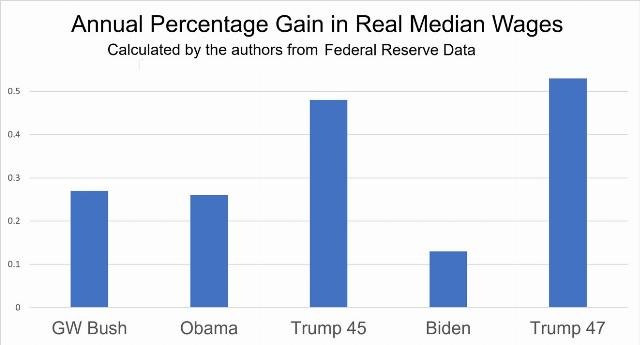
The comparison across presidencies also carries an inherent limitation that applies to any such analysis: presidents inherit economies, and the timing of a term can matter enormously. A president taking office near the trough of a recession will often post strong wage growth simply because the recovery was already underway. A president taking office near a peak may post weaker numbers for the same structural reason. The Richmans’ piece doesn’t attempt to control for business-cycle positioning, and their chart presents the results as a straightforward comparison across administrations.
There’s also the question of what else was happening during each period — monetary policy, energy prices, global supply conditions, immigration and labor force participation. Wage growth is a downstream outcome shaped by many forces, only some of which run through the White House. The authors’ argument is essentially that the correlation is meaningful and that the policy explanation is the most plausible one. Readers inclined to agree will find the pattern persuasive; readers inclined to skepticism will want to see controls the piece doesn’t provide.
The bottom line
What the source actually establishes is narrower than the headline might suggest. Federal Reserve data on median usual weekly earnings, adjusted for inflation, show stronger annual gains during Trump’s terms than during the other recent presidencies included in the comparison — with the important exception that the second Trump term is measured over just one year, and the authors say so themselves.
A strong August jobs report, with payrolls up 162,000 and Hassett calling the results four standard deviations above expectations, is offered as corroborating evidence that the labor market momentum behind those wage gains has persisted past the last available Fed reading.
The rest — the explanations, the emphasis on wage-earners over other income groups, the suggestion of electoral reciprocity — is argument rather than data. That’s not a flaw in the piece so much as a description of what it is: a case made by two authors who have spent years arguing that American workers’ economic interests deserve more attention than they typically get. Whether the Fed’s numbers prove the case or merely happen to be consistent with it is the question readers will have to weigh for themselves.
Source: www.americanthinker.com — https://www.americanthinker.com/blog/2026/09/middle-class-wages-rise-faster-when-trump-is-president/