
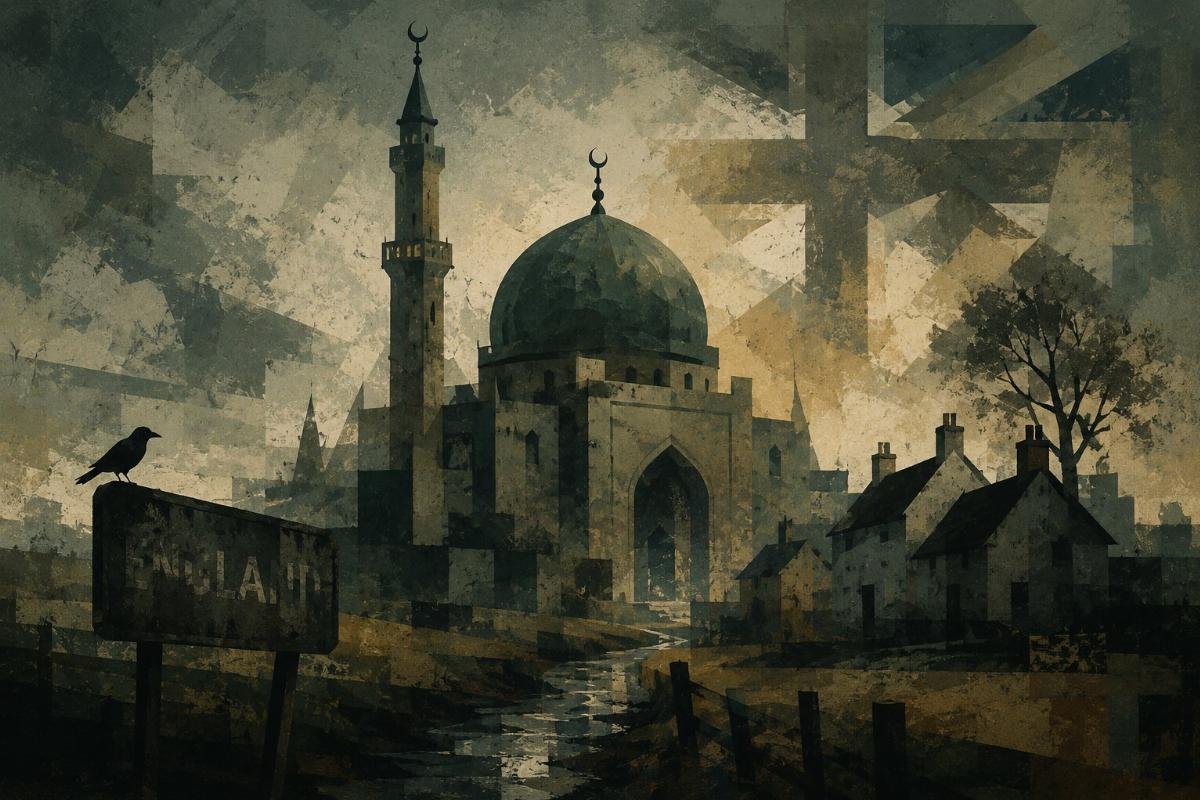
In a post that has ignited heated debate, conservative commentator Olivia Murray of American Thinker has highlighted what she calls a dramatic and troubling rise in the number of mosques in England over the past 75 years. According to her figures, England had roughly 5 mosques in 1950 and about 1,750 by 2026 — a 34,900% increase. Murray asks: “When will the left admit this is Islamic conquest?”
The post, shared on social media, includes a graphic that Murray says illustrates the growth: “England 1950: ~5 mosques, England 2026: ~1750 mosques. This is what an invasion looks like.”
Murray further argued that the increase is not merely about the number of buildings. She pointed to an incident in which worshippers prayed on the grounds of Westminster Abbey, one of the most sacred sites in the Anglican Church, despite London having more than 500 mosques. “Why?” she asked, implying that the choice to use a Christian site was deliberate and provocative.
Her commentary also drew on a map from the Institute for Remigration, which reportedly shows migration patterns into Europe since 2008, with each dot representing 100 illegal migrants. Murray described this as “an invasion and it must be stopped.”
While Murray’s post has found resonance among some readers who share her concerns about immigration and cultural change, it has also drawn sharp criticism from those who argue that her framing is exaggerated and misleading. Critics point out that the raw percentage increase from a very small base number (5) makes the growth appear more dramatic than it might otherwise seem, and that the number of mosques in England remains relatively small compared to the number of churches.
Religious demography in England has indeed shifted in recent decades, driven by immigration and higher birth rates among Muslim families, as well as conversions. However, scholars and interfaith groups have cautioned against interpreting such changes as a coordinated “conquest.” They note that the overwhelming majority of Muslims in the UK are peaceful citizens, and that modern Britain is a multi-faith society that accommodates a range of religious practices.
The Broader Context
Murray’s post is the latest in a series of commentaries that equate immigration with invasion. Her argument extends beyond mosques to a broader critique of Western immigration policies. She wrote: “Sure, these individuals might be fleeing from war and political persecution—which still isn’t a justification in my book for admission into the West—but more than that, they’re running from circumstances they created by their own culture, behavior, and values.”
She went on to describe political turmoil in some countries as “just a byproduct of a sh*t culture and people with low IQs who lack Western (Christian) morality, impulse control, and values of Western civility and democracy.” These comments have been condemned as racist and dehumanizing by many on the left and even some on the right who favor more measured rhetoric.
Murray also criticized what she called “leftards” and their immigration policies, calling them “criminal and frankly, genocidal.” But she extended that criticism to Republicans, sharing data that she said shows the eight fastest-growing H-1B visa districts in America are all held by Texas Republicans. “It’s not even the Democrats doing it here—it’s the Republicans. Can someone explain to me why I’m supposed to give them my vote in November?” she wrote.
Reactions and Implications
The post has sparked a flurry of responses on social media. Some users expressed agreement, sharing the “invasion” language. Others pushed back, pointing out that migration is a complex global phenomenon driven by a mix of factors including conflict, economic opportunity, and post-colonial ties. A common rebuttal is that the UK has a long history of welcoming migrants from former colonies, and that many of the “illegal migrants” referenced in the map Murray shared are asylum seekers, who have legal protections under international law.
Interfaith leaders in the UK have also weighed in. A spokesperson for the Church of England told a UK newspaper that Westminster Abbey is a place of prayer for all people, and that hosting worshippers of other faiths on its grounds is not a sign of conquest but of hospitality. “Our doors are open,” the spokesperson said.
The debate comes at a time when immigration is a top political issue in both the UK and the US. In the UK, recent governments have pledged to reduce net migration and crack down on illegal crossings of the English Channel. In the US, immigration remains a central issue in the 2026 midterm elections, with both parties jockeying for position.
Murray’s piece is unapologetically provocative, but it raises questions that many are asking: How should a nation balance its cultural heritage with the realities of a changing demographic landscape? Is the increase in mosques a sign of healthy pluralism or a threat to national identity? And when does legitimate concern cross the line into xenophobia?
For now, the answers remain as divided as the political landscape itself. What is clear is that the conversation—once fringe—is now part of the mainstream political discourse, for better or worse.
Source: www.americanthinker.com — https://www.americanthinker.com/blog/2026/08/in-the-last-75-years-england-saw-a-34-900-increase-in-mosques/