
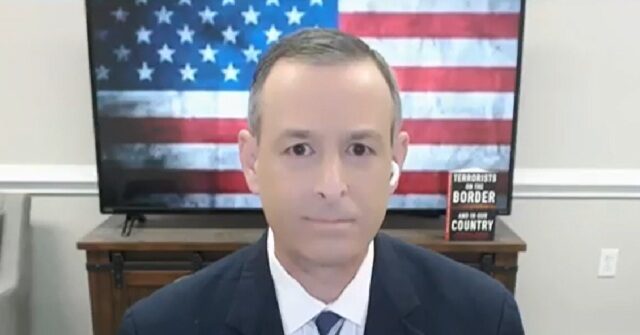
A former senior law enforcement adviser at the Department of Homeland Security is warning that the migrant crises on both sides of the Atlantic carry a threat that goes beyond the individuals who cross borders — the potential radicalization of people already living in host countries.
Charles Marino, who served as DHS Senior Law Enforcement Adviser during the Obama administration, made the argument Monday during an appearance on NewsNation’s “Morning in America,” according to a clip flagged by Breitbart News.
Marino said the flow of unvetted migrants into Europe and the United States doesn’t just introduce physical dangers. It also introduces what he described as ideological ones, and those can widen what security officials call the threat profile.
The ‘Threat Profile’ Argument
“Europe, as we have been experiencing here in the United States under the previous administrations, [has] been dealing with a significant migrant crisis,” Marino said. “And the reason why that is important is because many of the individuals, both Europe and here in the U.S., entered, they were unvetted, that is, we have no idea who they are.”
He continued: “And these are not just physical threats that entered the region. These are also ideological threats. And what that does is it expands the threat profile, Alex. It now includes those that are native to these areas and are susceptible to becoming radicalized for a number of reasons.”
The “Alex” reference was to the program’s host. The core of Marino’s claim is that the risk isn’t limited to a new arrival who might commit an attack — it extends to people who were born or raised in the host country and can be drawn toward extremist ideology, for reasons he did not enumerate in the clip.
Marino framed the concern as a long-standing one rather than a new discovery. “Well, it’s always been a worry, and we need to be prepared for this type of asymmetrical response from our adversaries, including Iran and their proxies,” he said.
He also said he believes the overall threat level in the United States has been elevated for some time, and that the agencies responsible for tracking it are on notice.
“I believe law enforcement and intelligence officials are aware of this and are paying close attention to this here at home,” Marino said.
Who Is Charles Marino
Marino’s résumé gives his comments some weight in the national security debate. As a senior law enforcement adviser at DHS during the Obama years, he worked inside the department whose components include Immigration and Customs Enforcement, Customs and Border Protection, and the intelligence and analysis office that tracks homeland threats.
His critique is notable coming from an alumnus of a Democratic administration, given that the broader immigration enforcement debate has been dominated by partisan disagreement. Marino’s argument in the clip was not framed around any particular administration’s border policy, but around the mechanics of vetting — or the absence of it.
A Europe-to-America Comparison
His remarks drew an explicit parallel between Europe’s experience and the situation in the United States. European countries have absorbed large numbers of migrants and asylum seekers over the past decade, and several have suffered high-profile attacks carried out by both recent arrivals and homegrown extremists — a pattern European security services have publicly described as a dual threat.
Marino’s point was that the same dynamic can take hold in the United States: an unvetted inflow creates a population about whom authorities have little information, and the presence and influence of that population can, in turn, contribute to the radicalization of people who never crossed a border at all.
It is a claim about indirect effects rather than direct causation, and Marino did not present specific data, cases, or intelligence assessments to support it during the segment. He described it instead as a structural vulnerability that demands preparation.
The segment arrives amid continuing national argument over border enforcement, asylum processing, and the capacity of federal agencies to screen people entering the country. Both supporters and critics of stricter immigration controls have clashed over how much weight to give vetting failures when assessing domestic terrorism risk.
Marino’s answer, at least on Monday’s broadcast, was that the concern is real and that the response has to be an intelligence and law enforcement one — detecting and disrupting plots before they mature, rather than assuming the threat is contained at the border.
He characterized the challenge as “asymmetrical,” a term security officials use for threats from non-state actors or proxies who avoid conventional military confrontation and instead exploit open societies.
A Debate That Cuts Both Ways
The radicalization argument is one that surfaces from multiple directions in the immigration debate. Some officials highlight it when arguing for stricter vetting and reduced inflows; others warn that stigmatizing migrant communities can itself damage the trust between those communities and law enforcement that is needed to detect real plots.
Marino did not address that tension in the clip. His focus was on what he sees as a gap in knowledge — people entering without vetting — and the second-order risk that follows from it.
What the segment reflects is a former senior homeland security official publicly stating that the threat calculation has shifted from a border-control question to a domestic radicalization question. Whether policymakers share that assessment, and what they propose to do about it, remains the subject of the ongoing fight over immigration policy in Washington.
Source: www.breitbart.com — https://www.breitbart.com/clips/2026/09/29/fmr-obama-dhs-adviser-migrant-crisis-in-europe-u-s-increases-risk-of-natives-being-radicalized/
Source: www.breitbart.com
Related coverage
- Feds Bust Sinaloa Cartel-Linked Drug Ring Run From Inside South Carolina Prisons
- Ohio Poll: Ramaswamy Trails Acton by 3 But 62% Expect Him to Win
- NYT: Seized Phone of Ilhan Omar’s Sister Reportedly Yielded Texts Used to Justify DC Home Raid
- Trump Admin Cracks Down on Deadbeat Dads, Recoups $7M in Child Support by Revoking Passports