
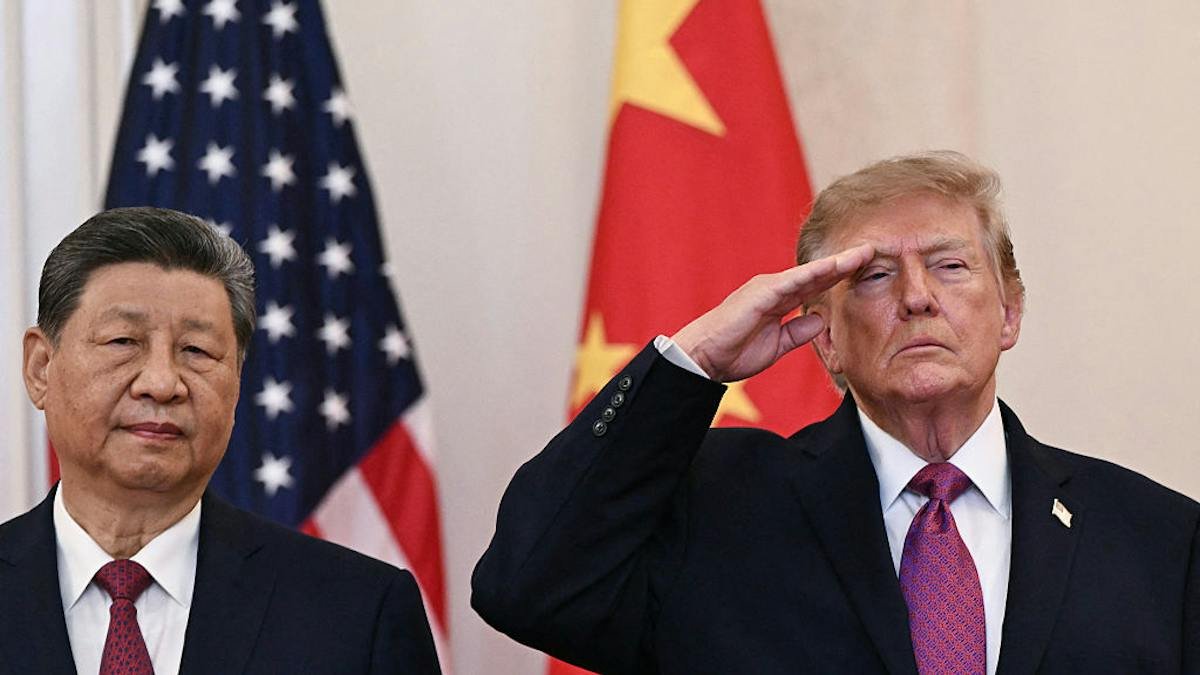
As President Donald Trump prepared for bilateral talks with Chinese leader Xi Jinping on trade and artificial intelligence, a former White House official who served as Deputy Assistant to the President and Senior Advisor on International Religious Freedom is publicly urging the administration to put political and religious prisoners at the top of the agenda.
Writing in The Daily Wire, Sarah E. Makin — who held the religious freedom post from 2017 to 2021 and now runs a Washington strategic advisory firm — argued that pressing Beijing on human rights is not a distraction from the trade and AI discussions, but a source of leverage in them.
“When America leads with our values instead of our shopping list, we set the terms,” Makin wrote, framing the release of detainees as a concrete concession the U.S. can demand rather than a symbolic gesture.
The case of Dr. Gulshan Abbas
At the center of Makin’s argument is Dr. Gulshan Abbas, a Uyghur-American physician who was detained in Xinjiang in 2018 — days after her sister, Rushan Abbas, spoke publicly in the United States. Makin describes that timing as deliberate, calling it “punishment aimed at an American family for using the First Amendment on American soil.”
Makin points to Dr. Abbas’s case as the clearest illustration of what she calls CCP transnational repression: a message that Chinese-American families who exercise free speech rights in the U.S. will see relatives in China pay the price. She noted that Dr. Abbas’s daughter, Ziba Murat, was a guest of House Speaker Mike Johnson at this year’s State of the Union address, while her mother remains imprisoned.
Makin argues the pattern amounts to a standing threat against Uyghur Americans and any U.S. citizen with loved ones across the Pacific, and that allowing it to continue with impunity weakens the First Amendment in practice, not just in principle.

A precedent for presidential pressure
Makin cites the release of Pastor Ezra Jin Mingri as evidence that direct presidential engagement works. In that case, she writes, Trump made a personal appeal and Xi responded — a win she says should be treated as a model rather than an isolated success.
She lists several more cases she says deserve the same urgency, including Pastor Wang Yi, reportedly serving a nine-year sentence for leading an unregistered church; the Panchen Lama, whose whereabouts have been unknown since childhood; and Zhou Deyong, a Falun Gong practitioner whose wife and son live in the United States. Makin acknowledges the list of political prisoners in China is far longer than those names suggest.
On Xinjiang, Makin repeats the widely documented allegations against Beijing: that millions of Uyghur Muslims have been held in internment camps described by Chinese authorities as reeducation facilities, and that detainees have faced forced sterilizations and abortions, forced labor, and denial of medical care. Beijing has consistently rejected such characterizations and denies operating camps or pursuing policies aimed at Uyghurs.

Why the meeting matters, even if it doesn’t end the camps
Makin does not claim a single bilateral meeting will resolve the situation. Her argument is more modest: that the talks can place the issue squarely on the record, press for the release of political prisoners, and establish that trade and AI cooperation cannot be decoupled from Beijing’s human rights record.
She grounds the case in a broader historical claim — that religion is typically the first target of authoritarian governments, because controlling belief and conscience precedes broader abuses. She invokes Nazi Germany and the Soviet Union as examples of totalitarian regimes that moved against people of faith before committing atrocities, and argues the same dehumanization tactics are playing out in China today.
Makin also ties her position to the American founding, invoking the First Amendment’s placement of religious freedom ahead of speech, press, assembly, and petition, and quoting Thomas Jefferson’s view that a nation’s liberties are secure only while its people believe those liberties are a gift from God. Strip that conviction out, she warns, and the rest of the constitutional structure begins to crack.
The essay lands at a moment when the administration’s China policy has centered on trade concessions and technology competition. Makin’s pitch is that overlooking religious persecution in that framework carries a cost: it surrenders moral standing the U.S. previously claimed without apology, and signals to Beijing that cooperation comes without conditions.
Whether the White House takes up the specific names she raises — Dr. Abbas, Pastor Wang Yi, the Panchen Lama, Zhou Deyong — remains to be seen. But Makin’s argument is aimed squarely at elevating religious freedom from a footnote in U.S.-China diplomacy to a negotiating position, and she points to Pastor Jin’s release as proof the approach has already produced results once.
Source: www.dailywire.com — https://www.dailywire.com/news/religious-freedom-belongs-on-todays-agenda-with-xi