
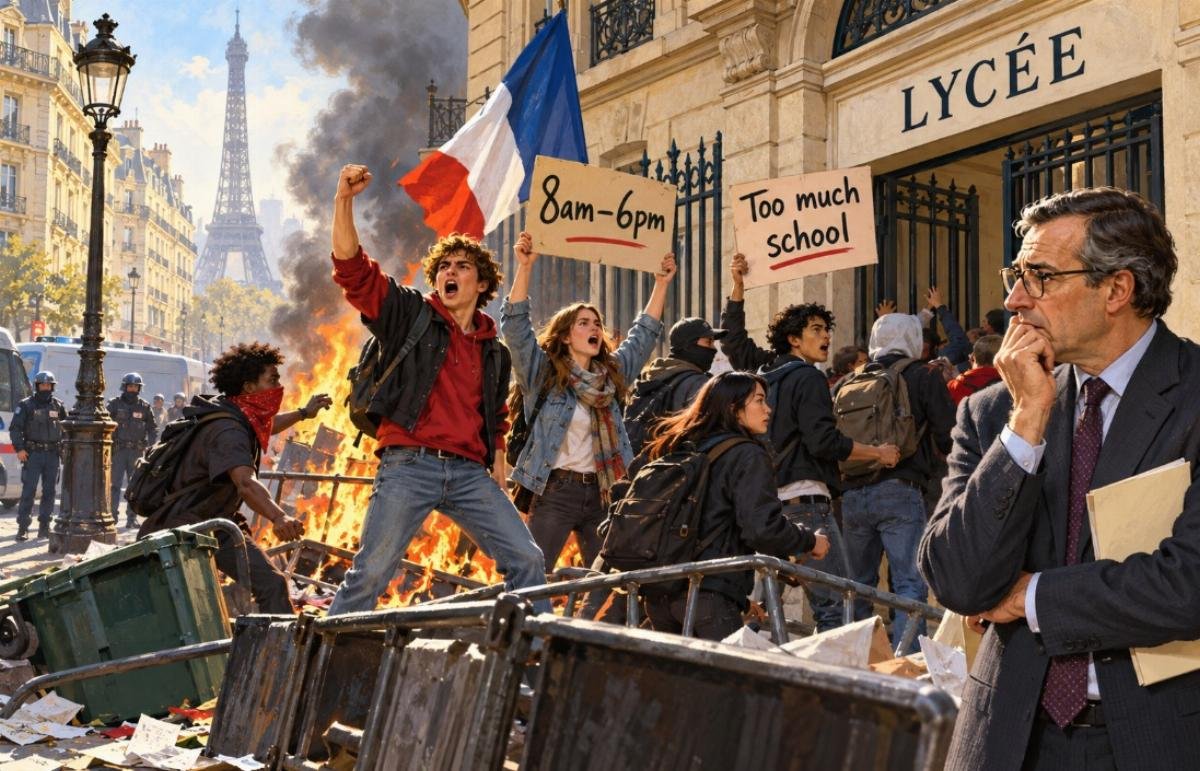
France is burning again, and this time the fire starters are high school students. That is the argument running through a new commentary from Silvio Canto Jr. at American Thinker, which surveys a wave of student rioting that has spread from the northern city of Lille to the banlieues of Paris and on to Marseille, with schools themselves serving as both the target and the tinder.
Canto opens with a note of weary familiarity. Two things happen every year in France, he writes: the country empties out for August vacations, and someone somewhere sets something on fire in protest. This year, though, the arsonists are teenagers, and the scope appears wider than the usual seasonal unrest.
A national crisis, declared late
Drawing on reporting from Jeffrey Blehar, Canto describes a country several days into a national bout of student rioting. Schools are burning, he writes, as high school students have blockaded and rampaged against their own campuses and against anyone caught in the crossfire. The unrest has touched Lille in the north, the Parisian banlieues, and Marseille in the south, with additional confrontations between students and police reported in Bordeaux, Rennes and Nantes.
Prime Minister Sébastien Lecornu has convened an emergency meeting of the French cabinet and declared a national crisis — a move Canto characterizes as arriving far too late for many observers’ tastes. The immediate trigger for the riots remains murky, though Canto notes the unrest appears to have spread through social media, and that the press has settled on a flattering framing: a quintessentially French rebellion by “the kids” against having to work too hard in school.

That framing is where Canto’s skepticism sharpens. Working hard in school, he argues, is precisely how a society trains the next generation to become successful and productive adults. Treating homework and long school days as an intolerable oppression strikes him as backwards, and he says so without much hedging.
The grievances on display at the Lamartine lycée in northern Paris, he notes, were spelled out on placards. One sign complained of an “8am-6pm” schedule, declaring students had “more hours of lessons than sleep.” Canto’s response is less analytical than exasperated: don’t students sleep at home? How many hours of sleep does a teenager actually need?
The culture that lets blockades become normal
If Canto is baffled by the stated motives, he finds a more coherent explanation in a social media post from Daniel Foubert, a former student at Lycée Racine in Paris’s 8th arrondissement. Foubert recalls what school blockades actually looked like in his day: a handful of far-left activists dragging rubbish bins in front of the entrance, piling up whatever they could find, and simply standing there.
The mechanism Foubert describes is one of institutional surrender. Authority, he writes, becomes embarrassed to exercise authority. Rules exist, but nobody wants to enforce them. The majority understands the situation is absurd yet waits for someone else to restore normality. A determined minority quickly learns that if it creates enough disruption, institutions will adapt themselves to the disruption rather than stop it.

Once that reflex takes hold, Foubert argues, it spreads well beyond schools. A society emerges in which blocking roads, occupying universities, shutting down public buildings, preventing people from working or studying, and paralyzing transport are treated not as exceptional breakdowns of normal life but almost as recognized forms of political expression. He calls it cowardice elevated into a social norm — the refusal to confront, to sanction, to impose limits, to say no. The result, in his telling, is a whole culture of retreat in which passivity gets mistaken for tolerance and fear of conflict for moral superiority. His verdict on contemporary France is blunt: spineless, gregarious, barbarian.
An old movie, playing again
Canto takes Foubert’s account as confirmation that France has been here before, and that the ending is predictable. The insane are running the asylum, he writes; the criminals are running the streets; teachers are afraid of their students. And the country’s leaders, in his reading, do nothing — because they are afraid of the mob too.
Whether that characterization holds up against the full complexity of French politics is a question Canto does not attempt to answer. His piece is an opinion column, and it reads like one: a frustrated observer watching a familiar cycle repeat with new actors and a heavier police presence. What it does capture is the central tension now facing Lecornu’s government — whether to treat the school burnings as an expression of youthful frustration to be managed, or as a breakdown of public order that demands a firmer response.
The cabinet meeting and the declaration of a national crisis suggest Paris has at least acknowledged the severity of the moment. Canto’s implicit argument is that acknowledgment came late, and that the deeper problem is not the fires themselves but a governing culture that has spent years teaching its most disruptive citizens that disruption works. That is a claim readers will evaluate on its own terms, but it is the thread running through the entire column.
For now, the images out of Lille, Paris and Marseille carry their own argument. Schools burning, students in the streets, police in confrontation, and a prime minister convening emergency meetings in a capital that has seen this particular movie more times than it would like to count.
Source: www.americanthinker.com — https://www.americanthinker.com/blog/2026/10/is-paris-always-burning/