
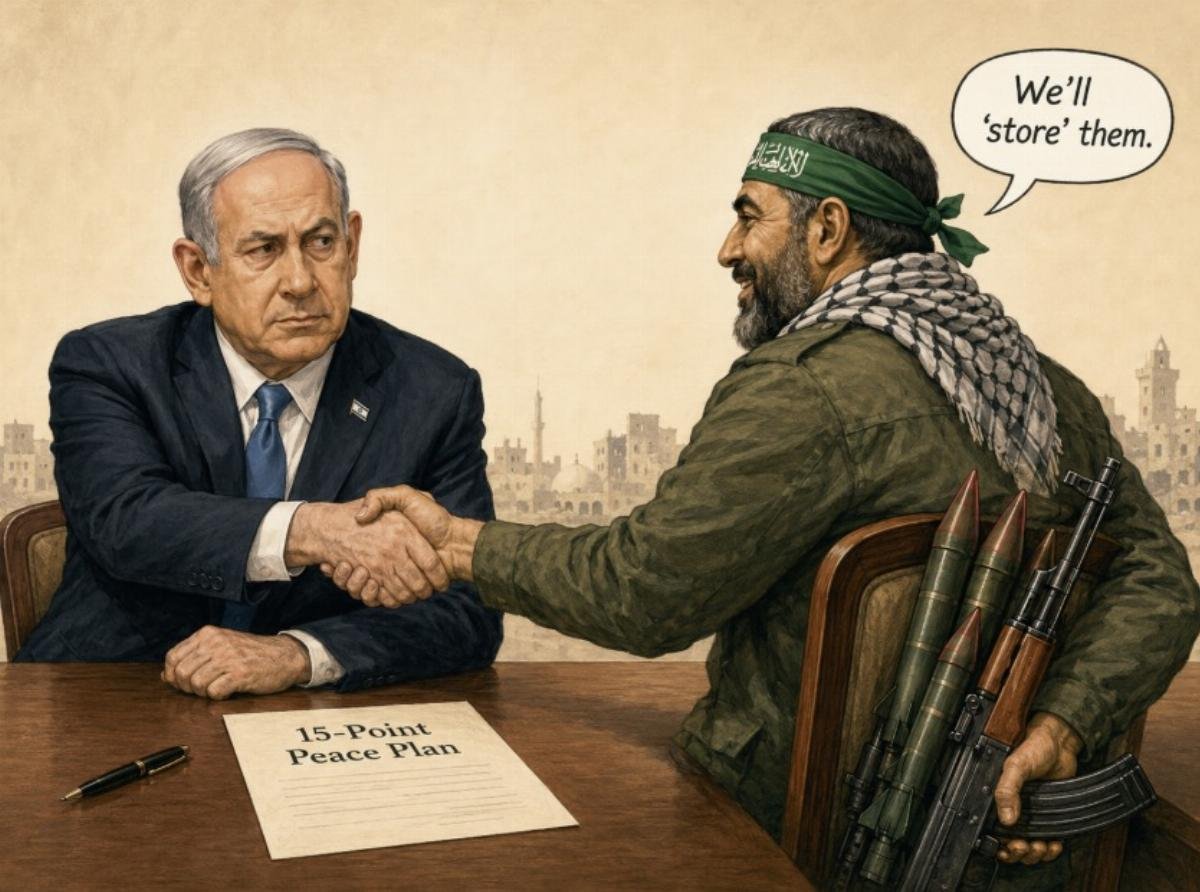
Just weeks after President Trump touted a 15-point agreement meant to bring peace to Gaza, the prospects for ending the conflict appear more distant than ever, according to a new analysis published by American Thinker. While the international community often blames Israel for stalling the peace process, the article argues that key details in the Hamas-Israel dynamic are frequently overlooked.
October 7 and the Question of Trust
The piece opens by reminding readers of the October 7, 2023, Hamas attack that ignited the war, and notes that Hamas attributes its actions to Israel’s ‘occupation’ of Gaza, even though Israel withdrew from the territory nearly two decades ago. American Thinker points out that Israel, the United States, and the European Union all classify Hamas as a terrorist organization bent on Israel’s destruction, raising the question: Can a group with such a stated agenda suddenly embrace peace?
According to the article, Hamas has repeatedly altered previously ‘settled’ terms in past negotiations, undermining confidence that it is serious about a binding commitment. This pattern is central to understanding why the latest agreement is already struggling.

The Critical Dispute: Weapons and Withdrawal
The core problem, as described, is Hamas’s interpretation of the Trump-proposed agreement. The group is demanding that Israel withdraw its troops while simultaneously ‘handing over its weapons’ for storage—but not actually disarming. Hamas has even specified it should retain certain categories of weapons, and has avoided the term ‘disarmament’ altogether.
The article quotes an Israeli security official, Yossi Kuperwasser, a brigadier general in the IDF reserves and director of the Jerusalem Institute for Strategy and Security, who highlights a glaring omission: the new agreement lacks any reference to the de-radicalization of Gaza, which was the first article of the earlier 20-point plan. ‘We are left with a radical Hamas governing Gaza and still very forceful, capable of rearming itself,’ Kuperwasser warned. ‘If we withdraw from Gaza under these conditions, Hamas is going to be on the doorstep of the same villages and communities that it attacked on October 7th.’
What Would Disarmament Look Like?
The Board of Peace—a US-backed Palestinian technocratic administration proposed to govern Gaza—issued clarifications that appear to support Israel’s position. The Board stated that the Israeli withdrawal beyond the ‘Yellow Line’ would only occur once decommissioning is complete, including light weapons, heavy weapons, and tunnels. Yet Hamas is reportedly already trying to reinterpret the terms, insisting on a withdrawal before full disarmament.
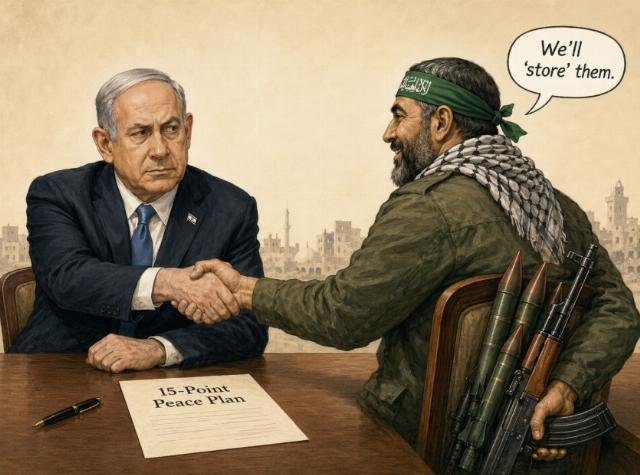
For Prime Minister Benjamin Netanyahu, the logical step is to refuse any move until Hamas completely relinquishes its arsenal. The article suggests that no Palestinian group should be trusted to ‘store’ weapons, given the political pressure that could lead to their return to Hamas.
De-radicalization: The Missing Piece
The article stresses that identifying strategies to de-radicalize Gaza is essential. At a minimum, Hamas-run schools must change their curriculum, which currently teaches children that Israel’s destruction remains a goal. Without such education reforms, any peace agreement is likely to be temporary.
Some critics accuse Netanyahu of being caught between radical elements of his own government and election pressures, but the article argues that his insistence on full disarmament is a reasonable, even necessary, stance.
As the world watches, the gap between the two sides appears wide, and the path to a durable peace remains unclear.
Source: www.americanthinker.com — https://www.americanthinker.com/blog/2026/08/the-prospects-for-peace-in-gaza-become-darker-all-the-time/