
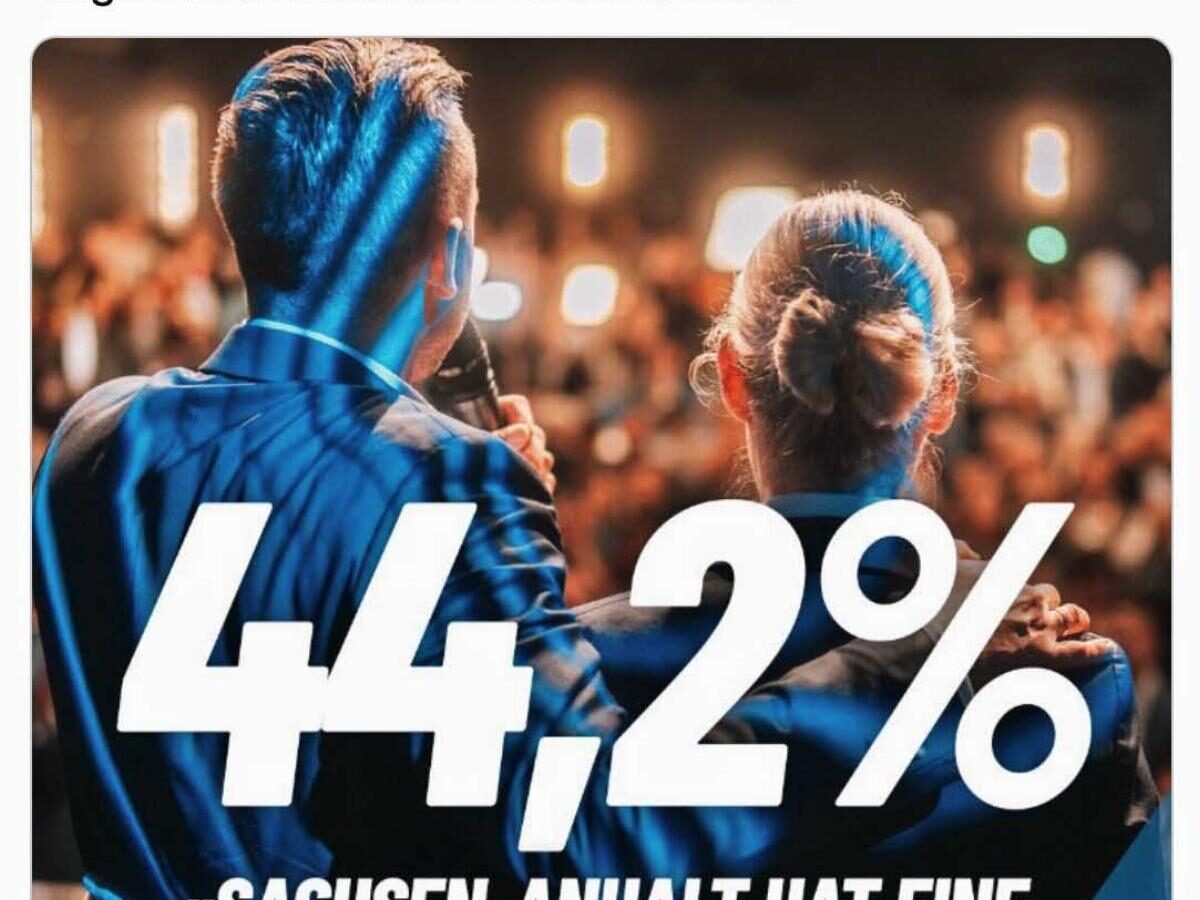
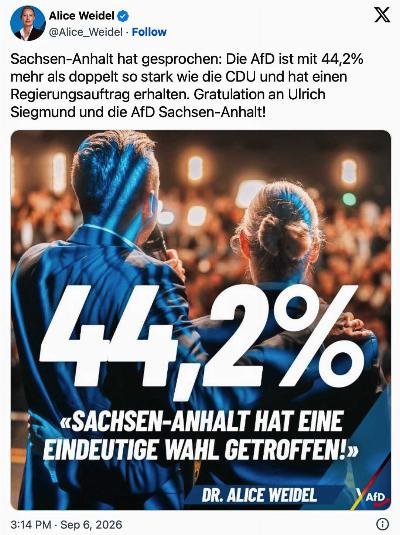
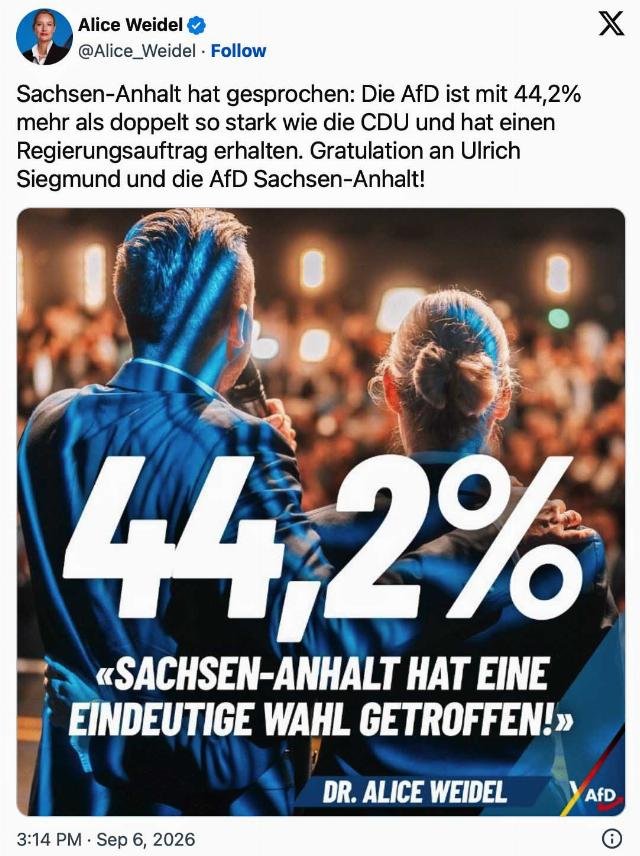
German state elections over the past few days delivered what many are calling a historic victory for the far-right Alternative for Germany (AfD) — but the celebration may have been premature. According to reports, the AfD initially took a commanding 51% of in-person votes on election Sunday, only to watch that lead evaporate as mail-in ballots were tallied beginning at 6 p.m. local time.
The pattern was stark: as mail-in ballots were counted, every other party gained ground while the AfD lost it. Critics on the left had cheered on election night, but the final results have now sparked a different kind of reaction — one of suspicion and accusations of manipulation.
Writing for American Thinker, commentator Silvio Canto, Jr. highlights an analysis by attorney Dirk Schmitz, published by alternative journalist Alexander Wallasch, that lays out the discrepancies in striking detail. “51.20% for the AfD at the ballot box — but only 24.27% of the mail-in vote. A drop of almost 27%,” Schmitz wrote. The gaps were even more dramatic in specific localities: In Mertendorf, the AfD took 63.2% at the ballot box but only 24.5% of the mail-in vote — a difference of nearly 39%. In Hedersleben, 62.9% of in-person votes went to the AfD, compared to just 26.4% of mail-in ballots. In one district of Magdeburg, the AfD received only 5.5% of the mail-in vote versus 41.5% at the ballot box, a minus of 36 percentage points. Obhausen saw the AfD at 24.8% by mail versus 60.5% in person, and in Meineweh the split was 27.9% mail-in versus 63.0% in person.
These numbers have led Stefan Weber — a plagiarism expert who previously helped strip the Ph.D. of Mario Voigt, the Christian Democrat governor of neighboring Thuringia — to call the results “a sign of systematic manipulation.”
A Familiar Debate Over Mail-In Voting
The controversy is hardly unique to Germany. In the United States, mail-in voting has become a flashpoint in recent election cycles, with critics on the right questioning the integrity of ballots that are not cast in person and in real time. Canto, who writes from Texas, acknowledges that there is a legitimate place for mail-in ballots — for soldiers overseas, for people with medical conditions, or for those who simply cannot make it to the polls. He notes that his own state offers a two-week early voting period that accommodates working people. But he argues that mail-in voting will always be controversial when such glaring discrepancies appear.
“It sounds a little spooky, doesn’t it?” Canto writes. “Maybe it’s all accurate, but some in the AfD are asking a few questions.”
The AfD, which Canto describes as a German version of MAGA that wants to “Make Germany Great Again,” has faced widespread criticism from mainstream media, which labels the party “far-right” and accuses it of harboring racist or even Nazi sympathies. Canto dismisses those characterizations as overblown, noting that the party’s actual platform — respecting borders, valuing culture, and seeking respect from the EU — hardly sounds extreme to him.
Still, the mail-in ballot question has become the central flashpoint. According to the analysis cited by Canto, the AfD failed to secure a majority because of the mail-in count, despite having won a clear majority of in-person votes. Leftists cheered on election day, but now, Canto notes, they aren’t.
The Postman Is Not an Election Official
Canto’s piece concludes with a pointed moral: “The postman is not an election official.” It’s a line that resonates with a broader skepticism about the security and reliability of postal voting systems, a concern that has gained traction on the right in both Europe and the United States.
While no evidence of fraud has been proven in the German case, the sheer scale of the discrepancy between in-person and mail-in voting patterns has raised eyebrows. Critics like Schmitz and Weber argue that such a dramatic gap cannot be explained by normal voter behavior, especially when the AfD’s support among mail-in voters was uniformly lower across dozens of districts.
Whether the claims of manipulation hold up under official scrutiny remains to be seen. But the controversy underscores a growing divide over how democratic elections should be conducted in the 21st century. As Canto puts it, there’s a place for mail-in ballots, but when discrepancies emerge, they inevitably invite suspicion.
For now, the AfD’s supporters are left to wonder what might have been if every ballot had been cast in person. The final results may stand, but the questions they raise are unlikely to fade quietly.
Source: www.americanthinker.com — https://www.americanthinker.com/blog/2026/09/please-mr-postman-look-and-see-whoa-yeah-is-there-a-ballot-in-your-bag-for-me/