
Olivia Murray has a term for a certain type of person, and she’s not shy about using it. In a new essay for American Thinker, the columnist describes what she calls the “get to no” woman—someone who derives visible satisfaction from refusing requests, enforcing arbitrary rules, and generally making life harder than it needs to be. And while she concedes that some men fit the mold, she argues the trait is “almost entirely confined to the female sex.”
Murray’s frustration is rooted in a specific, and deeply relatable, anecdote. Every summer, she buys a pool membership at a local country club—not a fancy one, she’s careful to note, but a modest facility that happens to charge enough to keep out what she calls “undesirable demographics.” She describes the club as “really quite dumpy” compared to others she’s known, including one her grandfather founded on Lake Mendota in Madison, Wisconsin. This is not a place that can afford to turn away paying customers.
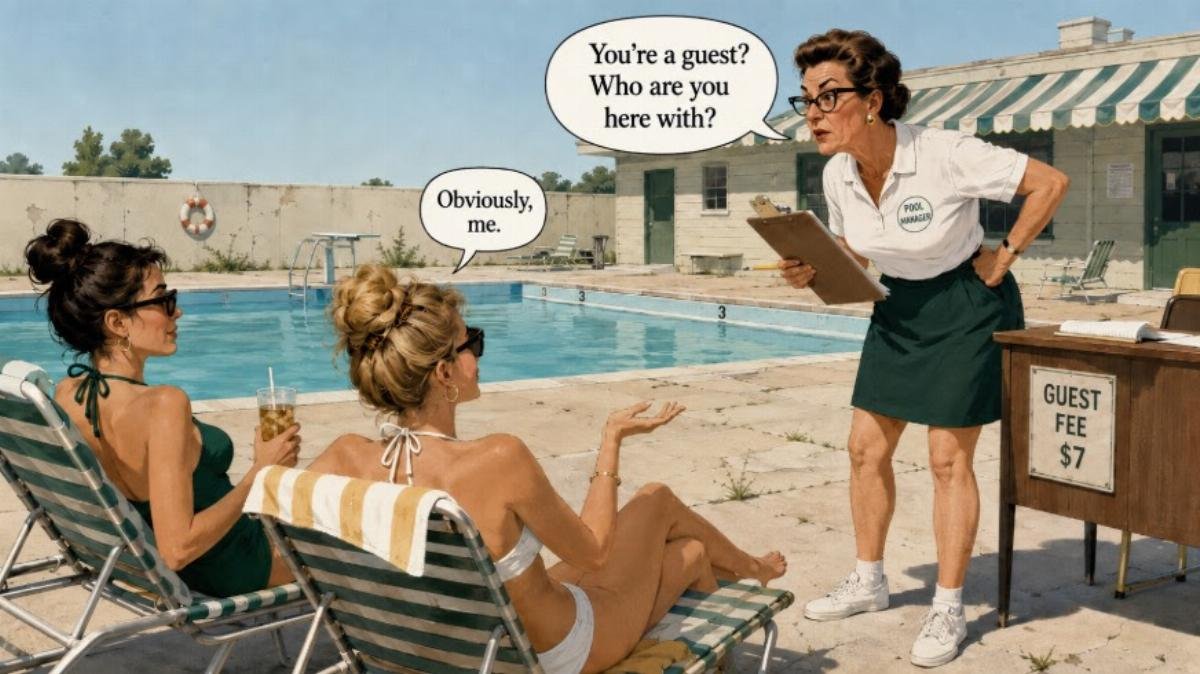
Earlier this week, she invited a friend to join her at the pool. The friend, who is not a member, has been coming throughout the summer and has always paid the $7 guest fee. On this particular day, the pool was completely empty—Murray and her guest had the entire deck to themselves. That’s when the pool manager, who had been glaring down from an upstairs window, came down to make sure the guest fee was paid.
An Empty Pool, A Full-Scale Interrogation
Murray identifies the manager as someone she’s dealt with before, and not pleasantly. “Let’s call her Miserable Judy,” she writes, noting that their prior interactions have been “unpleasant because she’s just a horrendous person.”
When Judy asked who Murray was, Murray provided her member number. Then Judy turned to the guest and asked who she was there with. Murray made a point of looking around the completely empty pool deck before answering: “Obviously me.”

Judy then launched into what Murray describes as an “accusatory assault,” claiming the guest had “abused the guest policy” and that it would not be allowed next summer. Murray notes the irony: Judy clearly knew exactly who they were, which made the confrontation feel less like enforcement and more like a power play.
Murray checked her membership agreement on the spot and found no such limit on guest visits. When she confronted Judy afterward, the manager’s response was blunt: “Well, it’s going to be policy next year.”
Murray’s reaction is unvarnished: “What a friggin’ b-word.” In her household, she says, they call this kind of person a “get to no” woman—someone who, when presented with a reasonable request, would rather jump through hoops to find a reason to refuse than simply give an easy yes.
The Joy of Saying No
Murray extends her critique beyond the pool deck. She describes the “get to no” woman as someone who is “overjoyed at how rigid and strict she now gets to be” when the opportunity to deny something arises. She offers examples that will feel familiar to anyone who has dealt with petty bureaucracy: the carnival worker who gleefully tells an excited child they’re “a fraction too short” for a ride; the DMV employee who stood inside a heated entryway and watched Murray shiver outside at 7:59:37 a.m. because the office technically doesn’t open until 8:00.
The common thread, in Murray’s telling, is a love of “no” that rivals any love of “yes.” It’s not about policy or fairness—it’s about the satisfaction of wielding a small amount of power.
Cutting Off Your Nose to Spite Your Face
The most pointed part of Murray’s argument is the economic one. Her friend wasn’t just a guest; she was a customer. Murray notes that the friend “routinely patronized the restaurant” and spent around $700 at the club over the summer. Now, thanks to Judy’s rigidity, the club will get “a big fat $0” from her.
And this is a club that, by Murray’s description, desperately needs the money. The golf course looks shabby. Weeds by the pool are knee-high. The concrete decking is cracked. The building needs repairs. If not for the sign, you’d mistake it for a public pool.
The irony is almost too neat: a club that can’t afford to lose a single paying customer just chased one away over a guest whose visits were perfectly within policy. Judy’s “no” wasn’t just petty—it was bad for business.
The Larger Point
Murray is writing in an opinion context that is unapologetically provocative. She acknowledges she’s been on “a bit of an anti-woman kick” in recent essays, not because she hates women—she is one—but because she’s been dealing with “a lot of awful women” lately. She also notes that some men exhibit the same “get to no” behavior, though she believes they’re “few and far between.”
Her essay is not a policy analysis or a data-driven sociological study. It’s a personal grievance, dressed up as a broader cultural observation, and it makes no apologies for that. The closing line is simple and direct: “Everyone hates a ‘get to no’ woman (and man), so don’t be one!”
Whether readers agree with the framing or find it reductive, the underlying point is one that resonates across political lines: rules are meant to serve people, not the other way around. When enforcing a policy becomes more important than the people the policy affects, everyone loses.
In Murray’s case, the loss is measurable in dollars—and in the simple, avoidable souring of an otherwise pleasant summer day at the pool.
Source: www.americanthinker.com — https://www.americanthinker.com/blog/2026/08/don-t-be-a-get-to-no-woman-or-man-you-guys-are-awful/