
A sweeping review of U.S. Senate polling has uncovered a striking pattern: roughly three out of every four surveys overstate Democratic support. The findings, published Tuesday by Republican pollster Patrick Ruffini, co-founder of Echelon Insights, are based on more than 3,000 polls spanning the last four election cycles.
Ruffini, who detailed his analysis on his Substack, said the data challenges the idea that recent examples of Democrats looking competitive in red-state races are simply a matter of selective memory.
“In the last few election cycles, we’ve seen a pattern of Democrats looking competitive in red state Senate contests during the summer only to fade by election day. I wanted to test if this was a consistent pattern, not just the selective memory of a Republican,” he wrote.
The average polling error across all surveys was a Democratic overstatement of 3.7 points, and 73% of polls released overstated the Democrat relative to the eventual election result. Ruffini emphasized that the sheer volume of data makes the finding difficult to dismiss as statistical noise.
“Again, that’s across more than 3,000 polls, so that’s hardly just statistical noise,” he said.
Summer Bias Most Pronounced
The pattern is most pronounced during the summer months, with the pro-Democratic bias peaking at nearly six points in late July before beginning to recede in late August, according to Ruffini’s analysis. By Election Day, the average error settles to a 2.6-point edge for Democrats.
This seasonal skew has particular implications for how races are covered and how money is spent, as summer polls often shape narratives about competitiveness and donor enthusiasm.
To illustrate the phenomenon, Ruffini highlighted three Senate races from 2020, 2022, and 2024 that followed a similar arc.
In South Carolina’s 2020 contest, a Quinnipiac poll from late July to early August showed a tied race between the late Republican Sen. Lindsey Graham and Democrat Jaime Harrison. That poll, Ruffini noted, kicked off a trend of neck-and-neck surveys that persisted almost until Election Day. A CBS/YouGov poll in September gave Graham just a one-point lead. Yet Graham ultimately won by 10 points.
“Democrats look like they’ve had a good chance in red states before,” Ruffini wrote. “A July 30 – August 3, 2020 Quinnipiac poll showing a tied race for South Carolina Senate race kicked off a trend of neck-and-neck polls that continued almost until the very end. Graham would eventually win by 10.”
All three Quinnipiac polls of that race showed statistical ties, underscoring the disconnect between polling and the final margin.
Ohio’s 2022 and 2024 Races Follow the Pattern
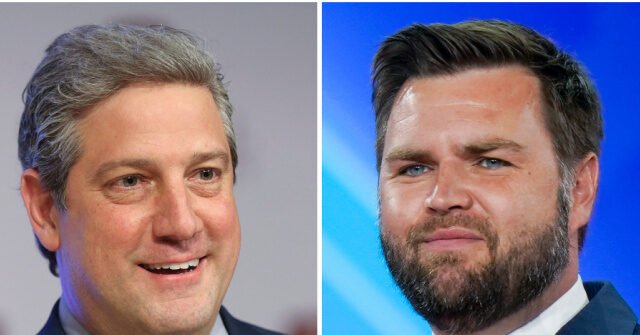
In Ohio’s 2022 Senate race, Democrats pinned their hopes on longtime Rep. Tim Ryan against Republican JD Vance, who would later become vice president. Ryan led in the vast majority of summer polls, holding an advantage into mid-September, before Vance pulled away and won by six points — a margin that matched the typical late-summer polling error.
“Ryan led in the vast majority of polls conducted in Ohio over the summer until being bested by JD Vance by 6 points,” Ruffini wrote.
The same dynamics played out in Ohio again in 2024, when incumbent Democrat Sherrod Brown faced Republican Bernie Moreno. Brown led in all but two pre-October polls, with summer surveys giving him an edge of two to six points. Moreno, however, won with 50.1% of the vote to Brown’s 46.5%.
Moreno led in just five of more than twenty polls in that contest, a clear illustration of the systematic overstatement of Democratic support.
Implications for Midterms and Presidential Years
Ruffini’s research also finds that the bias carries over into presidential election years. During the Trump era, Senate polls in presidential years have been consistently skewed toward Democrats, a bias that persisted through the 2024 cycle. In midterm years, the overall accuracy improved, but the summer months still showed a large pro-Democratic bias.
This pattern has real-world consequences. Campaigns, donors, and media outlets rely on polling to allocate resources and set expectations. If summer polls systematically overstate Democratic chances in conservative states, they can inflate optimism, divert funds, and distort the political narrative leading into the fall.
Ruffini’s analysis does not assign a specific cause to the phenomenon, but the consistency across cycles suggests something structural in how polls are conducted or how respondents self-identify in summer months.
The findings are likely to fuel ongoing debates among political professionals about the reliability of public polling, particularly in an era when response rates are low and weighting methodologies vary widely. It also gives Republicans a data-driven talking point heading into future cycles, where skepticism of polls favoring Democrats may now be the default.
The full report includes a detailed breakdown of the polling data, race-by-race examples, and a comparison of summer versus fall surveys. Ruffini’s decision to publish the findings on his own platform rather than through a traditional media outlet allows for a more detailed, transparent look at the methodology.
As the next election cycle approaches, campaigns in both parties will be watching closely to see whether the pattern holds or whether pollsters adjust their models to reflect the persistent bias — and whether the summer of 2026 will once again produce polls that overstate Democratic strength.
Source: www.breitbart.com — https://www.breitbart.com/politics/2026/08/18/republican-pollster-finds-long-term-trend-of-polls-overestimating-democrats/