
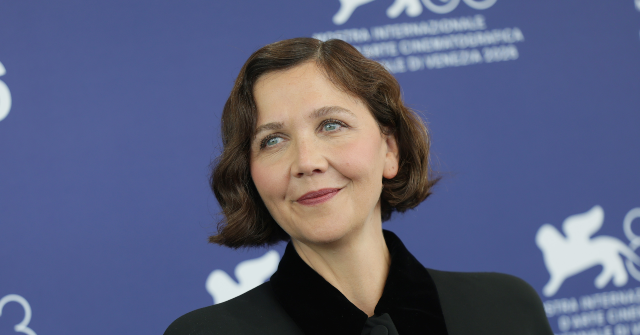
Maggie Gyllenhaal, serving as jury president at the 83rd Venice Film Festival, used her platform to call out the lack of female directors in this year’s competition lineup — a criticism that comes just months after her own directorial effort, The Bride!, became one of the year’s biggest box-office disappointments.
During a press conference, Gyllenhaal was asked about the noticeable absence of women helming films vying for the prestigious Golden Lion. According to a report from Variety, the actress-turned-filmmaker responded with pointed sarcasm: “I guess it’s finally become clear that men make better movies than women do.”
She went on to frame the issue as systemic, arguing that women face steep hurdles in getting their projects financed. “There’s a systemic problem. It’s harder for women to get films financed,” Gyllenhaal said.
But the statistics at this year’s festival underline her frustration. Only one film in the main competition — Woman Unknown, a drama from Danish-Egyptian director May el-Toukhy — was directed solely by a woman. Gyllenhaal wondered aloud whether the film industry’s gatekeepers undervalue stories that women want to tell, asking, “Could it be possible that women, having had a different experience of being alive in the world, want to make movies [that] are not always deemed high art? Who decides what’s good? Who decides what is valuable?”
Her comments carried an uncomfortable irony, as The Bride!, her sophomore feature, was released earlier this year to poor reviews and dismal box-office returns, making it one of the season’s most notable flops. Critics were quick to note the contrast between her critique of the industry’s treatment of female filmmakers and her own recent commercial failure.
Venice Defends Its Lineup
Venice’s artistic director, Alberto Barbera, reportedly responded to the criticism by pointing to the inclusion of Naza, a documentary co-directed by Yuval Abraham and Rachel Szor — the duo behind the acclaimed No Other Land. The film was added to the competition lineup just before the festival kicked off, a last-minute addition that Barbera seemed to cite as evidence of the festival’s openness to a range of voices.
Still, Gyllenhaal emphasized the personal significance of her role as the head of the seven-member jury, noting that it was meaningful for her to be chosen to lead the competition committee.
Press Conference Nearly Canceled
The press conference itself almost didn’t happen. There was reported talk that Venice might scrap the event entirely, citing “scheduling issues.” But after critics speculated that the cancellation was a move to protect jury members from uncomfortable questions about politics, the festival reinstated the press conference.
Gyllenhaal didn’t shy away from the political undertones the moment she took the stage. “Look, we could say, how are we possibly here talking about movies right now when the world is in a state of emergency?” she said. “To me, the answer has something to do with empathy.”
She elaborated, “I think that film allows an opening into an opportunity to find empathy inside of ourselves. I think we can challenge ourselves to hear stories about the most corrupt, most perverse people because it opens up the opportunity to find empathy for those people.”
A Pattern at European Festivals
Gyllenhaal’s remarks echo a recurring tension at major European film festivals, where political and social questions increasingly compete with cinematic ones. Earlier this year at the Berlin Film Festival, Michelle Yeoh and Neil Patrick Harris made headlines for sidestepping political statements despite pressure from some journalists to take a stand. A day before that, the festival’s jury head, Wim Wenders, faced similar questions and responded by insisting that filmmakers “have to stay out of politics.”
At Venice, however, politics seemed impossible to avoid, and Gyllenhaal’s comments about gender representation ensured that the conversation remained front and center. Her pointed jab about male directors, delivered with a straight face, may have been sarcastic, but it underscored a real frustration that many in the industry share.
With only one solo female-directed film in the main competition this year, Venice’s track record on gender parity remains a sore spot. Gyllenhaal’s critique, despite the awkward timing, has reignited a debate that the festival — and the broader film industry — will likely face again soon.
Source: www.breitbart.com — https://www.breitbart.com/entertainment/2026/09/02/maggie-gyllenhaal-complains-about-lack-of-female-directors-at-film-fest-after-directing-one-of-this-years-biggest-bombs/