
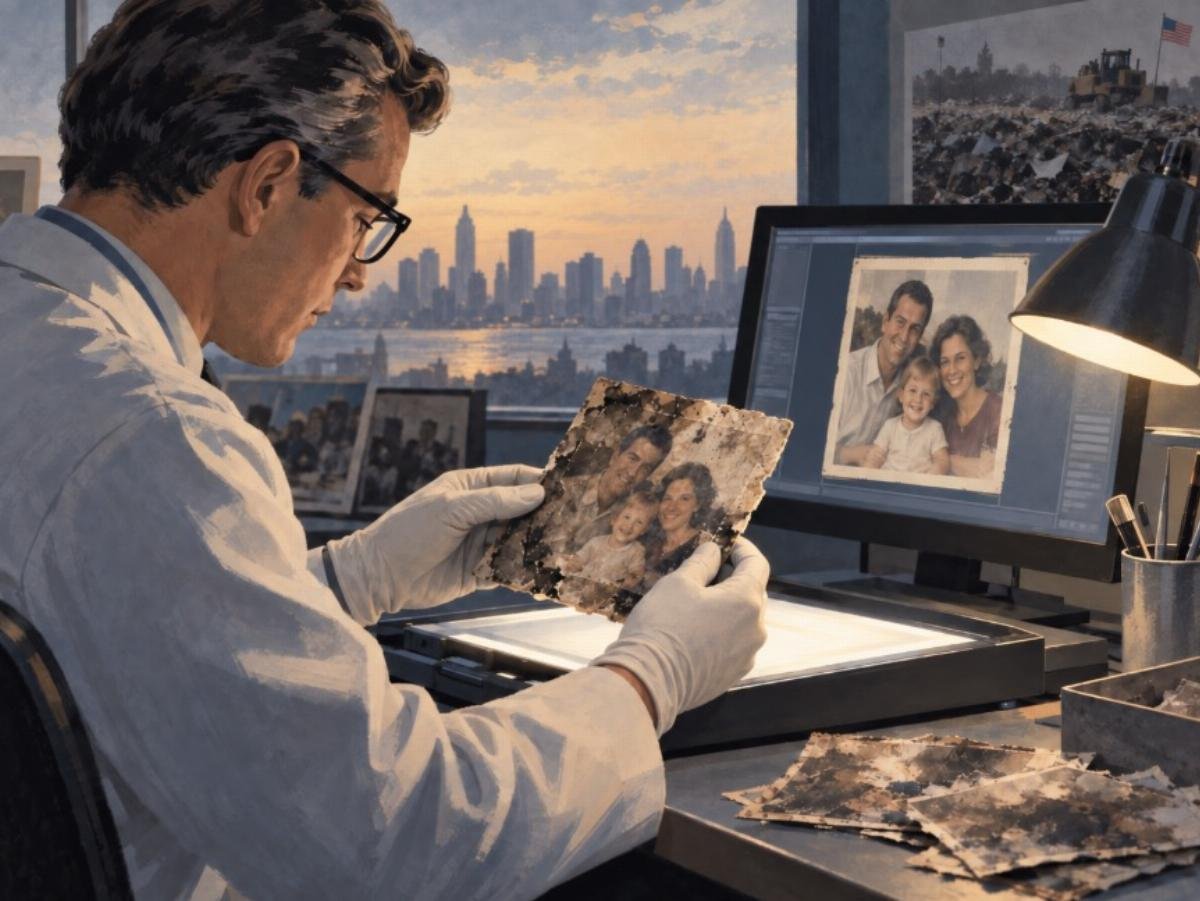
Most of the stories that came out of Ground Zero in the months after September 11, 2001, are stories about rubble, ash, and the machinery of recovery. John Woods has a different one, and he tells it in American Thinker — a story about photographs that survived being blown out of the towers when they fell, and about the people who were asked to put those photographs back together.
Woods was teaching an Adobe Photoshop class to employees and photographers at Eastman Kodak’s research labs on the morning of the attacks. Nobody in the room knew what was happening until they broke for lunch and learned about New York City. His skill set, as it turned out, was about to become an unlikely instrument of grief counseling.
Part of his job involved restoring old, faded, and water-damaged images, and he had applied for Certified Adobe Photoshop Expert status, which required passing a proctored exam. As he watched the towers collapse, he wrote, he had no way of knowing how completely the event would reshape his life.
From Kodak to the Sorting Fields
About two months later, the New York City Police Department reached out to Kodak for help cataloging and restoring damaged photographs that had somehow survived the collapse. His boss delivered the assignment bluntly: he was being sent to the Staten Island Fresh Kills Landfill to assist NYPD detectives with the more than 3,000 photographs recovered from the debris fields.
The scale of the operation was enormous. Debris from Ground Zero was scooped up, loaded onto barges, and ferried across to Fresh Kills, where it was spread across two or possibly three acres of sorting fields. Officers then walked those fields by hand, picking out personal items that had belonged to people who were inside the buildings when they came down.
During his orientation at Fresh Kills, detectives walked Woods past one of the flattened fire trucks — he believes it was Engine 8 or Engine 10 — that had been parked beside one of the towers. A vehicle that normally stood about ten feet tall had been compressed to three feet at most, twisted and scorched.
Then they took him into the detectives’ trailer, where boxes of surviving photographs were being held. Because the images were considered evidence, Woods had to be formally assigned to the detective division before any of them could be released into his custody.
Roughly a week after that visit, a special delivery truck arrived at the Kodak research labs carrying the boxes. That, Woods writes, is when the most rewarding and most difficult assignment of his career began.

The Work Itself
The lab’s imaging computers allowed Woods and his colleagues to scan and digitize each photograph, then use Photoshop to erase damage and reconstruct portions of images that had been destroyed. The goal was simple to state and painstaking to execute: return to families the wallet-sized and desktop photographs their loved ones had kept with them at work.
Over three months, the team restored, digitized, and preserved more than 3,000 images. The NYPD detectives, meanwhile, took on the task of locating the families so they could hand over the originals found at Fresh Kills along with a CD holding a digitized copy of the restoration work.
The restoration was the part Woods calls rewarding. The hard part was more human. To scan a photograph properly, the team had to turn it over and read whatever was written on the back — the notes left by sons and daughters, wives and husbands, boyfriends and girlfriends.
Woods describes the aftermath in plain terms: three months of rewarding but genuinely tough work, followed by nights when the images and inscriptions followed him into sleep. He believes he was suffering from a case of PTSD. Only after a few months did the images begin to fade and sleep come more easily.
What the Work Was Really For
There is a particular kind of labor in disaster recovery that rarely makes the evening news: forensic cataloging, evidence handling, the digitization of a stranger’s wallet photo. Woods’ account, published in American Thinker, is a reminder that the material recovered from Ground Zero was not only steel and ash but the ordinary personal effects people carry without thinking — the pictures tucked into a desk drawer or a back pocket.
His piece closes with an appeal that has nothing to do with Fresh Kills and everything to do with the country he was serving in a small, technical way. “Now more than ever,” he writes, “the ability to speak our minds is crucial to the republic we cherish.”
Source: www.americanthinker.com — https://www.americanthinker.com/blog/2026/09/picking-up-the-pieces/