
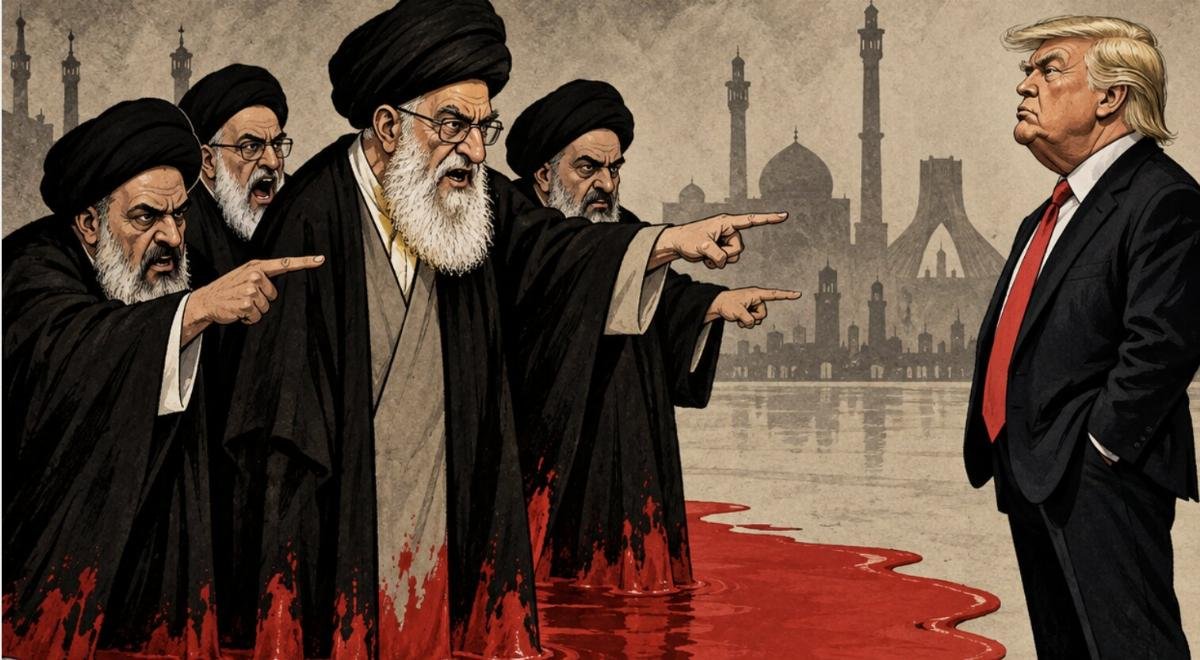
There is a particular kind of moral theater that only a theocracy can stage, and Tehran appears to be performing a new act of it. After a U.S. air strike in southern Iran reportedly killed four civilians at a wedding party in Kuhestak, in Hormozgan province, wounding 60 others, the mullahs have made the dead into a full-throated indictment of Washington. According to commentary from James Zumwalt published in American Thinker, the reaction from U.S. officials was immediate and firm: U.S. Central Command stated it never targets civilians and strikes only military targets tied to the IRGC. President Donald Trump called the allegation theater and demanded proof. Vice President J.D. Vance, asked about the charge, repeated that the U.S. would never intentionally target civilians while allowing that “sometimes things happen” — though he voiced skepticism about Iran’s version of events.
Some time later, an internationally recognized humanitarian body confirmed that the deaths did occur. That confirmation matters, and it should not be waved away. Four people at a wedding are dead. Whatever the argument that follows, the starting point is that the strike went wrong and civilians paid for it.
The math of a state that kills by calendar
But Zumwalt’s central point is about proportion — and about who is doing the complaining. Tehran, he notes, has been extraordinarily loud about those four deaths. In 2025 alone, Iranian authorities executed 2,201 people. That is an average of roughly six a day. The four killed in Kuhestak represent less than a single day’s worth of the regime’s intentional killings of its own citizens.
There is more where that came from. The protests that followed the 1988 mass executions — a wave of state violence that ended between 2,800 and 5,000 lives — sit on one side of the ledger. More recent protest crackdowns, in Zumwalt’s accounting, may have claimed as many as 30,000 additional civilian victims. Set beside that, four accidental deaths from an American strike do not make Iran the injured party. They make Iran the plaintiff with blood on its hands.
Which is why, Zumwalt argues, the skepticism from Trump and Vance was not cynicism. It was earned.
Why casualty numbers are never neutral
Anyone who has watched war reporting long enough knows that casualty figures arrive already shaped by the interests of whoever is releasing them. Russia’s battlefield losses in Ukraine are a case in point. Moscow wants its losses downplayed to avoid domestic unrest, and as the numbers have grown, so has its reluctance to release them. Outside analysts, left to estimate for themselves, believe Russia’s casualty rate runs at least two-to-one in Ukraine’s favor — likely worse — a figure Moscow simply does not report.
This is not a new Russian habit. During the Soviet war in Afghanistan from 1979 to 1989, Moscow routed many of its wounded to hospitals in Warsaw Pact countries. The treatment may have been faster. It also let the Kremlin keep the true scale of its wounded out of sight and out of mind at home — a bureaucratic trick that would have impressed any wartime censor.
Gaza, and the difference between counting and inflating
Then there is Hamas in Gaza, where the incentive runs in the opposite direction. Hamas wants civilian casualties counted — and, Zumwalt writes, exaggerated — because inflated numbers generate genocidal criticism of Israel. What goes unmentioned in those tallies is that many of the reported dead were Hamas fighters.
One recent survey seems to undercut a related Hamas claim. UNICEF, the United Nations agency focused on children’s and mothers’ health, conducted the survey in Gaza. Hamas had alleged “mass infant deaths” and instant famine. The survey found that, given Gaza’s emergency conditions, such fatalities were actually very low. It is a rare data point in a conflict where numbers function more as ammunition than as information.
Qaddafi wrote the playbook
The master of the genre, Zumwalt suggests, was Muammar Qaddafi. When U.S. aircraft bombed Tripoli on April 14, 1986, the Libyan leader announced that his adopted daughter Hana, less than a year old, had been killed. Until that moment, the world had not known Qaddafi had an adopted daughter at all. The timing raised suspicions: was the girl a real victim, or had Qaddafi adopted a dead child to manufacture one?
Twenty years later, with Qaddafi still in power, Libya staged an event called the “Hana Festival of Freedom and Peace.” The name implied a memorial. But the truth had already leaked out in a 1999 article by China’s Xinhua news agency, which published a photograph of a teenage Hana — alive — having lunch with her mother and South African President Nelson Mandela. Qaddafi had used a child as a prop to court sympathy at home and paint his enemies as heartless. The dead girl was, apparently, not dead.
The point is not that Iran is lying about everything
Zumwalt is careful to concede that this particular tragedy is real. The confirmation from a humanitarian body settles that. The U.S., in his framing, is guilty of an unfortunate accident — not of what Tehran wants the world to see. What Iran is doing is a Qaddafi-style maneuver: spotlighting four accidental deaths to vilify a superpower while keeping the cameras far away from its own execution chambers.
The uncomfortable truth is that both things can be true at once. The United States can conduct a strike that kills innocent wedding guests by mistake, and the Islamic Republic can exploit those deaths cynically while its courts hang, stone, and shoot thousands of its own people every year. Recognizing the first does not require pretending the second isn’t happening.
That is what makes the casualty claim game so effective — and so corrosive. Every number released in wartime has a sponsor, and every sponsor has an interest. The skeptical question is not an act of cruelty toward the dead. It is the only defense the living have against being used as evidence.
Zumwalt closes his piece with a warning about something larger than Iran: the ability to speak freely, to interrogate official claims from any government, is what allows the public to sort the real dead from the manufactured ones. In a war fought as much with figures as with munitions, that freedom is not a luxury. It is the only accounting that can be trusted.
Source: www.americanthinker.com — https://www.americanthinker.com/blog/2026/09/playing-the-casualty-claim-game/