
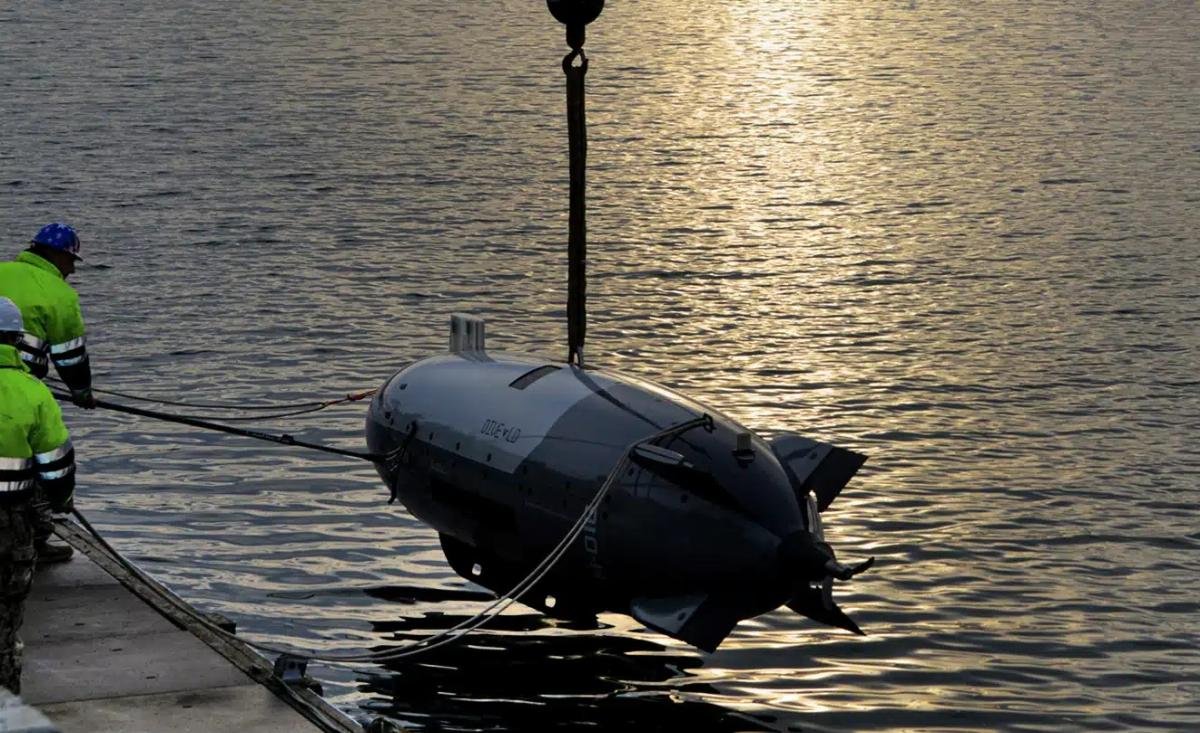
Iran is claiming a stunning naval victory over the United States — the capture of an American submarine, no less. But according to the U.S. Navy and defense analysts, the story is considerably less dramatic than Tehran’s propaganda suggests.
As reported by American Thinker, the object in Tehran’s possession is not a submarine at all. It’s an underwater drone — an unmanned aerial-vehicle-style craft designed to operate beneath the surface. And it wasn’t seized in a daring operation. It malfunctioned two days ago, popped to the surface, and was scooped up by Iranian forces who happened to be in the area.
The drone in question is the Anduril Dive-LD, a general-purpose, modular underwater UAV that can be configured for missions like minesweeping, reconnaissance, or surveillance. At roughly 18 feet long and three tons, it’s on the larger end of the underwater-drone spectrum — but it’s still a far cry from a Los Angeles-class nuclear attack submarine, the kind of vessel that can obliterate an enemy fleet without breaking a sweat.
The Navy has stated the drone was on a routine survey mission along the southern Iranian coast. It’s an older model, the service said, without advanced electronics or AI, and it wasn’t carrying any classified equipment. In other words: no loss to U.S. capabilities, no intelligence bonanza for Iran, no strategic shift in the balance of power in the Persian Gulf.
A propaganda victory that changes nothing
None of that has stopped Iran’s Islamic Revolutionary Guard Corps (IRGC) from celebrating as if it had just vanquished the Great Satan on behalf of the Mahdi. The IRGC’s claims that the drone is “the most advanced and classified UAV” are nonsense, according to the American Thinker report. The Dive-LD is a general-purpose system, not a cutting-edge secret weapon.
Legacy media outlets have given the story breathless coverage, with some early commentators apparently buying the “submarine” line hook, line, and sinker. Others have drawn comparisons to the 2016 seizure of two small Navy patrol boats by Iranian forces — an incident in which American sailors were briefly detained and shown on Iranian television appearing to cry, and during which one officer apologized to Tehran.
But as the American Thinker piece notes, this is no longer Barack Obama’s navy. The comparisons to 2016 are misleading; the strategic environment, and the U.S. posture in the region, has changed considerably since then.
Some commentators have predicted that Iran will reverse-engineer the drone and turn the technology against the U.S. That’s a neat trick, as the piece dryly observes, when you have no industry left to speak of.
The timing raises questions
The timing of the Iranian announcement is also worth scrutiny. It comes on the heels of news that the U.S. Navy has successfully cleared mines from the southern route through the Strait of Hormuz — a development that is now being overshadowed by the so-called “submarine capture,” precisely at the moment Tehran might want some good news of its own.
Iran is broke, blockaded, and has no navy, no air force, and no defenses to speak of, according to the American Thinker report. Its entire war strategy is in tatters. The country has been losing tankers “like old socks” over the past two weeks. The capture of a malfunctioning drone does not put those mines back in the water, nor does it replace the tankers Iran has lost.
What this actually tells us
The episode is a useful case study in how propaganda works in the modern information environment. Tehran took a minor operational incident — a defective drone surfacing in the wrong place at the wrong time — and dressed it up as a world-shaking victory. A compliant or credulous media amplified the claim. And somewhere in the noise, the actual news — the successful U.S. mine-clearing operation in the world’s most important oil chokepoint — got lost.
For Iran, the episode changes nothing strategically. For the media, it’s a reminder that not every claim from a hostile government should be taken at face value. And for the U.S. Navy, it’s a minor and quickly forgotten embarrassment — the kind of thing that happens when you operate drones in contested waters near an enemy coast, which is precisely what those drones are designed to do.
The operation continues, as the American Thinker piece puts it, “keepin’ on keepin’ on.” The mines are cleared. The survey missions continue. The drones will keep flying — or rather, sailing — and occasionally malfunctioning. And Iran, for all its chest-thumping, remains exactly where it was before: broke, blockaded, and losing the war it started.
Source: www.americanthinker.com — https://www.americanthinker.com/blog/2026/09/iran-takes-the-dive/