
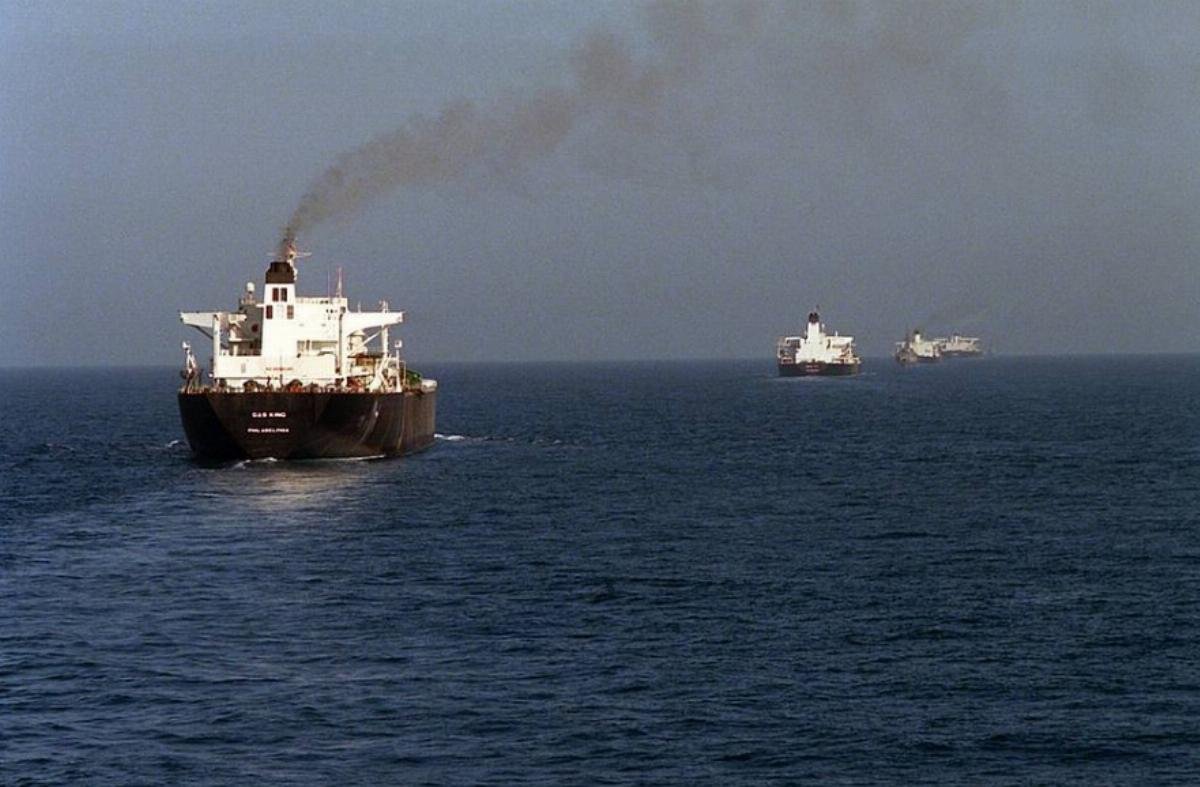
For three centuries, the maritime insurance market that underwrites the tankers carrying the world’s oil, gas, and goods has been anchored in London. According to an American Thinker commentary by Timothy Birdnow, that arrangement has now ruptured in the Strait of Hormuz — and the vacuum is being filled by American insurers and the U.S. Navy.
The piece describes a rapid sequence of events: Lloyd’s of London withdrew from underwriting tanker coverage in the strait, a chokepoint through which roughly 30 percent of the world’s seaborne oil supply passes. Within 48 hours, the U.S. Navy, operating through U.S. Naval Forces Central Command, expanded escort operations across the Gulf, while American insurers began moving to replace Lloyd’s coverage entirely.
Birdnow frames this as a seismic shift in the global balance of financial and military power — one he says most market analysts have not yet fully priced in.
The Insurance Chokepoint
The commentary argues that maritime insurance is not a back-office function but a form of strategic control. “Control the insurance, and you control who can sail,” Birdnow writes, paraphrasing the logic that has governed global shipping for generations. Without coverage, tankers cannot transit a war zone; without transit, oil does not move.
That principle made Lloyd’s dominance over Hormuz coverage — which Birdnow describes as lasting since the reign of William III — one of the most quietly powerful financial monopolies in history. The commentary notes that British financial infrastructure has held that position for over 300 years, underwriting not just tankers but the broader flow of global commerce.
The rupture, according to the piece, was not caused by war or sanctions directly. Rather, Lloyd’s blinked at the wrong moment, and the resulting vacuum was filled quickly. The commentary describes the Crown’s three-century chokehold on global energy insurance as having been severed by that withdrawal and the American response to it.
Why London Stepped Back
Birdnow attributes the British withdrawal to a combination of political dysfunction and policy priorities in London. He argues that “Trump Derangement Syndrome” and the Labour Party’s focus on renewable energy led Britain to refuse to aid the United States in reopening the strait.
That refusal, in his telling, was self-defeating. The United States, he notes, has no real need for Gulf oil; Europe and Britain do. By declining to help secure the passage, London left itself dependent on a corridor it was no longer willing to help protect.
The commentary is blunt about the irony: Britain’s insurers and Royal Navy once gave the country global power, in no small part because they insured shipping and protected it. Now, the piece argues, that dual role has migrated to the United States.
American Insurers Move In
As the U.S. Navy expanded its escort operations, American insurers stepped into the market Lloyd’s vacated. Birdnow names Travelers, Berkshire Hathaway, AIG, Liberty Mutual, and The Hartford among the companies getting rich off the new arrangement. He frames this as money coming home to America rather than “stuffing the pockets of the British nobility.”
The U.S. government is guaranteeing this insurance in partnership with American companies, according to the commentary. Birdnow acknowledges that the pricing may look like gouging, but he argues it is reasonable given the risks involved. The costs, he concedes, are killing shippers and driving up prices.
That, he says, has to change — but he expects it to be temporary, lasting only as long as the military has to back up the tankers. Running cargo through a war zone is expensive by nature.
The Home-Front Math
Birdnow is candid about the political stakes. Oil prices are high now, partly because of the spike in tanker insurance costs driven by Iran’s attacks on vessels in the strait. He writes that if oil prices drop, Republicans will win next month’s elections.
“We need oil prices at three bucks a gallon or less,” he writes. “If we get that big a drop we’ll win, if not, it’s a toss-up.”
The commentary does not shy away from the domestic pain. Americans are paying more at the pump, and the insurance-driven increase is part of the problem. Birdnow’s argument is that the pain is the price of taking control of a strategic corridor — and that it will ease when Iran “crumbles” and conditions normalize.
Pax Americana, Insured
The broader thesis is that the United States now controls both the physical escort corridor through the world’s most critical oil shipping lane and the financial infrastructure that makes commercial shipping through it possible. Birdnow describes this as a realignment that benefits America, driven by a president he characterizes as a sharp businessman who understands how to make money off a bad situation.
He reaches for biblical language to frame the moment, citing Genesis 22:17, in which God promises Abraham that his offspring shall possess the gate of his enemies. “Control the passageways, control the gates of your enemies, and you rule the world,” Birdnow writes.
The commentary argues that by ensuring the free flow of trade, the United States effectively controls the gates of both its enemies and its friends. It compares the moment to Britain’s imperial peak, when men in business suits gave the country as much power as its military did.
Birdnow also draws a contrast with Russia, which he says tried and failed to take control of global energy. Energy, he writes, is the lifeblood of civilization. And he suggests that China will have to be very polite to the United States in the future, because whoever controls shipping rules the world.
“Pax Americana is back, and better than ever,” he concludes — “if we can keep it.”
Source: www.americanthinker.com — https://www.americanthinker.com/articles/2026/10/pax-american-on-the-seas/