
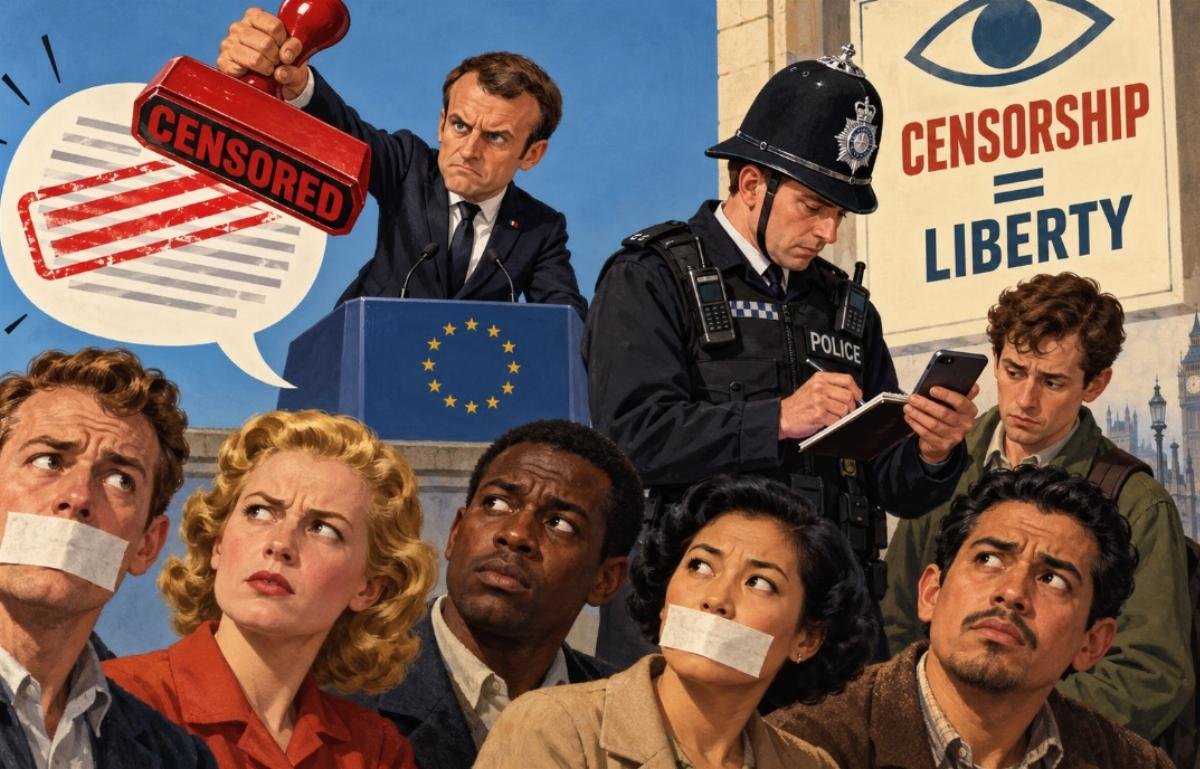
French President Emmanuel Macron is once again making the case for a more aggressive European censorship regime, and the editors at American Thinker are not impressed. In a biting weekend column, J.B. Shurk accuses the French president and his Brussels allies of treating dissent as a threat to the state, then dressing up the instinct to silence it as a form of liberation.
Speaking to reporters last week, Macron defended the European Union’s speech-policing framework — the Digital Services Act — as a weapon that should be deployed “much more extensively, much faster, and much more forcefully” against information governments deem false. He then framed American free speech traditions in adversarial terms, telling reporters that “so-called American ‘free speech’ — at least as it exists today and has been promoted by some people — is the opposite of free speech.” The French leader went on to argue that his own freedoms end where insult or vandalism of the public square begins, and that platforms disseminating content should be held to account.
The Weekly Standard of European Liberties
Shurk reads all of this as an admission of weakness. His argument is simple: if Europe’s governing class cannot win public arguments without silencing the other side, its ideas must not be worth defending. He likens the dynamic to a boxer demanding that his opponent’s hands be tied behind his back before claiming the heavyweight title.
The column’s sharper turn comes when Shurk accuses Macron of hypocrisy. While the French president wants to criminalize speech that he considers untrue, Shurk argues, Macron spreads his own falsehoods — pointing to Macron’s reported claim that “Brexit is the biggest lie of the last thirty years,” made while “beseeching British Prime Minister Andy Burnham” over the matter. According to Shurk, that framing is itself absurdly false: British voters did choose to leave the European Union in 2016, whatever the noise from Brussels since.
And the consequences, Shurk contends, have not matched the warnings of Brexit fearmongers. He notes that despite predictions of imminent economic collapse and what he calls the best efforts of “Brexit saboteurs at home and abroad,” the United Kingdom outperformed France and other major European economies during the run-up to 2026 — leading the G7 in growth in the first half of the year. One driver of the 2016 vote, he adds, was British voters’ reluctance to see their military folded into a European Army beyond their control — a scenario once dismissed by pro-EU voices as disinformation, but which Shurk argues looks increasingly plausible as Brussels moves to centralize European defense structures around the Russia-Ukraine War.

When Speech Laws Meet Comedy Legends
From there, the column pivots from macro-politics to a pair of British enforcement stories it treats as cautionary tales about what centralized speech policing looks like in practice.
The first concerns John Cleese, the 86-year-old Monty Python veteran. A member of the public has reportedly filed a Prevent referral against the comedian, arguing that his continued mockery of Islam should be treated as a “moderate to high risk” for radicalization, communal tension, and hate incidents. Cleese’s offending line, according to the complaint, was the observation that “I personally prefer a culture that does not approve of FGM, Child Marriage and Killing Infidels.”
The comedian’s response, per Shurk, has been defiant: Cleese wrote that “the Islamic male ego becomes so bloated by its lack of restraint that it believes any criticism is blasphemy,” said he looked forward to being arrested, and later described the targeting as one of the proudest moments of his life.
The second story is smaller in profile but no less pointed. A retired police officer, Shurk writes, was recently fined more than £1,000 under the UK’s Communications Act for reposting a bacon joke ridiculing Islam. The column quotes a free speech advocate’s observation that no one making a similar joke about Jesus would face prosecution — the kind of asymmetry, in Shurk’s telling, that reveals an official two-tier standard rather than a neutral rule.
Both cases, he argues, sit alongside what he characterizes as a broader pattern: a British government that hands out skilled worker sponsorship licenses to Islamic bookstores selling jihadist literature, and a mosque with charitable status whose preacher reportedly encourages Muslim men to beat disobedient wives and describes approved methods for executing gay men — sermons, Shurk notes, that are freely available on YouTube. Yet when a comedian and a retired cop mock Islam’s violent fringe, the state scrutinizes their speech as threats.
The Architecture of Monitoring
The column goes further still, pointing to a Home Office-linked unit that has been recording social media criticism of the government’s Prevent program. According to the piece, documents show 77 observations concerning people and organizations criticizing Prevent on X and Reddit. Shurk reads this as evidence that government-linked officials are actively cataloguing the speech of citizens who publicly challenge a controversial counter-extremism policy — the machinery of oversight turned inward on the governed.
To this he adds two more data points for the “Orwellian” ledger: a UK Green Party push to replace “mother” and “father” with more inclusive language, and the award of Germany’s Westphalian Peace Prize — a prize historically tied to the end of a European war — to NATO, a military alliance.
The rhetorical flourish arrives at the end, a riff on Orwell’s Newspeak: parents are strangers now, war is peace, free speech is violence, and censorship promotes liberty. It is a familiar inversion in a column that treats Europe’s speech enforcement apparatus not as a debate about platform moderation but as a live political struggle over whether citizens may criticize their leaders at all.
What Is Actually at Stake
Strip away the invective — and there is plenty of it, from “le petit fromage” to “mini-mouse Macron” to “Euro-weenie censors” — and Shurk’s core argument is a fairly conventional liberal one: free speech means nothing if it protects only the uncontroversial. A speaker must be able to say something offensive or heterodox without fear of state reprisal, or the phrase is decoration. On that framing, the Digital Services Act’s push for faster, more forceful action against perceived falsehoods is not a refinement of European democracy but a threat to it.
Macron’s defenders would frame the same measures differently: as a democratic response to disinformation that undermines elections, public health, and civil order — and as a defensible difference in how European societies prioritize individual expression against collective stability. That is a real debate, and one the column, to put it mildly, does not attempt to settle with anything approaching even-handedness.
But the questions Shurk raises are not trivial. Who decides what is false? How does a penalized citizen appeal? And why, in a system that polices offensive jokes so aggressively, do preachers who endorse wife-beating and the execution of gay men operate with what he describes as impunity? Shurk does not pretend those questions are merely academic. He closes by suggesting the stakes touch something more fundamental than platform policy — the ability of ordinary people to think aloud in public, and by doing so, to hold their leaders accountable. Whether one shares his alarm or dismisses it as polemic, the trendlines he catalogues are worth watching. Free speech is rarely lost in one dramatic stroke; it tends to erode through increments, each one justified as a modest correction to someone else’s excess.
Source: www.americanthinker.com — https://www.americanthinker.com/articles/2026/10/cowardly-europe-fears-dissent/