

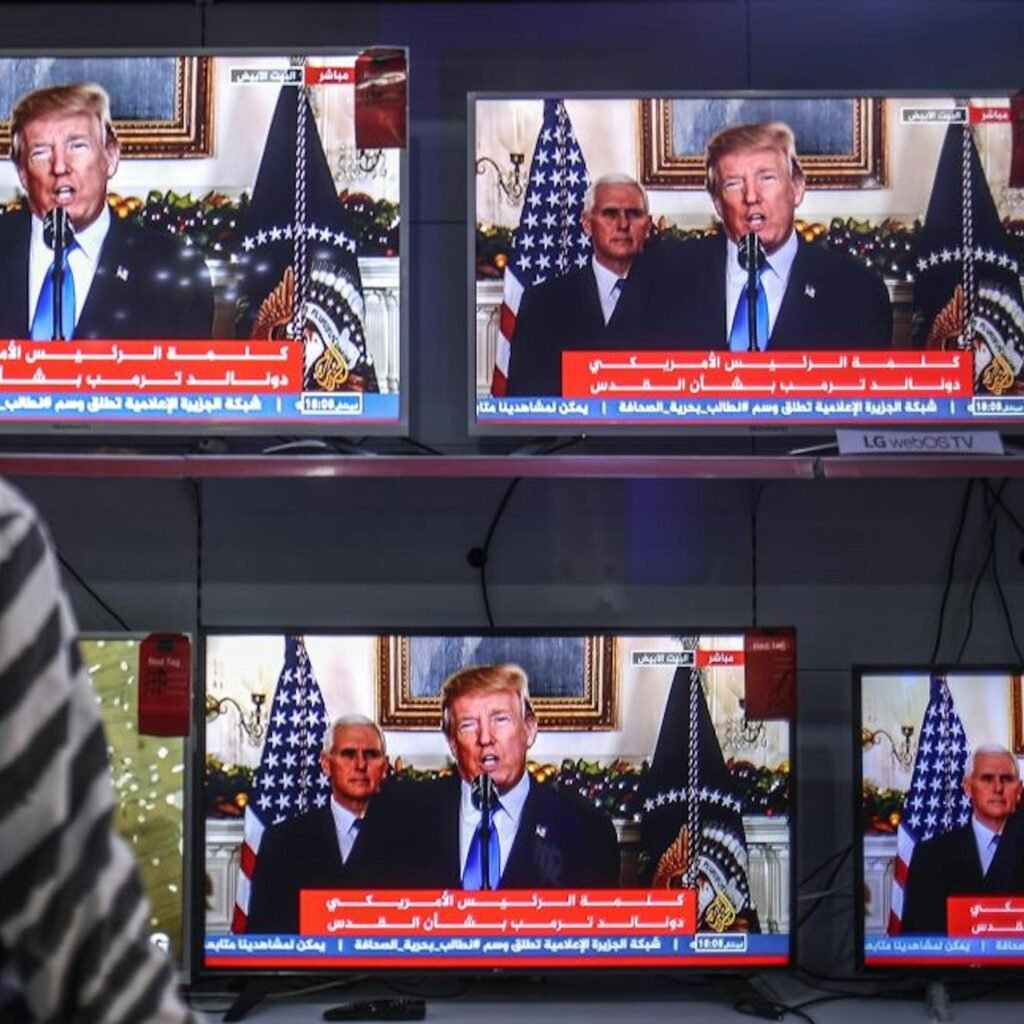
Journalist Matt Taibbi is fed up with the way political identity has become the only thing readers care about. In an essay published by The Daily Wire and republished from his Racket News Substack, Taibbi laments that no matter what a writer produces, audiences now file it away according to one metric: its position relative to Donald Trump.
“You can publish 50 words or 5,000, but what you’re producing for most audiences is a compass heading, showing where you reside on a map in relation to Donald Trump,” Taibbi writes. Whatever the intended subject, he says, “the compass reading is the only thing most people care about.”
The piece, titled “Anti-Anti-Trump Politics Swallowed The World,” serves partly as an explanation for Taibbi’s recent quiet spell. He cites three reasons: a book manuscript nearing completion, a document-heavy investigative story in the works, and what he calls an “existential pileup” — a crisis of purpose in a media environment where every output gets tagged with a political coordinate.
The ‘Anti-Anti-Trump’ Frame and Its Origins
Taibbi traces the current dynamic back to Peter Beinart’s 2017 Atlantic essay “The Anti-anti Trump Right,” which he says defined almost anything short of explicit opposition to Trump as “evading the reality” and “opposing the people who oppose Trump.” Under that logic, Taibbi argues, nearly any subject or argument can be dismissed as throat-clearing on the way to a refusal to say what is required about the former president.
He links that rhetorical move to a broader shift in academia, where he says a large segment of the social sciences chose to purge “objective” pursuit of knowledge — a decision one literature professor, quoted by Taibbi, derided as the act of “intentionally [dissociating] their work from the political and ideological exigencies of the time.”
As a fresh example, Taibbi points to Northwestern University professor Gary Saul Morson’s recent essay “Advocacy in Literary Studies,” part of a broader “State of Scholarship” report promoted by the chancellors of Vanderbilt University and Washington University in St. Louis. Morson’s essay invokes William Hazlitt’s observation that literature, unlike the hard sciences, does not progress — Aristotle’s Poetics remains relevant in a way his physics does not, and no dramatist has surpassed Shakespeare. Taibbi notes that the report was promptly denounced as a “diabolical” attack on academics who are “critical of configurations of power in the Trump years.” The mere suggestion that “Anna Karenina” will always be a great book, he writes, now offends someone’s politics.
“Call it anti-anti-Trump academia,” Taibbi writes.
A Profession’s Old Warnings Come Due
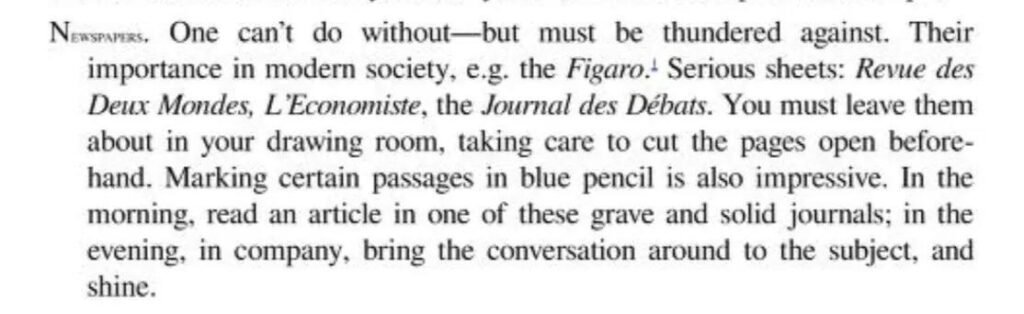
Taibbi, a New York Times bestselling author and creator of Racket News, admits he once laughed off the warnings of his journalistic heroes. He recalls Hunter Thompson calling the profession a place where “thieves and pimps run free and good men die like dogs,” Oscar Wilde saying “journalism is unreadable, and literature is not read,” and Balzac labeling it a “bottomless pit of iniquity and treachery and lies.”

He also cites Flaubert, who in a letter to George Sand described the press as a “school of demoralization” that “dispenses with thinking,” and H.L. Mencken, whom Taibbi idolized, calling the newspaper a “public organ for making the ignorant more ignorant and the crazy crazier.” Taibbi notes that many of journalism’s harshest critics were cheerful practitioners — Mencken himself spoke of living the “life of kings” even as he derided newspapers as opinion factories.
But now, he writes, “I’m beginning to appreciate those old warnings.”
The problem, as Taibbi frames it, is not that journalism is dead or that reporting has no value. It’s that a writer’s “most unforgivable sin is being boring,” and in the current climate, the quickest way to bore an audience is to refuse the binary. Once readers can classify a piece by its political taxonomy, the game is up. He acknowledges it’s fine if people find Trump interesting, or if they want to send an unambiguous signal about where they stand. But he resists the idea that everything must be a signal.
Why the Best Stories Live Elsewhere
To illustrate the dysfunction, Taibbi points to the most influential stories of a period being set far from its present: “Julius Caesar,” “The Crucible,” “Gulliver’s Travels,” “Minority Report.” He dwells on Mikhail Bulgakov’s “The Master and Margarita,” written in the mid-1930s when the author knew he’d never see it in print under Stalin. Bulgakov wrote partly for a hypothetical future and partly for his own sanity, creating a story about mortality, art, love, and bravery — and laughing all the way.
“People reading that book 50 years from now won’t have a clue he wrote it in the middle of the purges,” Taibbi writes, “which seems like the ultimate triumph over those purges.”
He concedes the comparison is different from his own situation. But the point stands: the best work often resists being reduced to the politics of its moment.
Taibbi says he has ideas for more traditional reporting and research on Racket without being dull, including a project seeking “academic escapees” who might help dig into a thing or two. He asks readers for patience and suggestions, noting he’s now more able to attend events. But he draws a line at playing what he calls the binary game.
“The whole country can’t be the same desert,” he writes. “Can’t we find new worlds to explore?”
The essay originally appeared on Racket News and is republished with permission.
Source: www.dailywire.com — https://www.dailywire.com/news/anti-anti-trump-politics-swallowed-the-world