
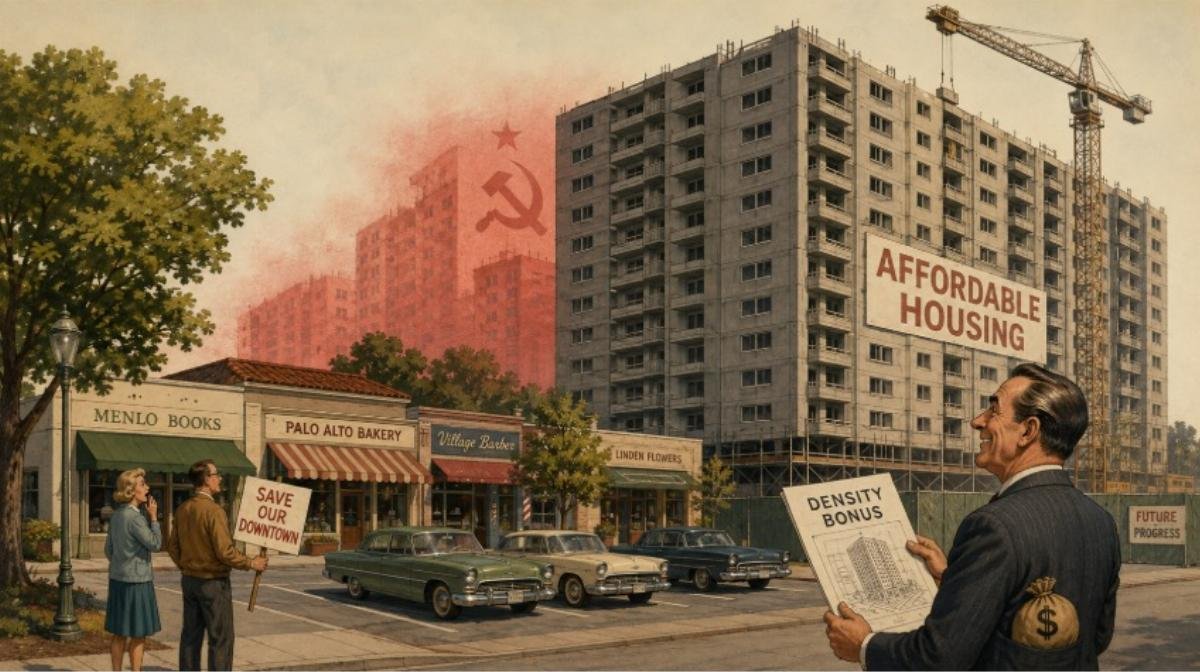
In the heart of Silicon Valley, the classic bedroom community of Menlo Park is facing what residents describe as an existential threat to its character. The city’s council has endorsed a plan to convert three downtown parking plazas—lifelines for its collection of mom-and-pop shops—into high-density, subsidized housing projects rising seven and eight stories. According to a recent op-ed in American Thinker by Cherie Zaslawsky, a Menlo Park resident and writer, the proposal could shutter half of the town’s small businesses during construction alone, with more closures likely once the new towers bring roughly a thousand new residents into 345 units shoehorned between one-story storefronts.
Zaslawsky describes the local reaction as immediate disbelief, with residents exclaiming, “That makes no sense!” That sentiment has coalesced into civic action, including a ballot measure slated for the November election. But she argues Menlo Park is not an isolated case. Across the Bay Area and beyond, suburban communities are being targeted for what she calls “radical urbanization,” with massive apartment complexes appearing in neighborhoods that once prided themselves on a quieter, more spacious way of life.
The driving forces, according to Zaslawsky, are state-level policies that prioritize density as a tool to combat climate change, often wrapped in the language of “affordable housing.” Developers are incentivized through so-called density bonuses: set aside a percentage of units at below-market rates, and they can greatly increase the total number of units. Meanwhile, California’s generous subsidies mean even families earning up to $250,000 in some Bay Area counties can qualify for reduced rents—a point Zaslawsky highlights as a distortion of the housing market.
A Statewide Pattern That Started with Plan Bay Area
Zaslawsky traces the roots of this transformation to Plan Bay Area, created in 2013 by the Association of Bay Area Governments and the Metropolitan Transportation Commission. That regional blueprint imposed a one-size-fits-all template on all nine Bay Area counties and their 101 cities, channeling growth into “transit corridors” and “priority development areas” near bus and train lines. The explicit goal was to reduce car reliance and promote public transportation, but Zaslawsky argues the effect has been to strip cities of their local character and historic control over zoning and land use.
She points to a wave of subsequent state legislation that further eroded municipal autonomy, forcing cities to accept higher densities they never chose. “Before you count your blessings since you live elsewhere,” she writes, “remember the motto: ‘As California goes, so goes the nation.'” The same dynamics, she warns, are quietly spreading across the country through policies inspired by international frameworks like Agenda 21, which she says draw eerie parallels between the Bay Area’s “priority development areas” and the plan’s densely populated “Human Settlements” zones.
The Money Behind the Movement
Zaslawsky does not mince words about the financial incentives at play. Developers, she says, are “making out like bandits,” using the affordable-housing ruse to secure approvals for projects far larger than anything previously permitted. But they are not alone. She also calls out nonprofit advocacy groups like YIMBY Law, which she describes as profiteering NGOs that “virtue-signal their love for ‘the poor'” while collecting substantial donations. She notes that YIMBY Law’s 501(c)(3) boasted $2.23 million as of 2024.
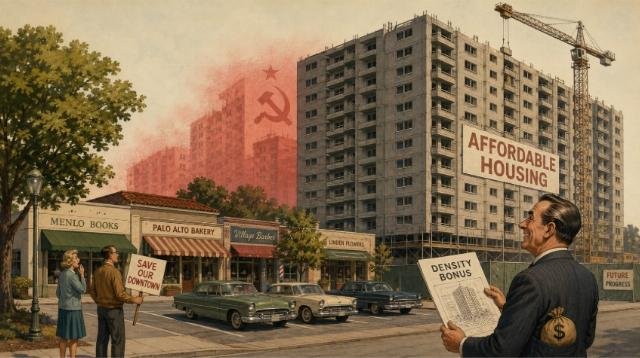
For Zaslawsky, the stakes go beyond parking lots and building heights. She frames the fight as a battle for the American Dream itself. “Dismantling our suburbs means foreclosing on the American Dream—a shortcut to upending America,” she writes. The architecture of these new projects—charmless, utilitarian high-rises that she compares to Soviet-era Plattenbau housing—only reinforces her sense that something fundamental is being lost.
Notably, she observes a bitter irony: just as Russia’s Vladimir Putin ordered the demolition of Moscow’s iconic post-war apartment blocks, California seems determined to build its own stack-and-pack housing. The comparison suggests a larger ideological drift, one that Zaslawsky believes deserves more attention than it gets.
Local Resistance Meets State Power
In Menlo Park, the battle lines are drawn. Residents face a city council that appears to have sided with developers and regional planners over the community’s own wishes. Zaslawsky argues that the council’s plan ignores the reality that California’s population is not actually growing at the rate claimed, with residents leaving in droves and the only increase coming from undocumented immigrants—a statement that reflects the op-ed’s broader political perspective.
Whatever one makes of that argument, the underlying conflict is real and escalating. Suburban communities across the country are being forced to confront a fundamental question: should they accept high-density housing as a necessary response to climate change and affordability, or should they resist what they see as an imposed transformation that threatens their way of life?
For Zaslawsky, the answer is clear. She calls on readers to fight back locally and nationally, insisting that “the war against our way of life is real, and the battlefield is quite literally our suburbs.” Whether voters in Menlo Park agree will become clear in November.
Source: www.americanthinker.com — https://www.americanthinker.com/articles/2026/08/the-wrenching-transformation-of-our-suburbs/