
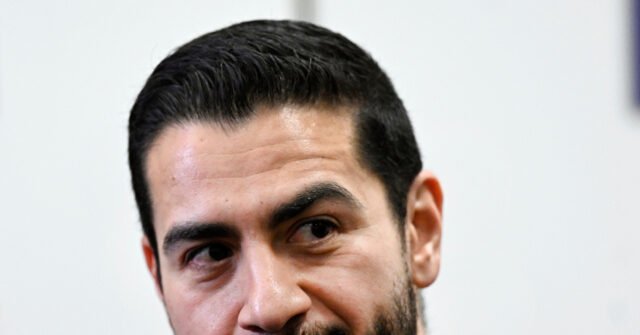
A bitter internal divide is threatening Democratic prospects in Michigan’s pivotal Senate race, with party centrists reportedly more fearful of their own nominee than a Republican victory, according to a report from the Intercept published Saturday.
The outlet reported that centrist Democrats view Abdul El-Sayed’s potential election to the U.S. Senate as “the nightmare they fear most,” a stunning admission that highlights the deep ideological fractures within the party ahead of Tuesday’s midterm elections.
El-Sayed, who won the Democratic primary in August against moderate Rep. Haley Stevens, has faced intensifying scrutiny from both Republicans and members of his own party in the final days of the campaign. The intraparty tension reached a boiling point this week over an advertisement produced by Cenk Uygur’s Rebellion PAC that linked domestic price increases to U.S. military aid to Israel.
Though El-Sayed’s campaign had no involvement in creating or distributing the controversial ad, party moderates pressured him to publicly distance himself from it. When his campaign issued the requested condemnation on Thursday, Stevens used the moment not to unite behind her party’s nominee, but to launch a scathing critique of El-Sayed.
Primary Wounds Remain Fresh
Stevens framed her decision to campaign for El-Sayed this weekend alongside Rep. Jim Clyburn of South Carolina as a “celebration” of her magnanimity, while simultaneously laying out conditions for her support with just days remaining before the election. The Intercept’s Eoin Higgins characterized the move as taking a conciliatory gesture from El-Sayed and turning it into a “springboard for a scathing denouncement.”
The public discord comes at a critical moment for Democrats nationally, as the party grapples with broader questions about its ideological direction. According to the Intercept report, “right-wing Democrats aren’t stupid” and recognize “their influence over the party is at a historic low,” suggesting that centrist opposition to El-Sayed may stem partly from anxiety about their diminishing power within Democratic politics.
The Michigan race has also become emblematic of reported tensions between Democrats focused on economic messaging and those prioritizing social issues, particularly regarding transgender rights and related policies. These internal divisions could complicate the party’s ability to capitalize on potential House or Senate majorities in 2027.
Republican Opponent Seizes Opening
Republican Senate candidate Mike Rogers has wasted no time capitalizing on the Democratic disarray, directly courting Stevens’ supporters to defect to his campaign. In a social media post, Rogers framed his outreach as an olive branch to Democrats uncomfortable with their own nominee.
“When people tell you who they are, believe them. Abdul El-Sayed’s campaign has been based on vile racism and antisemitism, funded by groups who support terrorism, and designed to divide and blame,” Rogers wrote, deploying harsh rhetoric against the Democratic nominee.
He continued: “As I said the day after the primary, if you believe Michigan can have a future where we can all come together, you have a home with us. I say today: if you are a Haley Stevens voter who rejects this bigoted and hateful candidate, you have a home with us.”
Rogers positioned his campaign as focused on bread-and-butter issues, promising to “work together to make housing affordable, improve education and, lower gas prices.”
Trump Weighs In With Endorsement
President Donald Trump entered the fray on Saturday with a full-throated endorsement of Rogers, praising the Republican’s military and congressional service while launching attacks on El-Sayed that touched on both policy positions and personal characteristics.
“From the U.S. Army to Congress, Mike has served our Nation with distinction, and will bring that same Fighting Spirit to the U.S. Senate,” Trump wrote on Truth Social.
The president characterized El-Sayed as opposing Trump’s tax proposals, including no tax on tips, overtime, or Social Security benefits, claiming the Democratic candidate “wants massive Tax Increases, Open Borders, Men playing in Women’s Sports, and Transgender Mutilization of your Children.”
Trump concluded his endorsement by calling El-Sayed “Reckless, Radical, and Dangerous.”
Trump had previously campaigned in Michigan, telling supporters: “I’m here today in Michigan for a very important reason, I’m here to keep a jihadist Muslim Brotherhood member from becoming a United States senator, and that’s the fact. We’re not going to let that happen.”
Broader Implications for Democratic Party
The Michigan Senate race has become a flashpoint in the ongoing struggle over the Democratic Party’s future direction. El-Sayed represents a progressive wing that has gained strength in recent years, particularly among younger voters and activists, while centrists like Stevens reflect an establishment wing anxious about electability and ideological positioning.
The willingness of party insiders to reportedly prefer defeat over a progressive victory suggests the internal ideological battle may be viewed by some Democrats as more consequential than losing ground to Republicans in the short term.
With the midterm elections just days away, the public discord in Michigan stands as a stark example of how intraparty divisions can undermine electoral prospects, potentially handing Republicans an advantage in a race that could help determine Senate control. Whether moderate Democrats will ultimately turn out for their party’s nominee, or whether some may tacitly support Rogers, could prove decisive in what appears to be a competitive contest.
The outcome in Michigan will likely be watched closely by both parties as an indicator of which ideological faction holds sway with voters when Democratic divisions are laid bare before the electorate.
Source: www.breitbart.com — https://www.breitbart.com/midterm-election/2026/11/01/report-centrist-democrats-would-rather-lose-than-see-abdul-el-sayed-become-a-u-s-senator-the-nightmare-they-fear-most/