

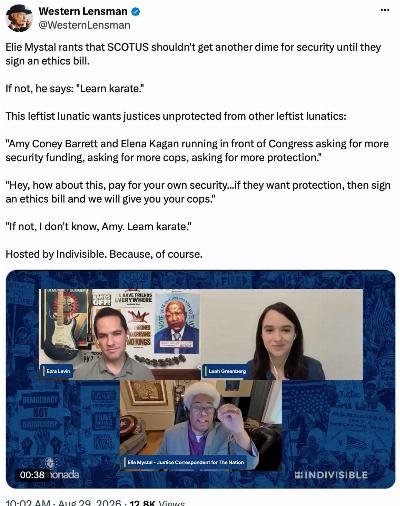
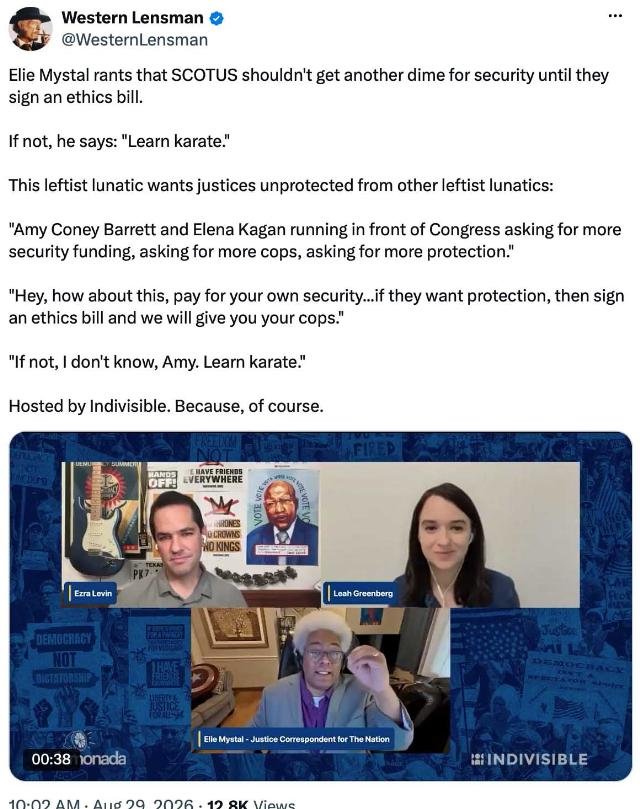
In a recent appearance on a progressive video cast, journalist Elie Mystal, known for his blunt critiques of the judiciary, proposed that Supreme Court justices could dispense with their security detail and instead “learn karate.” He made the comment while specifically singling out Justice Amy Coney Barrett as a candidate for such training, according to a report in American Thinker.
Mystal, who serves as the Justice Correspondent and Columnist for The Nation magazine, made the remarks during a program hosted by Indivisible, a progressive advocacy group. His suggestion came in response to a series of recent Supreme Court rulings that have drawn criticism from the left, American Thinker reported.
The outlet’s columnist, M. Walter, framed Mystal’s comment as not merely rhetorical but as part of a broader pattern of escalating hostility toward the judiciary. Walter noted that Mystal chose to single out Barrett—the youngest and most physically vulnerable of the conservative justices—rather than the Court’s elderly male members, calling the choice “selective misogyny.”
Mystal’s role extends beyond commentary. He is a board member of Demand Justice, a progressive group focused on federal court reform, and his opinions carry weight within activist circles, Walter wrote. The comments appeared on the video cast of Indivisible, which has been connected to protests outside the homes of justices.
Protests at Justices’ Homes Draw Attention
The article points to recent demonstrations organized by Indivisible, including a gathering in the small Maine town where Chief Justice John Roberts has a summer home. Protesters reportedly lined the streets near the property, and some went further by paddling kayaks close to the shore in front of his residence.
Walter argued that such actions cross a line, turning peaceful protest into intimidation. “It’s a very short paddle from kayaks in one’s backyard to direct confrontation,” he wrote, adding that once activists know where a justice lives, the risk of escalation becomes real.
The piece also references a 2018 protest outside the home of Senator Susan Collins, who faced a crowd of demonstrators clanging pots and pans over her vote on a Supreme Court nominee. Walter, who is no admirer of Collins or Roberts, nevertheless insisted that basic civility and safety should transcend political disagreements.
Call for Stronger Laws
Walter is not content to merely criticize the protests. He calls for new legislation that would impose a mandatory minimum sentence of one year in jail for anyone caught loitering or disturbing the peace outside a judge’s or Justice’s private property. He suggests a threshold of one minute of standing in front of a home—excluding those actually delivering goods or passing by on foot—would be sufficient to trigger the penalty.
“One minute = one year. Sounds good to me,” he wrote, adding that similar protections should extend to legislators’ homes, noting that current laws already prohibit protesting the judiciary with the intent to influence adjudication, but no such protections exist for lawmakers.
The columnist acknowledged that nothing can be done to silence Mystal, conceding “you’re allowed to be stupid in public.” But he urged Senate Majority Leader John Thune to act on the proposed legislation, arguing that the “left has lost control, and they are dangerous.”
The broader context is a judiciary increasingly under pressure from both ends of the political spectrum, with activists on the right also staging protests outside justices’ homes in recent years. However, this piece focuses specifically on left-wing actions, which the author argues have crossed into dangerous territory.
While Mystal’s karate remark may be dismissed by some as hyperbole, Walter insists that the underlying threat is real. The combination of explicit suggestions that security is unnecessary, paired with actual protests at private residences, creates an environment in which judges and their families could become targets.
Implications for Judicial Independence
The article raises concerns about the ability of judges to act without fear of reprisal. Protests at homes, even if peaceful in form, can feel like intimidation to those inside, and judges’ families are particularly vulnerable, Walter argues. He notes that spouses, children, and elderly relatives should not have to worry about their safety simply because of a loved one’s public role.
Walter’s proposal for a mandatory custodial sentence is heavy-handed, and it would face serious constitutional challenges over free speech and assembly rights, but the sentiment reflects a growing frustration among conservatives who see judicial protest as a form of coercion.
For now, the karate comment remains a rhetorical flashpoint. Whether it translates into policy is uncertain, but it has drawn a sharp line between those who see it as a joke and those who see it as a threat to the rule of law.
Source: www.americanthinker.com — https://www.americanthinker.com/blog/2026/09/msnow-leftie-tells-justin-acb-to-lean-karate/