
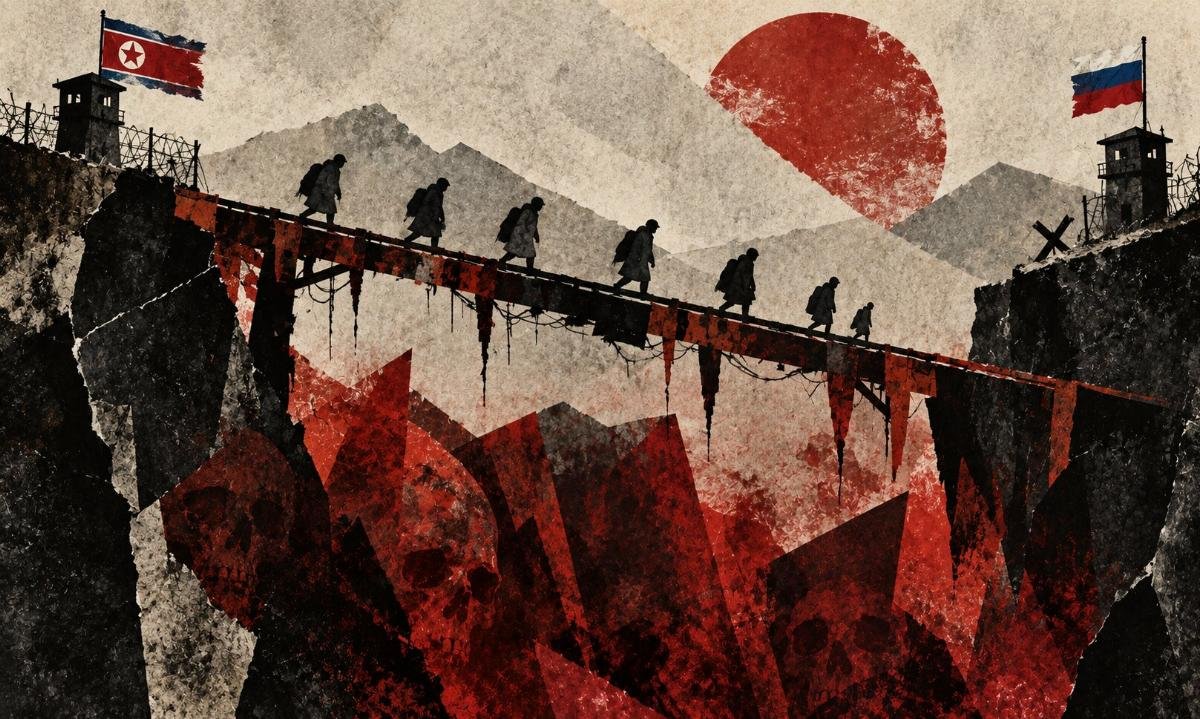
In early September, North Korea finished a small piece of infrastructure that may end up mattering far more than its size suggests. Pyongyang opened a two-lane road and bridge across the Tumen River on September 7, the river that marks part of its frontier with China and its entire maritime border with Russia before emptying into the Sea of Japan. According to James Zumwalt, writing in American Thinker, that 324-mile waterway is now crossed by a structure that functions less as a trade route than as a conveyor belt for manpower.
The bridge is almost certainly an outgrowth of the strategic partnership agreement Moscow and Pyongyang signed in 2024, which commits each side to military assistance if the other comes under attack. But Zumwalt argues its real purpose is narrower and darker: moving North Korean soldiers into Russia and onward to Ukraine, where Moscow desperately needs bodies to absorb losses it cannot otherwise sustain.
A Hermit Kingdom With Only Four Doors
North Korea has spent seven decades earning the label “Hermit Kingdom,” a name that originally described the entire peninsula’s isolationist posture in the late 19th century and stuck to the North after the two Koreas became separate states in 1948. The isolation is enforced with unusual thoroughness. Pyongyang permits entry through its capital’s airport from only four cities worldwide, all of them in China and Russia. There are no direct flights from Seoul to Pyongyang — even a traveler who has secured government authorization must first fly to a third country and connect from there.
That tight control cuts both ways. It is meant to stop illegal immigration, a genuine rarity, though at least seven U.S. soldiers have defected since the Korean War. It is far more importantly meant to stop emigration, which remains a persistent problem for the regime. This is the context in which the Juche ideology of total self-reliance took root — and the context in which the North has remained a third-world economy while its southern neighbor ranks 13th in the world.
Against that backdrop, a brand-new bridge to Russia is a striking departure. It is also a telling one.
The Cannon Fodder Pipeline
Moscow’s relationship with Pyongyang predates the current war. The Soviet Union funneled financial aid to North Korea until it collapsed in 1991, and post-Soviet Russia, eager to keep influence in Pyongyang, forgave a $10 billion debt and later sold the North oil. Then came February 2022 and Russia’s invasion of Ukraine, a gamble Zumwalt describes as Moscow biting off more than it can chew.
Since then the two countries have traded lifelines: technology from Russia, manpower from North Korea. The arrangement suits Pyongyang’s leadership, which Zumwalt says has historically shown no regard for its own people’s lives. He points to Kim Il Sung, grandfather of current leader Kim Jong Un, who pressed Hanoi to let North Korean pilots fly combat missions during the Vietnam War. Poorly trained, nearly every North Korean pilot who engaged a U.S. aircraft was shot down, and more than a dozen never came home. Their remains rest in a cemetery in Bac Giang Province, roughly 30 miles east of Hanoi.
Kim Jong Un, in this telling, cares even less. He initially sent 12,000 soldiers to Ukraine, many of whom have already become casualties. The Tumen River bridge gives him a permanent people-mover to accelerate that flow — and it solves a domestic problem at the same time.
An Army That Is Fed Less
North Korea boasts the world’s fifth-largest military, roughly 1.3 million personnel, about the same headcount as the U.S. armed forces. Feeding it has always been a strain.
The consequences are visible in the bodies of the soldiers themselves. More than two generations after the peninsula split, North and South Korean troops still share the same DNA and the same geography — but the average North Korean soldier stands about five inches shorter and weighs twenty pounds less than his southern counterpart. The phenomenon is known as “biological divergence,” and it has one cause: the South has had food in abundance, while the North has endured repeated shortages and famines. Zumwalt’s framing is blunt — the South fields an army of Goliaths, the North an army of Davids, and the northern Davids have no biblical advantage to fall back on.
Shipping soldiers abroad, then, eases a logistical burden Pyongyang has carried for decades. What Russia gets in return is less clear. North Korea has little modern weaponry to offer beyond ammunition, so the bridge is expected to carry far more human traffic than materiel.
Staggering Losses — and a Surprise Defection
The numbers emerging from the battlefield are grim. Roughly 20,000 North Korean troops are believed to be on the ground in Ukraine, with Pyongyang expected to send up to 50,000 more. Ukraine reports at least 6,000 dead among them and thousands more wounded. British intelligence puts the casualty rate considerably higher, at 50 percent of those deployed.
Surrender is not an option. North Korean soldiers have been ordered by their superiors to take their own lives rather than be captured. In exchange for that sacrifice, Pyongyang receives Russian technical assistance for spy satellites, drones, and surface-to-air missiles.
There is one outcome the North’s leadership almost certainly did not anticipate. Reportedly, 200 North Korean personnel have not only defected but volunteered to join the Ukrainian army and fight the Russians — a small but remarkable reversal for soldiers sent abroad to die on Moscow’s behalf.
Combat, meanwhile, is teaching the North Korean military something, however brutally. The force is now described as “less inept” than it was, though the improvement has been purchased entirely in corpses — and mostly in place of Russian ones. Russian forces on Ukrainian battlefields have been losing at roughly a 2:1 ratio; North Korean troops may narrow that gap, but only by dying where Russians would have.
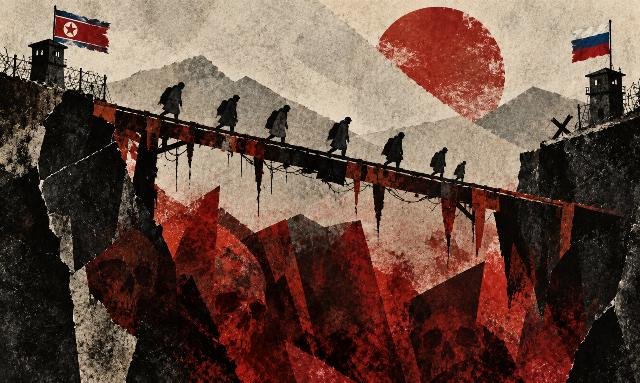
Zumwalt’s conclusion is unsparing. The soldiers crossing the Tumen River know what awaits them on the other side. For them, the new bridge is not a route to Russia. It is a bridge to death.
Source: www.americanthinker.com — https://www.americanthinker.com/articles/2026/09/north-korea-s-bridge-of-death/