
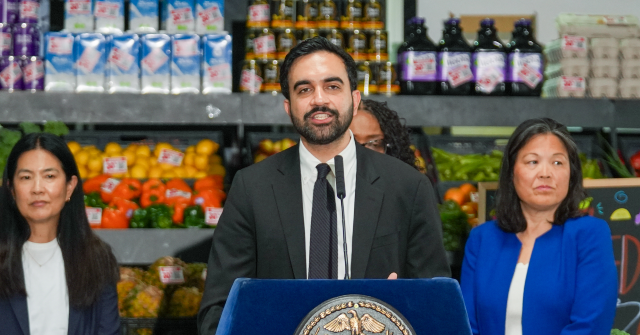
New York City Mayor Zohran Mamdani’s initiative to establish government-run supermarkets will require shoppers to present identification before making purchases, according to recent statements from city officials that have sparked debate over ID requirements and government programs.
The requirement emerged during a discussion about the city’s Request for Proposals (RFP) for operating the government-run grocery stores, where Mamdani explained the identification measure is designed to prevent resale fraud.
“So, our RFP makes very clear that this is a program for New Yorkers to be able to put food on the table, not a program for people to be able to make a quick buck through reselling,” Mamdani said, before turning to Jeanny Pak, the Interim President and CEO of NYC Economic Development Corporation.
Pak elaborated on the identification system: “Yes, if you look at our RFP for the operator, we are looking to make sure that we target New Yorkers, whether it be [through] a sort of a library card-esque [system], and also, we manage who’s buying and that it’s focused on everyday New Yorkers.”
Government-Subsidized Food Sales
The government-operated grocery stores would reportedly sell food at prices approximately 30 percent below typical retail costs. This pricing structure has raised concerns about the potential impact on privately-owned grocery stores, which typically operate on profit margins below five percent.
Critics of the program argue that the significant price differential could drive private grocery stores out of business, potentially increasing government control over food distribution in the city. The concern centers on the possibility that as private stores close due to competition from subsidized government stores, the city would expand its network of government-run outlets, further reducing private sector involvement in food retail.
Voter ID Controversy
The identification requirement has drawn attention due to its apparent conflict with positions many Democratic officials, including those in New York, have taken regarding voter identification laws. Democratic lawmakers have frequently opposed voter ID requirements, arguing that such measures create barriers to voting, particularly for minority and low-income voters.
Common arguments against voter ID laws include claims that government-issued identification can be difficult or burdensome for some residents to obtain, that such requirements disproportionately affect certain demographic groups, and that voting is a fundamental right that should not require additional documentation.
The apparent inconsistency between opposing voter ID while requiring identification for government grocery purchases has become a focal point of criticism. If obtaining government ID presents obstacles for voting, critics ask, wouldn’t the same barriers apply to accessing food through government stores?
Fraud Prevention Rationale
City officials justified the ID requirement as necessary to prevent individuals from exploiting the program by purchasing subsidized groceries and reselling them at higher prices for profit. The concern about resale fraud appears to have prompted the decision to implement identification verification systems.
The “library card-esque” system referenced by Pak would function as a form of government-issued identification, since libraries are government-operated institutions. This characterization has further fueled debate about the nature of the ID requirement and its relationship to broader discussions about identification in accessing government services and exercising rights.
Economic and Political Implications
The program represents a significant expansion of government involvement in food retail, an industry traditionally dominated by private enterprise. Mamdani’s approach to establishing government-operated supermarkets marks a departure from conventional municipal services and raises questions about the appropriate role of government in commercial markets.
The initiative’s potential effects on New York’s grocery retail landscape remain uncertain, but the combination of substantial price subsidies and ID requirements has generated discussion about both economic policy and civil liberties. The debate encompasses questions about market competition, government assistance programs, and consistency in policy positions regarding identification requirements.
As the city moves forward with its RFP process for selecting operators of the government-run stores, the controversy over ID requirements is likely to continue shaping public discourse about both the grocery program itself and broader questions about identification policies across different government services and civic activities.
Source: www.breitbart.com — https://www.breitbart.com/politics/2026/08/03/nolte-zohran-mamdani-wont-let-you-buy-his-food-without-government-id/