
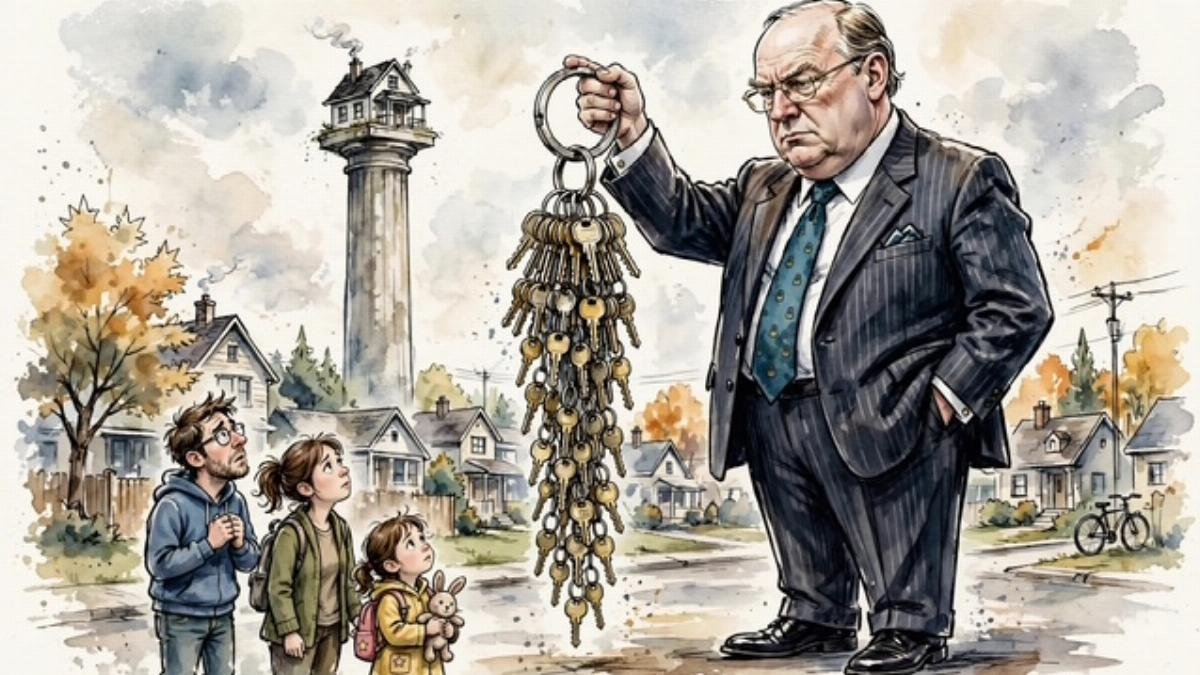
For years, the popular narrative of class conflict in America has centered on a familiar set of battle lines: the rich versus the poor, workers versus corporations, generations squaring off over resources and blame. But according to a new essay at the American Thinker, those framings may be missing the more consequential division taking shape.
The piece, written by George P. Brooks, argues that the next American class war will not be primarily between rich and poor, but between owners and dependents. The distinction, Brooks contends, is not merely about income or wealth—it is about autonomy, leverage, and the ability to make decisions without asking permission from someone else.
“Ownership is autonomy. Ownership is leverage. Ownership is the ability to make decisions without constantly asking permission from somebody else,” Brooks writes.
His argument reframes the economic anxieties that have dominated political discourse for the past decade. Rather than focusing solely on stagnant wages or income inequality, Brooks suggests that the more telling metric—and the more politically potent one—is whether ordinary Americans can accumulate assets that give them a stake in their communities and their futures.
The gap between earning and owning
Central to Brooks’s thesis is a rejection of the assumption that a comfortable income equals economic freedom. A person earning six figures but carrying heavy debt, with little savings and few meaningful assets, may have far less freedom than someone earning less who owns a home, runs a small business, and maintains an emergency fund.
“Income tells you what someone earns. Ownership tells you what someone controls,” Brooks writes.
His point is that the wage economy alone does not create independence. A paycheck can be taken away. A supervisor can be displeased. A landlord can raise rent. Ownership, in contrast, provides a buffer—room to breathe, to take risks, to say no, and to build something that outlasts a single job.
That distinction, Brooks argues, is becoming increasingly relevant as the traditional path to ownership—work, save, buy, build equity, and pass something on—becomes harder for millions of Americans to follow. When ownership is out of reach, he contends, dependence becomes structural, not temporary.
The family formation question
Brooks also connects the ownership crisis to a demographic puzzle that has puzzled policymakers and cultural commentators alike: the declining rates of marriage and childbearing among young Americans, especially young men.
“We keep asking why young Americans are delaying marriage and children, but perhaps we should also ask a brutally practical question: How do you build a family when you can barely build a balance sheet?” he writes.
His argument is that family formation requires stability—and that stability is increasingly tied to asset ownership. A young man who cannot envision buying a house, who cannot accumulate savings, and who is burdened by debt will approach marriage and parenthood far differently than his grandfather did, Brooks suggests. The intangible desire for family, in his telling, is undermined by a material incapacity to provide a foundation for one.
A conservative case for ownership
Perhaps the most pointed part of the essay is its challenge to conservatives. Brooks argues that right-of-center politics has too often equated economic freedom with low taxes, deregulation, and minimal government—what he calls “simply about what government doesn’t take.”
“But economic freedom isn’t simply about what government doesn’t take. It is also about what individuals are capable of owning,” he writes.
His proposed agenda is deliberately practical: make it easier to build starter homes, reduce regulatory barriers that inflate construction costs, encourage apprenticeships and skilled trades, ease the formation and survival of small businesses, promote financial literacy and saving, and make retirement ownership more accessible.
The essay takes a dig at the decades-long consensus that a college degree is the primary ticket to the middle class. Millions of young Americans followed that advice, often borrowing heavily to do so, only to emerge with credentials, debt, and no house. Meanwhile, Brooks notes, the skilled trades are desperate for workers.
“There is something wonderfully conservative about a person who can look at a broken machine and know how to fix it. There is something even more conservative about a person who can build a house and eventually own one,” he writes.
A nation of stakeholders
Underneath the policy proposals lies a broader cultural argument. Brooks wants more people to become wealthy—not because money is the meaning of life, but because economic independence creates options. Ownership, he argues, converts passive observers into civic stakeholders, people with enough skin in the game to care whether the game survives.
He draws a sharp line against what he calls the “dependency mindset,” warning that governments, corporations, and even cultures can foster dependence while claiming to help. A government can make people dependent while handing out benefits. A corporation can make people dependent while paying well. A culture can make people dependent while reassuring them they are free.
The essay concludes with a call to reorder how we measure the health of the American middle class. Instead of measuring success exclusively by income, Brooks suggests, we should ask a more consequential question: How much do they own?
“A nation of workers can be economically productive; a nation of owners is politically independent and economically productive,” he writes.
Whether the “owners versus dependents” framing gains traction remains to be seen. But the essay touches on a live political nerve, one that resonates across party lines as housing costs climb, student debt persists, and the stability of the middle class continues to be a central theme in American political life.
Source: www.americanthinker.com — https://www.americanthinker.com/blog/2026/08/the-new-american-class-war-is-between-owners-and-dependents/