
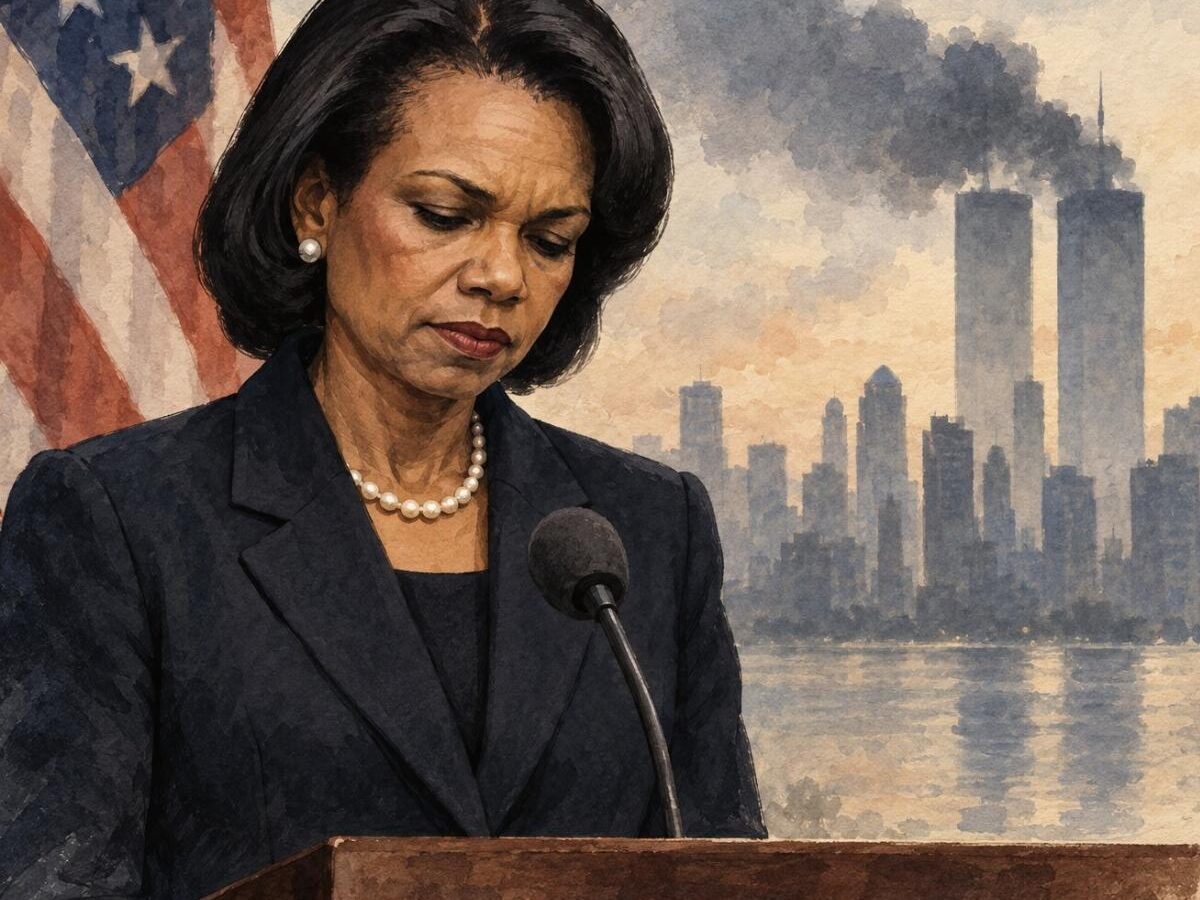
Condoleezza Rice’s apology on the 25th anniversary of 9/11 was striking for its personal tone. The former national security adviser told the families of the fallen that she would “always carry deep personal remorse” and that “those of us in authority on that day did not see the nature of the danger in time to prevent the attack.”
But a new column in American Thinker argues that Rice is apologizing for the wrong thing — and that the person who actually owes the families an explanation is Bill Clinton.
Written by Allan J. Favish, an attorney in Los Angeles, the piece contends that Rice “did not see the nature of the danger in time” because the Clinton administration never gave her the details it already had about a 1995 plot to hijack commercial airliners and fly them into American landmarks. In Favish’s reading, Rice should not blame herself “for failing to connect dots that the Clinton Administration failed to give her.”
The column builds its case from decades of news reporting and a newly declassified intelligence memo, stitching together a timeline that it says shows Washington was warned years in advance that al Qaeda-affiliated terrorists wanted to turn planes into weapons.
The 1995 plot that had a name
Favish anchors his argument in Operation Bojinka, an al Qaeda-linked scheme uncovered in the Philippines in 1995 after a fire broke out in a Manila apartment that turned out to be the hideout of Ramzi Yousef. Yousef, later convicted for his role in the 1993 World Trade Center bombing, escaped, but investigators captured his right-hand man, Abdul Hakim Murad.
According to a CNN report from September 18, 2001, Murad described a plot to hijack a commercial plane and crash it into CIA headquarters and the Pentagon. Philippine investigator Rodolfo Mendoza recalled Murad narrating the plan to ram a commercial jetliner into Langley, Virginia. Philippine authorities also found evidence pointing to targets in San Francisco, Chicago, and New York City, and said they passed the information to the FBI in 1995 — though, as CNN noted at the time, it was not clear what the bureau did with it.
Similar reporting followed in the Washington Post days later. By September 26, 2001, the Village Voice reported that a computer expert working with Philippine investigators had downloaded files describing a diabolical project that included hijacking U.S.-bound airliners from Asian capitals and crashing them into “key structures in the United States,” including the World Trade Center, the White House, the Pentagon, the Transamerica Tower, and the Sears Tower. The expert told the Voice that one piece of the plot involved blowing up planes in flight, while other plans called for crashing them into specific targets — and that a dry run had actually been conducted in 1994, when a small bomb went off under a passenger seat on a Tokyo-bound Philippine Airlines flight, killing a Japanese tourist.
Favish writes that all of this was known to the Clinton administration and surfaced publicly in the weeks and months after 9/11.
Flight schools, warnings, and the 1998 PDB
The column also points to a May 19, 2002 Washington Post report stating that a “broad array of signals” — from foiled plots to FBI field interviews — had for years suggested al Qaeda-affiliated groups were considering using airplanes as missiles and U.S. flight schools as pilot training grounds. FBI investigators visited two flight schools in 1996 after the plot surfaced in the Philippines, school operators said. In 1998 and 1999, analysts warned federal officials that terrorists might crash hijacked aircraft into landmarks such as the Pentagon and the World Trade Center.
Far more detailed was a December 30, 2001 Washington Post Magazine piece about Murad’s capture, which reported that both the CIA’s Manila station chief and the resident FBI legal attache were notified, and that a team of intelligence agents flew in from Washington. The magazine quoted Aida Fariscal, the retired Philippine policewoman central to the capture, saying “The FBI knew all about Yousef’s plans.” General Avelino Razon, one of the lead investigators on the Bojinka case, told reporters after the attacks: “We told the Americans about the plans to turn planes into flying bombs as far back as 1995. Why didn’t they pay attention?”
Favish then cites a September 11, 2026 report from the California Post about a newly declassified Presidential Daily Brief memorandum dated September 10, 1998. According to that reporting, the memo prepared for Clinton warned that Bin Laden had said his preferred option was to strike the U.S. on its own soil in Washington, and that the same group responsible for the embassy bombings in Kenya and Tanzania might fly an explosive-packed airplane into a U.S. city.
A military aide’s account
The column also invokes retired Air Force Lieutenant Colonel Robert “Buzz” Patterson, a military aide to Clinton from May 1996 to May 1998 who was one of five people entrusted with carrying the nuclear football. In his March 2003 book “Dereliction of Duty,” Patterson wrote that during the summer of 1996 he personally learned the administration knew terrorists were plotting to use commercial airliners as weapons. One late-summer Saturday, Patterson wrote, the president asked him to retrieve several days’ worth of PDBs from the Oval Office. While rearranging the handwritten notes stuffed inside the folders, Patterson wrote that he noticed the heading “Operation Bojinka” and a reference to a plot to use commercial airliners as weapons. Because he was a pilot, Patterson wrote, it caught his attention — and he stated for a fact that the information circulated within the intelligence community and that the president was aware of it in late 1996.
The article notes that Rice herself addressed the question of what she was told. At a press conference on May 16, 2002, she said the Clinton administration did not inform her about Bojinka. Testifying before the 9/11 Commission on April 8, 2004, she repeated that the Clinton administration did not tell her about what was uncovered in the Philippines in 1995.
That testimony is the hinge of Favish’s argument. If Rice was kept in the dark about a plot that had been documented in U.S. intelligence channels years earlier, he writes, then her apology frames the failure as a personal shortcoming when it was at minimum an institutional handoff problem stretching across two administrations. The question he wants asked is not why Rice missed the danger, but why the information about it never reached the people responsible for acting on it on September 11, 2001.
The column does not address the counterarguments that have been made over the years about the difficulty of acting on fragmentary pre-9/11 intelligence, or the ways the Bush administration itself has been criticized for how it handled threat reporting in the summer of 2001. Favish’s focus is narrower: the specific, named plot that he says was passed up the chain and then apparently lost.
Whether that argument lands or not, it reframes the anniversary moment. Rice offered remorse. Favish argues the remorse should point somewhere else — at the administration that left her, in his telling, without the dots in the first place.
Source: www.americanthinker.com — https://www.americanthinker.com/articles/2026/09/the-mysterious-9-11-apology-by-condoleezza-rice/
Source: www.americanthinker.com
Related coverage
- FlyDubai Flight Attacked From Cockpit, Lands in Saudi Arabia — and an Israeli Song Breaks Out
- WNBA’s Eligibility Stalemate Draws a Sandy Posey Throwback Question
- American Thinker Defends Hegseth’s Push for Public Firing Squad for Nidal Hasan, Blasts George Will
- Did JD Vance Just Betray Trump for a 2028 Run? Inside the VP’s Explosive Israel Comments