
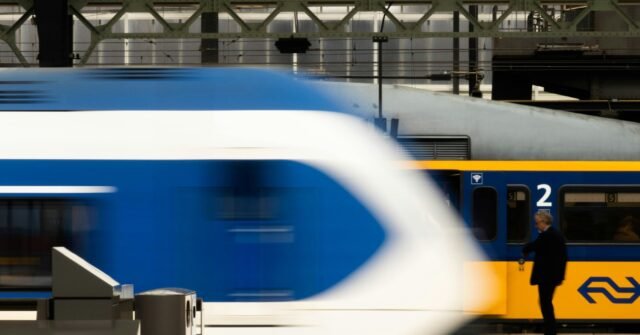
Unknown saboteurs brought large parts of the Dutch railway network to a standstill on Tuesday, using the system’s own safety technology against it to trigger red signals across the country, according to reports. Police and the Dutch general intelligence and security service, the AIVD, are investigating the coordinated action, which the national rail operator said involved deliberate human interference at more than 30 known locations.
The disruption left no trains running at all across wide areas of the northern and central Netherlands, with knock-on effects spilling onto roads and international services. As of Tuesday afternoon, services were beginning to resume, but the rail operator warned that not every disruption had been resolved.
How the attack worked
The method exploited a basic feature of modern rail signalling. Railways use low-voltage electrical circuits running through the two rails to detect where trains are: when a train’s wheels and axle bridge the gap between the tracks, they close the circuit, and the signalling system registers that the section is occupied.
By manually shorting that circuit, the saboteurs were able to make the network believe phantom trains were sitting on the line. The automatic system responded exactly as designed, turning signals red to prevent the imaginary trains from colliding, which in turn forced real trains to stop as well.
A railway spokesman described the objects as deliberately placed. Because the pipes lie across the track, he explained, the computer system receives a signal that the section is occupied at that location. Crews were finding them in multiple places spread across the country.
In some spots the conductive items were metal pipes around 1.5 meters long — just long enough to span two standard-gauge rails set four feet, eight and a half inches apart. In others, ordinary car jump-start cables clipped onto both rails achieved the same result.
Even more striking, the operator said that at some locations where materials had already been cleared, fresh objects appeared in the same place once engineers and police had left. In an update raising the count of known incidents from 27 to 30, the network described what it called an intentional disruption of train traffic caused by human action, adding that who was responsible and what the motive might be was not yet known.
The operator said repeated reports came in from certain locations: material was removed from the track, only for another malfunction to be reported at the same spot later.
Physical risk and spreading chaos
Compared with deliberately derailing a train, this type of sabotage is generally less dangerous to life, since it stops traffic by forcing signals to red. But the tactic has a blind spot: if a train is already close when the track is compromised, the obstruction will not be detected in time. Dutch newspaper De Telegraaf reported that a train struck a metal pole in at least one case on Tuesday morning. No injuries were reported.
The phantom-train problem also escaped the rails. At several locations, level crossings were automatically triggered to protect motorists from approaching trains that did not exist, pushing the disruption out onto the road network.
Dutch roads faced separate trouble the same morning, when farmer groups protesting environmental regulations imposed on the country by the European Union dumped burning hay bales onto major routes. That action, along with a paint-throwing protest in The Hague, was timed to coincide with Prinsjesdag, the royal procession that opens the parliamentary year — the Dutch equivalent of the State Opening of Parliament in the United Kingdom.
No claim, and denials
No group had come forward by Tuesday to claim responsibility for paralysing what amounts to nearly an entire European nation’s rail network. Some campaigning organisations, including Extinction Rebellion and a farmers’ protest movement, have publicly denied any knowledge of the sabotage.
The AIVD is assisting the investigation and says its focus is identifying who is behind the attack. The national counter-terrorism centre declined to comment.
The fact that short-circuiting of the safety systems occurred repeatedly at the same locations within a single day suggests the campaign was effectively ongoing even as recovery work began.
A pattern across Europe
Tuesday’s operation fits into a broader series of attacks on European transport and energy infrastructure in recent years, many of which have been claimed by or attributed to hard-left anarchists and environmental extremists. As recently as last Friday, sabotage was suspected after a train derailed in western France near Cléon, injuring dozens and leaving an 18-year-old woman in critical condition.
Climate extremists have also targeted power infrastructure. The decentralised nature of rail and electricity networks — spread thin, hard to watch closely and difficult to fortify — appears to make them attractive targets.
In at least one case, a European railway has been sabotaged by a state actor: Russia was blamed for a bombing of a Polish railway in what was described as a false-flag attack last year.
Germany’s power networks have been repeatedly hit by the hard left in recent months. Last week, an extremist is believed to have used dozens of homemade rockets to knock out high-voltage substations serving coal plants nationwide. Berlin’s grid is periodically subjected to arson with considerable fallout. Previous attacks plunged the capital into darkness for days at a time on two occasions; hard-left climate extremists claimed responsibility for setting high-voltage lines on fire, causing the largest blackout the city had seen since the Second World War.
In September 2025, 50,000 homes lost power after a hard-left group said it burned out a key line, overwhelming backup systems as the outage dragged on long enough to exhaust battery packs and generators. Trams were left stranded, blocking major junctions, and even emergency telephone numbers for police and other services stopped working. Local media described it as a left-wing extremist attack carried out with insider knowledge of exactly where to set fires for maximum disruption.
A group calling itself “Some Anarchists” said its ultimate aim was to end the use of electricity altogether, arguing that without it life would be filled with freedom rather than domination and exploitation, and describing electricity as the primary energy source powering every machine and the progress needed to reproduce the current system. The group is thought to have been behind dozens of similar attacks.
The month before, German railways suffered days of massive disruption when an ultra-anarchist set fire to cables, rendering a major intercity and international line unusable. As the first round of damage was repaired, a second fire was found nearby and knocked the line out again. Regional interior minister Herbert Reul said at a press conference that, based on authorities’ assessment, it was left-wing extremists trying to bomb the country back to pre-industrial times. A group calling itself “Kommando” claimed responsibility, writing in a manifesto that the only solution was the complete dismantling of the technological-industrial system and that attacks on transportation, communications and energy infrastructure were essential to that fight.
Breitbart News reported in 2022 on another strikingly similar case, in which backhaul communications cables tied to Deutsche Bahn’s radio system — safety-critical equipment without which modern, tightly timetabled high-speed trains cannot operate safely — were targeted.
Source: www.breitbart.com — https://www.breitbart.com/europe/2026/09/15/coordinated-sabotage-attack-brings-dutch-railways-grinding-to-a-halt/