
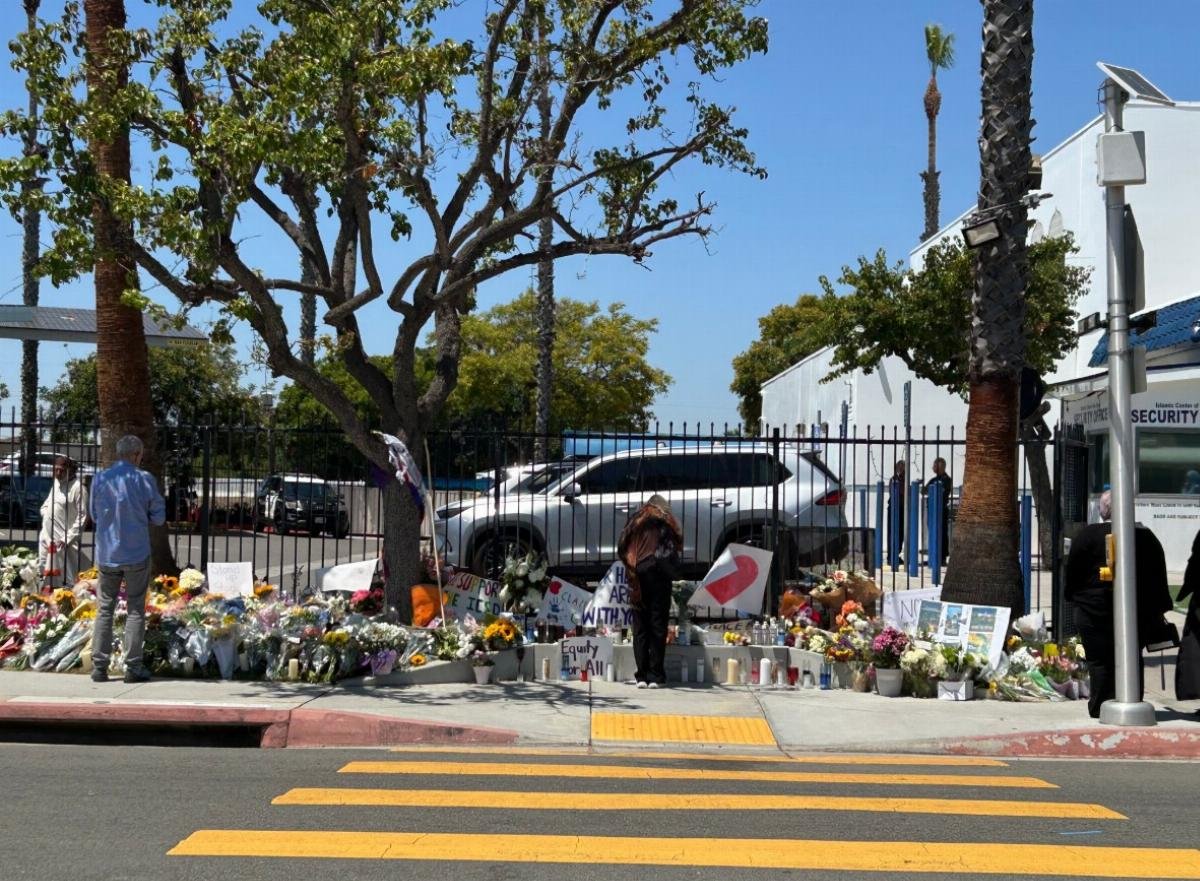
In an extraordinary turn of events, the sole surviving suspect in a May 2026 mass shooting at a San Diego mosque will be prosecuted not in California, but in North Carolina. The decision, confirmed by San Diego County District Attorney Summer Stephan, has ignited a fierce debate about the adequacy of California’s juvenile justice system and the lengths prosecutors must go to secure accountability for violent crimes.
The case stems from a horrific attack in which two high-school students, motivated by anti-Semitic conspiracy theories, opened fire on a mosque’s playground, targeting children. Three men from the mosque’s congregation bravely confronted the shooters, sacrificing their lives to save the children. The two attackers subsequently fled and died by suicide, leaving a 16-year-old girl, Sarah Santiago, as the only person to face charges for her alleged role in planning and documenting the atrocity.
Santiago is accused of agreeing to film the murders, spread the videos online, and share the shooters’ manifesto, reportedly to immortalize them and inspire others. She will be charged as an adult—but not in San Diego, where the crime occurred. Instead, prosecutors will pursue her case in North Carolina, a decision that has raised eyebrows and prompted sharp criticism of California’s legal framework.
DA’s frank admission
In comments to the San Diego Union-Tribune, DA Summer Stephan did not explicitly say whether her office had reviewed the case but offered a candid explanation for the unusual prosecutorial venue. “Our system in California would not allow for the same level of accountability in this instance as the criminal system in North Carolina will allow,” Stephan said. She added that while it “would be ideal that all prosecutions related to these hate-inspired killings be handled in San Diego,” the priority is ensuring “justice be attained for the victims to the greatest extent possible. In this particular prosecution, justice will be served through the court in North Carolina.”
Critics argue that Stephan’s carefully worded statement amounts to an admission that California’s juvenile justice system is so riddled with loopholes that it cannot adequately hold minors accountable—even for mass murder. Writing for American Thinker, Monica Showalter, a local resident who has spoken with mosque members, contended that California’s laws have been “rigged for criminals” by “woke” legislators, allowing under-18 offenders to “get away with anything they do.” Showalter cited a litany of crimes—cartel activity, drug dealing, arson, gang violence—that she claims have benefited from these permissive statutes.
A deeply felt trauma
The shooting has left an indelible mark on the San Diego mosque community. Showalter described the aftermath as traumatic, noting that even days later, Muslim patrons at a nearby grocery appeared visibly in shock. She detailed the lives of the three men who died, painting a portrait of pillars of the community: one a devoted cat lover, another the community cook who prepared meals for social events, and a security guard who made it his mission to greet every immigrant in their native language—greetings in Bengali, Turkish, Uighur, Punjabi, Arabic—to welcome newcomers.
Showalter wrote that if the community is to see justice, it will have to rely on North Carolina’s system, because California’s elected officials have “rigged the laws for criminals.” She raised pointed questions about the double standard this case exposes, asking whether every youth killer can now be tried in North Carolina, or whether a group must attack a mosque to trigger such decisive action. “I sure hope [the same tactic would be used if a church were shot up], but thus far, we only see it with the mosque,” she wrote.
Broader critique of California governance
The opinion piece extends its criticism beyond the juvenile justice system, linking the lack of accountability to seemingly unrelated state issues. Showalter argued that California’s failure to deliver justice in this case is of a piece with its struggles over “vagrant encampments” and “rigged rotten elections,” all tracing back to “one source” in Sacramento. “California has got to clean up its laws,” she wrote, “just as surely as it needs to clean up its streets.”
The decision to prosecute Santiago out of state is rare, if not unprecedented, in cross-jurisdictional criminal law. Typically, charges are filed where the crime occurred, but prosecutors may seek alternative venues when legal obstacles make a conviction unlikely. In this case, California’s rules for trying minors as adults appear to present a higher bar than North Carolina’s, prompting the San Diego DA’s office to look eastward for what it considers a more viable path to justice.
While the specifics of California’s minor-as-adult statutes were not detailed in the opinion piece, the implication is clear: the state’s laws are so protective of youth offenders that even a teenager accused of facilitating a mass killing might escape meaningful punishment. North Carolina’s more direct procedure for adult certification offered a way around that.
Weighing justice and precedent
The case raises profound legal and ethical questions. On one hand, prosecutors are duty-bound to seek the most severe appropriate punishment for heinous crimes, and the victims’ families deserve a trail that leads to meaningful consequences. On the other, the decision to forum-shop for a friendlier legal system could set a troubling precedent, potentially opening the door for defendants to argue they should be tried in more lenient jurisdictions, or for prosecutors to cherry-pick venues based on outcomes rather than fairness.
Legal experts note that such cross-state prosecutions are subject to constitutional constraints, including due process and the Sixth Amendment’s venue clause, which ordinarily requires trial in the state and district where the crime was committed. However, exceptions exist when a defendant’s conduct has substantial effects across state lines—for example, conspiracy charges that involve co-conspirators in multiple states. In this case, Santiago is alleged to have coordinated with the two shooters, one of whom was a North Carolina resident, potentially giving that state jurisdiction over her actions.
The case is proceeding, and North Carolina courts will ultimately decide Santiago’s fate. But the broader dispute over California’s juvenile justice system is far from over. As Showalter’s commentary makes clear, many residents are asking why the state’s laws so often shield young offenders from accountability—and why it took a tragedy at a mosque to force a workaround.
For the San Diego mosque community, the pain remains raw, but the promise of justice, however circuitous the path, offers some solace. Whether this unusual legal detour will spur legislative reform in California remains to be seen. But for now, the state has been reduced to borrowing another state’s justice system to prosecute a crime that occurred on its own soil—a sobering commentary on the state of the law.
Source: www.americanthinker.com — https://www.americanthinker.com/blog/2026/09/in-mosque-shooting-case-san-diego-reduced-to-borrowing-north-carolina-s-justice-system-because-its-own-is-so-woke-and-permissive/